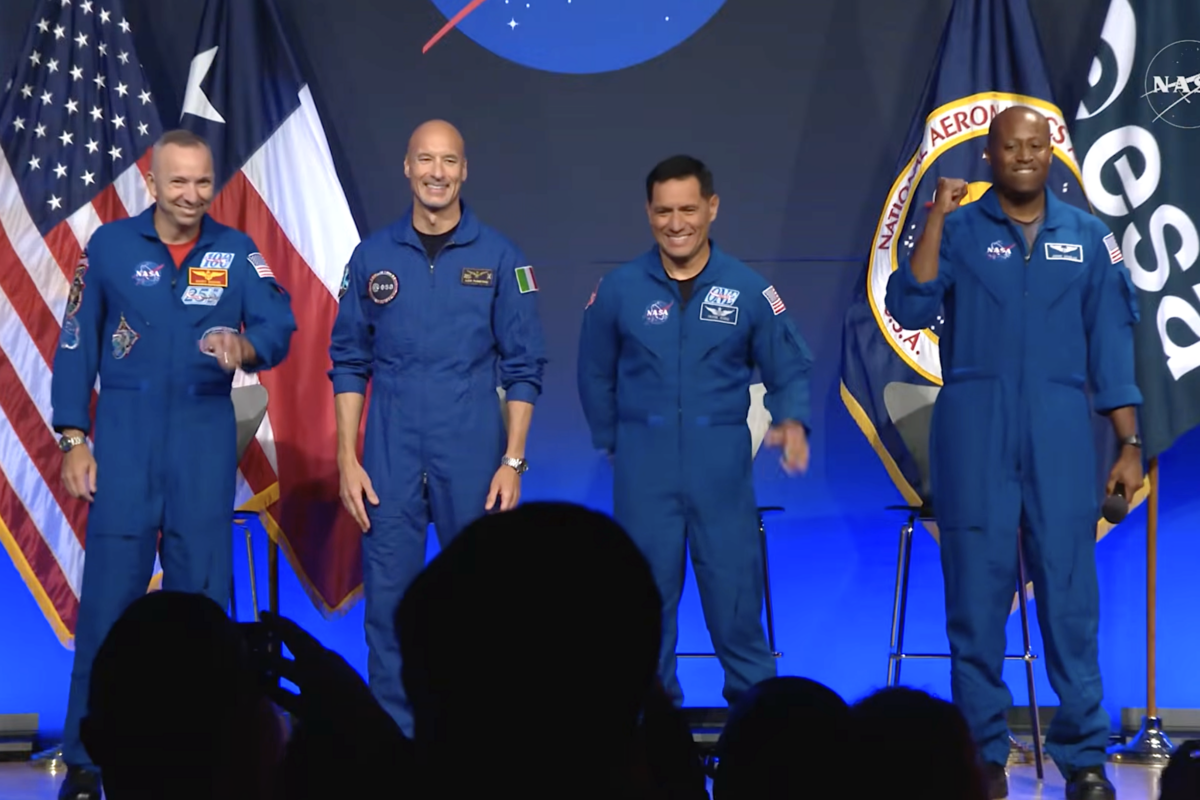

NASA and European Space Agency leaders gathered in Houston on June 9 and unveiled an all-star crew of astronauts assigned to the Artemis III mission and its challenge to bridge the gap between Artemis II’s historic lunar flyby and Artemis IV’s prospective lunar landing.
NASA astronauts Randy Bresnik, Frank Rubio, and Andre Douglas, as well as European Space Agency (ESA) astronaut Luca Parmitano, will embark on what is being called one of the most complex missions ever attempted.
They are backed up by NASA astronaut Bob Hines.
Four astronauts will take part in a coordinated launch of three separate vehicles over the span of approximately two weeks. They will be the first to dock with, enter, and test the commercial spacecraft that NASA has ordered from Blue Origin and SpaceX to return its astronauts to the lunar surface. They will also test new spacesuit technology designed for operations at the lunar south pole.
Here’s what to know.
Artemis III Mission Timeline
Artemis III is slated to launch in 2027.
It will start off with Blue Origin’s New Glenn rocket shipping the crewed Blue Moon MK2 lander into low Earth orbit.
Artemis III’s Space Launch System rocket will launch next, docking with Blue Origin’s lander for two days, with the crew venturing into the spacecraft, testing the technology, and demonstrating its systems.
Then the four astronauts will stay in orbit awaiting the launch of the SpaceX lunar lander, which according to Jessica Jensen, SpaceX’s vice president of customer operations and integration, could simply be a starship with a docking port. Artemis III will dock for a day, then head back to Earth.
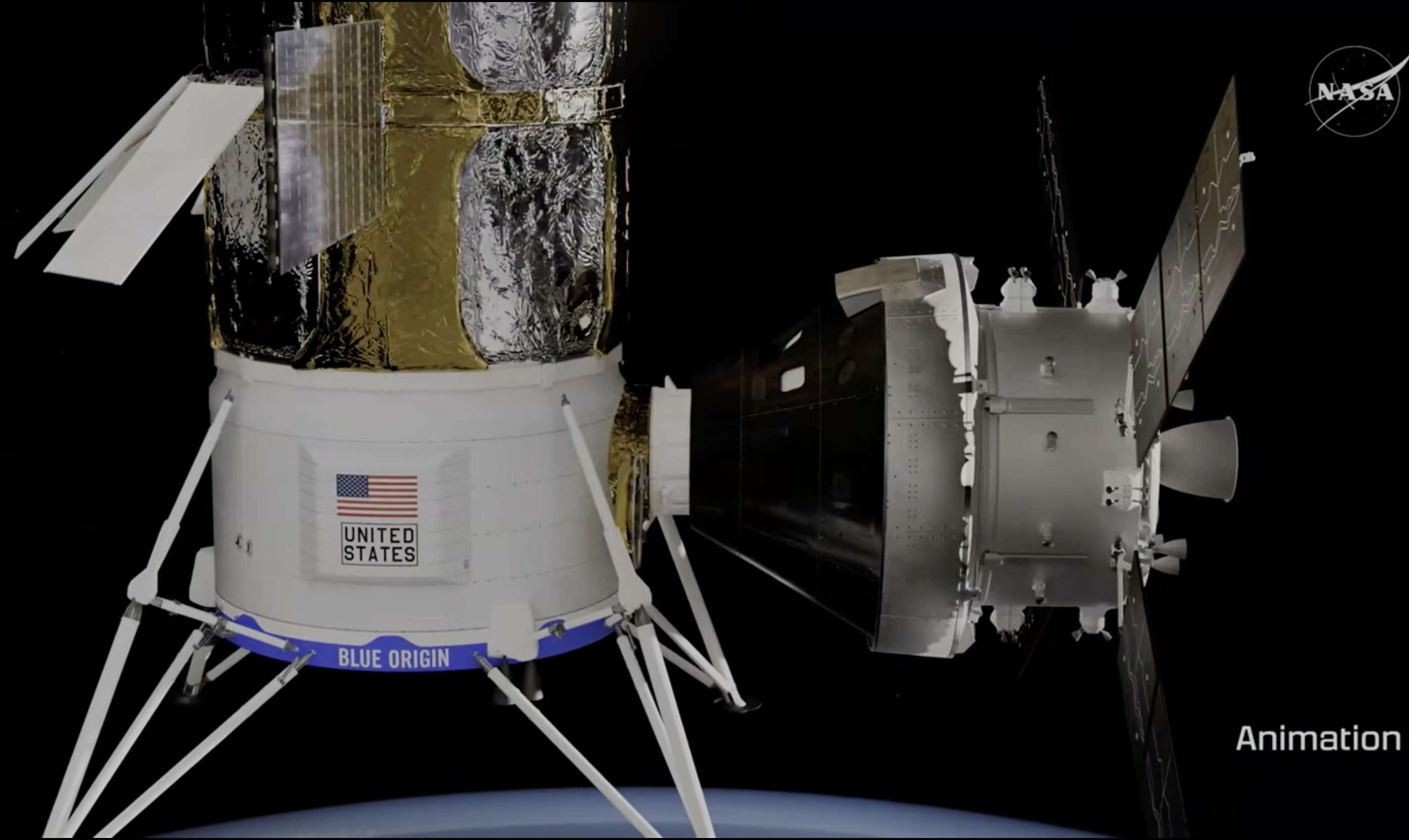 Illustration of NASA’s Orion spacecraft docked with Blue Origin’s Blue Moon lander during the upcoming Artemis III mission shared by NASA on June 9, 2026. (NASA/Screenshot).
Blue Origin and NASA leaders remain confident that despite the recent explosion on the launch pad, everything will be ready in time for the mission.
“Every aspect of Artemis III will give us insight into how to refine our plans for Artemis IV and beyond, and buy down risk,” said Jeremy Parsons, acting assistant deputy associate administrator for NASA’s Moon to Mars program.
“The mission, together with the uncrewed lander demonstrations to the moon, is specifically designed and targeted to the most significant risk for a lunar landing.”
The Artemis III Crew
Commander: NASA Astronaut Randy Bresnik
NASA has put a retired U.S. Marine colonel and former Space Station commander at the helm of Artemis III.
After a career as a test pilot and combat pilot, logging more than 7,000 hours in 95 different aircraft, Bresnik joined NASA. He flew to space twice before, first aboard the Space Shuttle Atlantis in 2009 and then aboard a Russian Soyuz for a nearly five-month stay aboard the International Space Station in 2017.
Since 2018, NASA said he served as assistant-to-the-chief of the Astronaut Office for Exploration, “managing the development and testing of everything that will operate beyond low Earth orbit on Artemis missions.”
“We are certainly humbled as a crew to be able to be your crew that executes this Artemis III mission in space,” Bresnik, the mission’s commander, said at Johnson Space Center in Houston.
He saw his mission as “that unifying link” between Artemis II and Artemis IV, “where we will again be the first to land humans on another celestial body.”
Pilot: ESA Astronaut Luca Parmitano
Sitting next to Bresnik in the pilot seat will be ESA astronaut Parmitano. A colonel in the Italian Air Force, Parmitano has also flown to space twice before aboard Russian Soyuz spacecraft, accumulating more than 300 days in space. He served as the third European and first Italian commander of the International Space Station.
“We could not have wished for a better pilot,” ESA Director General Josef Aschbacher said.
Mission Specialist: NASA Astronaut Frank Rubio
Joining Bresnik and Parmitano is Rubio, a third space station veteran. His one and only previous spaceflight lasted 371 consecutive days from September 2022 to September 2023 setting a record for the longest duration spaceflight by an American astronaut. Rubio is also a medical doctor and an Army Black Hawk helicopter pilot.
“Thank you first and foremost to my wife and our four amazing kids,” he said. “Thank you for your sense of adventure and your resiliency. You guys have made all this possible.”
All four crew members spent a significant amount of their speaking time thanking their wives and families for helping them reach this milestone in their careers.
Mission Specialist: NASA Astronaut Andre Douglas
The second mission specialist is Douglas. Artemis III will be his first trip to space, but he joins the crew with significant experience with the Orion spacecraft after serving as a backup crew member for the Artemis II mission with Jenni Gibbons of the Canadian Space Agency.
“This mission is going to be fantastic,” Douglas said. “What an excellent crew! Very proud to serve with these gentlemen.”
Backup Crewmember: NASA Astronaut Bob Hines
NASA Administrator Jared Isaacman also announced a fifth backup crewmember: Hines, a NASA astronaut. Yet another space station veteran, he racked up 170 days in space while serving as the pilot for NASA’s SpaceX Crew-4 mission.
As the sole backup crew member, Hines is expected to “step into any role needed on this mission,” Isaacman said. This is in contrast to the days of Apollo, which featured complete backup crews that allowed astronauts to remain focused on their one particular job.
Hines told The Epoch Times that all of that extra training will give him a unique and valuable perspective on the overall mission.
“When the four of them are in the seat, I’ll be able to, you know, be outside and observe and get kind of a god’s eye view of the way things are working as a crew, and seeing how things interact,” he said. “So, I think that’ll be a really valuable aspect to the training.”
Hines said he was very excited and honored to be named a backup crewmember, but ultimately hoped that he didn’t get to fly because that would mean that something would have to happen to his other crewmates.
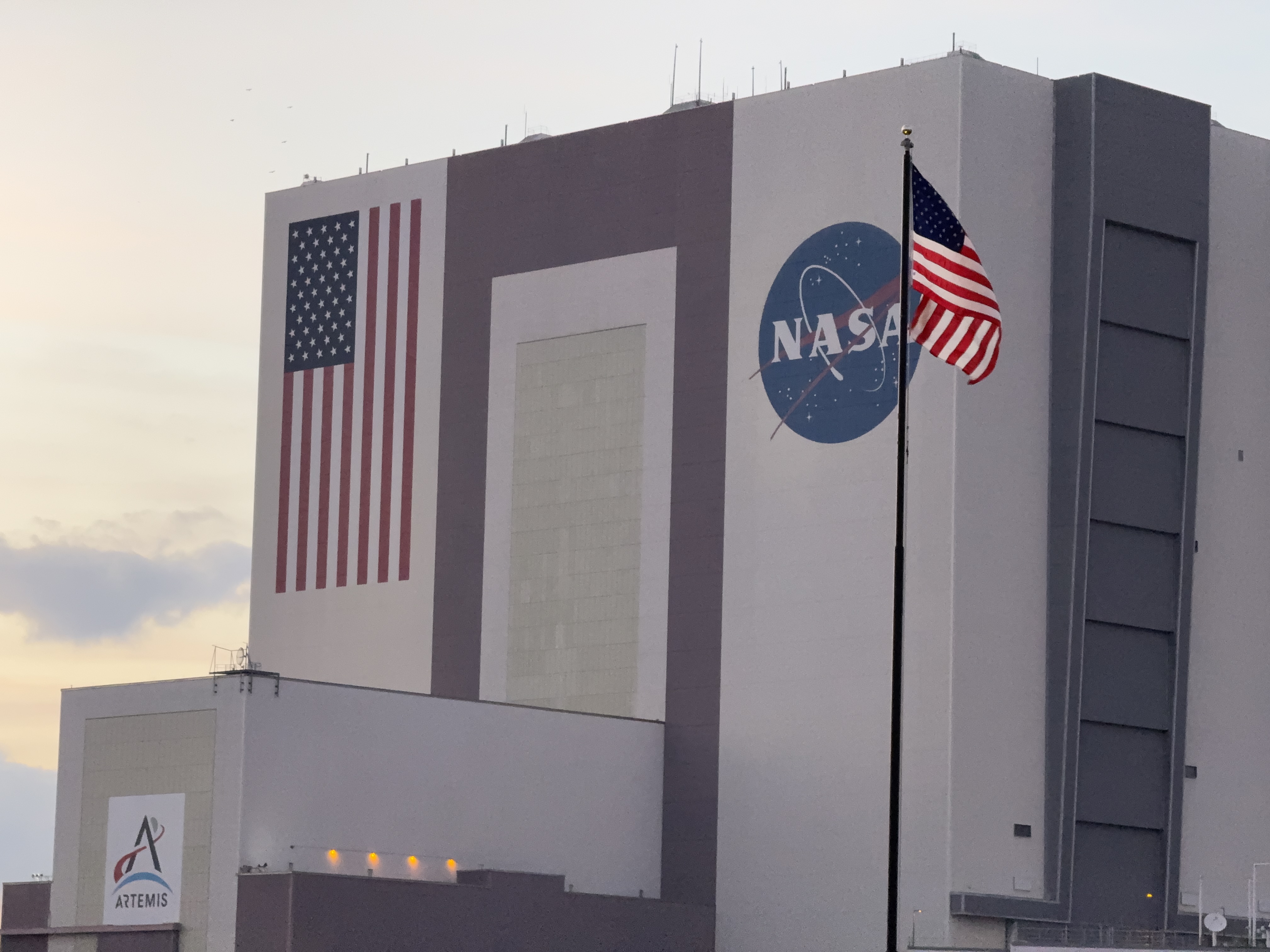 An American flag flies in front of NASA’s Vehicle Assembly Building at Kennedy Space Center, Fla., on Feb. 19, 2026. (T.J. Muscaro/The Epoch Times)
Artemis III Production Progress
Back on Florida’s Space Coast and other sites across the country, work continues on the plethora of moving parts that have to come together for Artemis III.
Isaacman said that NASA teams would begin stacking the Space Launch System rocket this summer and expected to begin wet dress rehearsals before the end of the year. Upgrades to the Orion capsule from Artemis II have already been implemented and a modified second stage to meet the lower demand of a low Earth orbit mission was already in development.
Blue Origin and SpaceX activity on Merritt Island, Florida, also continues to speed ahead, including the development of the first starship launchpads outside Texas.
“Today’s Artemis III crew announcement is another historic milestone for America’s space program and a proud moment for Florida’s Space Coast,” said Rep. Mike Haridopolos (R-Fla.), chairman of the Space and Aeronautics Subcommittee, whose district includes Kennedy Space Center.
“These astronauts represent the very best of our nation and will help test the technologies and systems that pave the way for a sustained human presence on the moon and future missions to Mars.”
 Friends Read Free
Copy
Facebook
Tweet
Friends Read Free
Copy
Facebook
Tweet