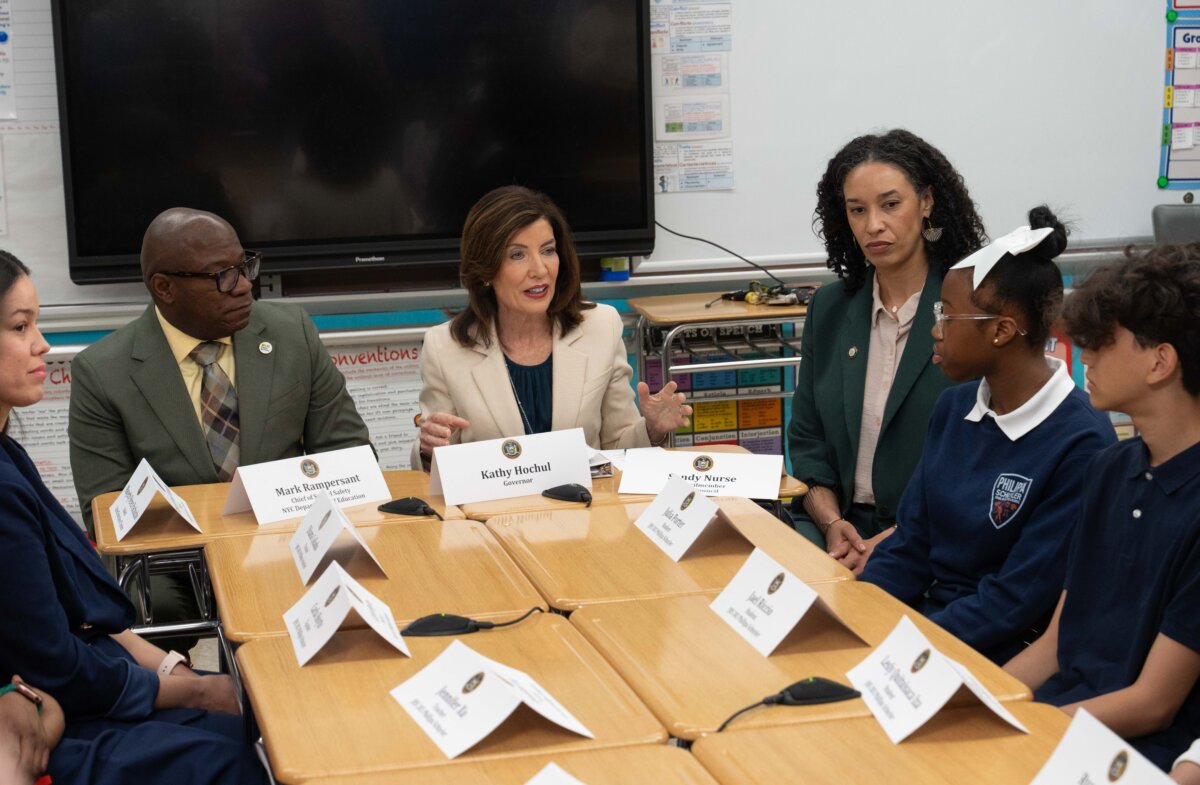

The first school year where students in New York state could not use their cell phones for the entire school day is coming to a close, and teachers say that students are more attentive in class and socialize more during lunch, according to officials.
“This gives me a sense of great pride,” said Gov. Kathy Hochul, speaking on June 1 at Philippa Schuyler Middle School in Brooklyn.
Hochul said that of everything she has done as governor, the phone ban had the most immediate impact. Just months after the ban took effect, young people were telling her that their experience of school was much more positive.
Hochul signed the statewide ban on student cell phone use in K–12 schools into law in May 2025, and the law took effect at the start of the 2025–2026 school year.
Kids are socializing more with each other and making new friends, New York City Public Schools Chief of Safety Mark Rampersant said.
“This is bringing a newfound happiness to young people who, for the most part, walked around with their heads down,” he said. “And sat in the cafeteria with their heads down.”
New York state’s bell-to-bell ban restricts students from using their smartphones for the entire school day; phones without internet capability are allowed. School-provided tablets and laptops are not restricted by the policy. Schools make their own policy for how to store devices and return them at the end of the day.
Starting in 2023, when Florida passed a statewide ban on cellphone use during class, states across the United States have enacted rules restricting students’ use of cellphones at school. As of May 15, 44 states across the United States have set restrictions on cell phone use in K–12 classrooms.
Policies are a mix of full-day or bell-to-bell bans, such as New York state’s, or class time restrictions (in which phones can be used outside of class), as well as “no show” policies in which students can keep the phone in their pocket or backpack, but they cannot pull it out to use it.
A national study released in April from the National Bureau of Economic Research on the effect of phone bans on student achievement found no measurable difference in test scores, attendance, classroom attention, or bullying. The study compared the results of schools that used Yondr pouches, a magnetically locking phone pouch, with those in similar schools that did not. In 2026, nearly 5,000 schools are using the pouches to store phones during the school day.
The study found that bans generated a 16 percent increase in suspension rates within the first year, but that trend drops off in years two and three of the bans.
Even so, according to the governor’s survey of 585 teachers and administrators, 80 percent said the phone ban has had a positive effect on their school, with 75 percent of teachers saying the policy improved their ability to teach effectively. Teachers said students were more actively participating in discussions and collaborating better with each other. Sixty percent of teachers said they saw bullying in school decrease.
Students at Philippa Schuyler said that with the phone ban in place, their fellow students are more engaged.
Speaking at a roundtable discussion with the governor, one student said, “Because when students are bored, before the phone ban, they would just have taken out their phone, but now class is like the only thing.”
“So you have no choice, you have to learn,” Hochul said, responding to his comment.
 Friends Read Free
Copy
Facebook
Tweet
Friends Read Free
Copy
Facebook
Tweet