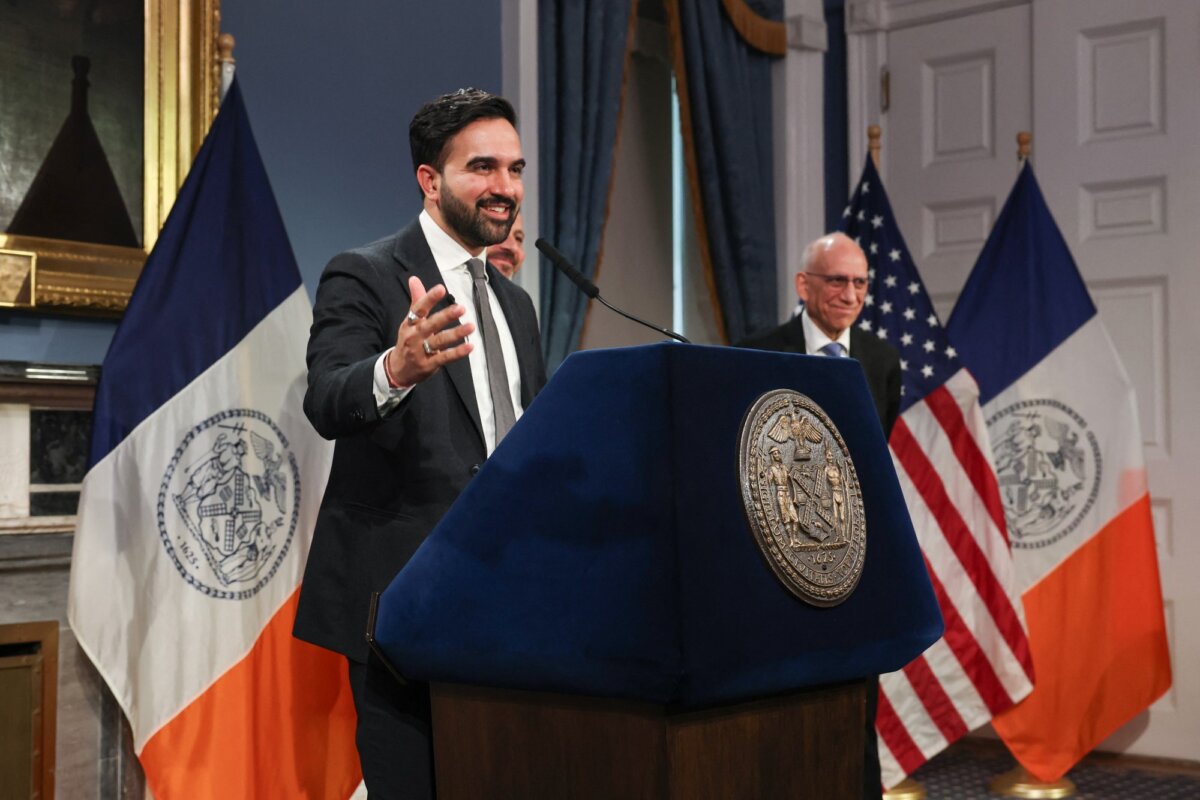

New York City Mayor Zohran Mamdani has secured a new state aid package he said will allow the city to close its projected $5.4 billion budget gap.
Mamdani, who has spent the past three months pressing Albany for more aid while warning that the city may otherwise need to raise property taxes, on May 12 unveiled a $124.7 billion budget proposal for fiscal year 2027. The proposal does not include the property tax hike, and the mayor’s office said the plan also avoids cuts to core city services for those most in need.
“It has not been easy, but we have balanced the budget, and we have done so without placing the burden on the backs of working New Yorkers,” Mamdani said at a news conference.
Mamdani said the city closed the gap through a combination of agency efficiencies, reversals of fiscal burdens left from former New York Gov. Andrew Cuomo’s years, and “tax the rich” measures that he described as “asking those with the most to contribute a little bit more to support those with the least.”
However, the most important factor is a new agreement with the state.
On May 12, New York Gov. Kathy Hochul announced a $4 billion state aid package for New York City, bringing total state assistance to the city to nearly $8 billion over the next two fiscal years. The package is not entirely direct cash aid. It includes state funding, state-authorized savings measures, and actions to delay, restructure, or reduce some of the city’s fiscal obligations.
“This is what a results-driven, responsible partnership looks like, and I’m proud to work with Mayor Mamdani to deliver for working New Yorkers,” Hochul said in a statement.
The latest package includes $202 million in actions to offset recurring spending obligations, $150 million in additional school aid, and $3.2 billion in state authorizations. The state is also committed to a pied-à-terre tax on unoccupied second homes in New York City valued at $5 million or more, a measure Hochul has said could raise $500 million.
Mamdani, a self-described democratic socialist, praised the measure after Hochul proposed it. Last month, he used billionaire hedge fund manager Ken Griffin’s $238 million penthouse—one of the most expensive home sales in the Big Apple’s history—as the backdrop for a TikTok video promoting the tax on high-value second homes used part-time by the wealthy.
The second-home surcharge remains under discussion as part of ongoing state budget negotiations in Albany, with details on its structure and enforcement still unresolved. But it has allowed Mamdani, at least for now, to step back from an even more controversial property tax increase.
In his preliminary budget released in February, Mamdani said the city might have to raise property taxes by 9.5 percent if it did not receive additional help from Albany. Describing it as a last resort, he noted that property taxes are one of the city’s only tools for closing the projected budget gap without new legislation at the state level.
That proposal, which was expected to generate $3.7 billion, drew sharp backlash from homeowners and the real estate industry. Hochul’s second-home tax has also prompted concerns that New York state could drive away its millionaires and billionaires.
President Donald Trump, in a May 12 interview with New York City radio host Sid Rosenberg, warned that losing “people like [Griffin]” would be “a big loss for New York.”
“When you lose people like that, it’s not recoverable,” Trump told Rosenberg, saying that city leaders should instead take the “opposite” approach to build a friendly environment to keep high-net-worth individuals and their business in the city.
“You won’t have a city left. You won’t have a state left. Very, very dangerous thing that’s happening right now.”
 Friends Read Free
Copy
Facebook
Tweet
Friends Read Free
Copy
Facebook
Tweet