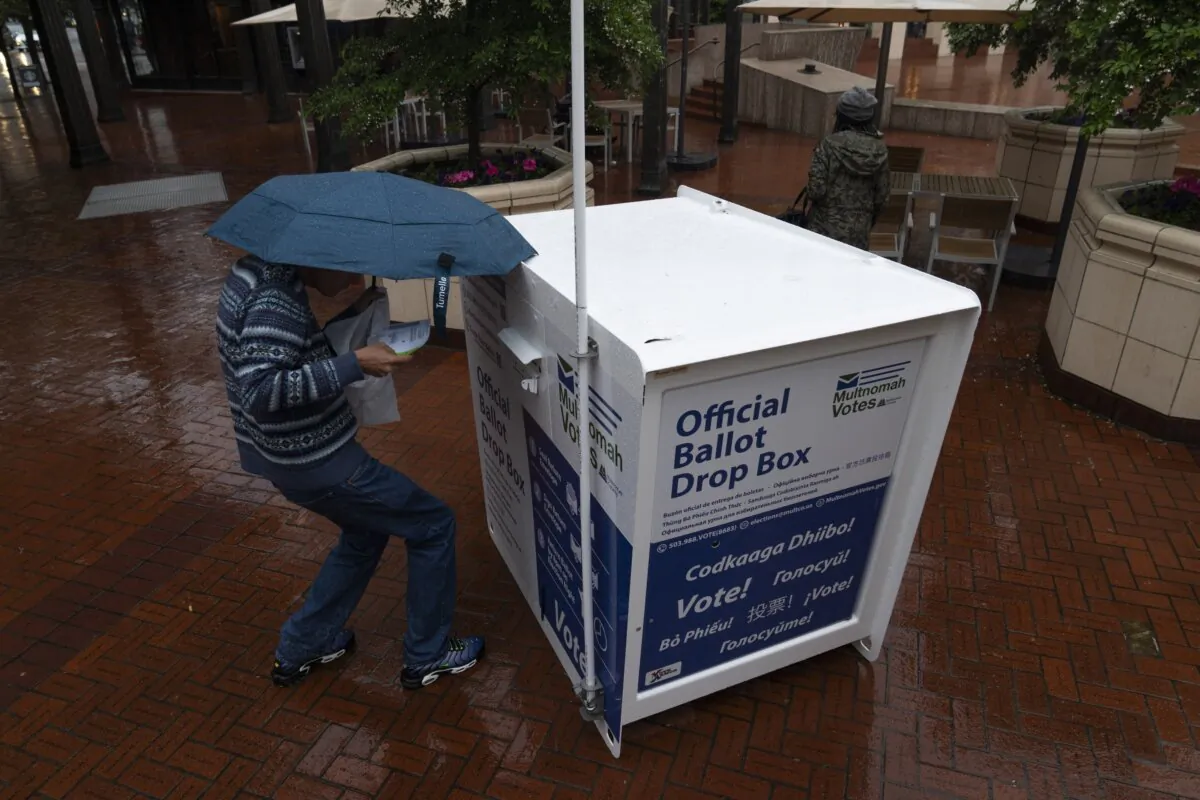

Oregon has updated its online voter registration system to allow residents to register without an Oregon driver’s license or state identification card, a change state officials say will expand access while preserving election integrity, but that critics say weakens safeguards and risks undermining public trust.
Under the update, announced by the Secretary of State’s office on Dec. 30, eligible Oregonians can register to vote online by submitting the last four digits of their Social Security number along with an electronic image of their signature.
Previously, online registration was limited to individuals with an Oregon-issued driver’s license, permit, or state ID because the system relied on signatures already on file with the Department of Motor Vehicles (DMV).
Before the change, which is mandated by House Bill 4133, individuals without qualifying identification could register only by completing a paper form, which was processed by county elections offices.
Under the new online registration system, county elections officials will review and verify each registration before it is accepted, including confirming the Social Security information and evaluating the submitted signature, the Secretary of State’s office said.
Oregon Secretary of State Tobias Read said the new process mirrors the requirements used for paper voter registration forms and expands voter access without undermining election integrity.
“Everything in our modern society is evolving to be more convenient—our elections should do the same,” Read said in a statement. “Every citizen should get the same opportunity to hold their government accountable at the ballot box. This update will keep online voter registration secure and accurate while making it more available to eligible voters.”
House Minority Leader Julie Fahey, the bill’s chief sponsor and a Democrat, said in floor debate that by making it easier for individuals who lack DMV-issued identification to register, the bill expands ballot access to many groups with historically low election participation rates, such as minorities and the disabled.
Critics Warn of Weakened Safeguards
While supporters say the change benefits eligible voters who lack driver’s licences or state IDs, critics have raised concerns that the expanded system reduces safeguards and increases the risk of fraudulent registrations.
State Rep. Ed Diehl, a Republican, said removing the requirement for DMV-linked identification creates new vulnerabilities.
“The last four of an SSN [Social Security Number] is one of the most widely compromised identifiers in existence. It proves almost nothing about who someone is,” Diehl wrote in a recent post on social media.
“A signature image provides no security,” he continued. “Anyone can copy a signature, trace one, forge one, or upload something crude and hope it passes. There’s no chain of custody, no trusted source, and no authentication.”
In a separate statement, Diehl said Oregon’s approach reflects broader weaknesses in election oversight.
“There are two undeniable realities about Oregon’s election system,” Diehl said. “The state continues to make the system more vulnerable to fraud through weakened verification standards and expanded access mechanisms that reduce safeguards. At the same time, Oregon does not meaningfully look for fraud.”
“That combination isn’t ‘expanding access’—it’s eroding trust,” he added.
Diehl also expressed concern about another provision of House Bill 4133 that directs the secretary of state to explore allowing third-party organizations to submit voter registrations electronically through an application interface. The GOP lawmaker said that this could open the door to identity theft and fraud risk, including registrations made without voters’ knowledge by potentially biased organizations.
“Once this is implemented, state-funded or politically motivated organizations could be equipped with an app that registers voters using just last-four SSN and a signature image—no physical paper trail back to the person who was supposedly registered, no witnessing by a county clerk or a DMV employee, and a whole lot of trust placed in outside groups who may have their own agendas,” he said in an earlier statement.
The Secretary of State’s office has said it has no plans to implement this third-party voter registration functionality.
Diehl said the proposal is a risk to election integrity.
“Instead of strengthening verification and trust, the state keeps expanding who can inject data into the voter rolls while loosening safeguards,” Diehl said. “Yes, every citizen has a right to vote. But citizens also deserve high-integrity elections. These changes push Oregon even farther out of balance.”
The Epoch Times has reached out to the Oregon Secretary of State’s office with a request for comment on Diehl’s concerns.
 Friends Read Free
Copy
Facebook
Tweet
Friends Read Free
Copy
Facebook
Tweet