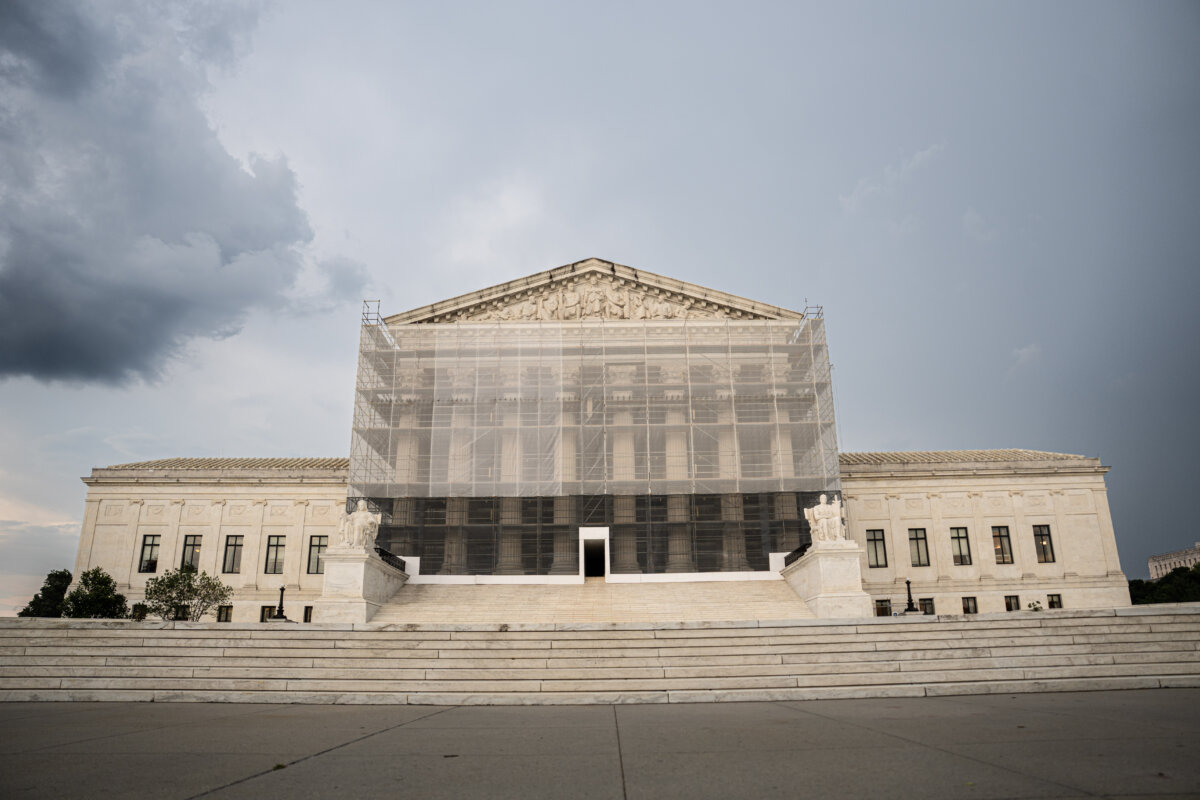

The Supreme Court said on June 27 that the Federal Communications Commission (FCC) had not violated the Constitution in its operation of a fund geared at providing universal telecommunications service to Americans.
The 6–3 decision said that the FCC’s scheme of funding universal service did not violate the nondelegation doctrine, which generally prohibits Congress from allowing other entities to take on its legislative responsibilities.
Justice Elena Kagan wrote the majority opinion and was joined by Chief Justice John Roberts in addition to Justices Brett Kavanaugh, Amy Coney Barrett, Sonia Sotomayor, and Ketanji Brown Jackson.
In the dissent was Justice Neil Gorsuch, who penned an opinion joined by Justices Samuel Alito and Clarence Thomas.
The Biden administration had asked the Supreme Court to intervene after it lost in the U.S. Court of Appeals for the Fifth Circuit. There, a panel of judges held that the FCC couldn’t delegate its power to the fund, which is run by a private company. It also said that Congress may have “impermissibly delegated its taxing power to private entities.”
The Biden administration disagreed with the appeals court’s decision and told the Supreme Court in September that Congress had set up comprehensive guidance for the FCC to implement the fund. Because Congress outlined things such as who receives the benefits of the funds, it gave the FCC some authority but didn’t unconstitutionally delegate its power, the administration said.
By the time the case was argued in March, the Trump administration was defending the FCC. Acting Solicitor General Sarah Harris similarly pointed to the ways Congress had instructed the FCC. Congress’s law on universal service was “no delegation running riot,” Harris said.
Writing for the majority, Kagan said that the court’s precedents didn’t require Congress to do more than lay out a general policy with principles and boundaries for the FCC to follow.
“For nearly three decades, the work of Congress and the Commission in establishing universal-service programs has led to a more fully connected country,” she said.
“And it has done so while leaving fully intact the separation of powers integral to our Constitution.”
In Gorsuch’s dissent, he wrote that the majority departed from “time-honored rules” on the separation of powers. The Universal Service Fund collects contributions from communications carriers—something that a group known as Consumers’ Research described as a tax.
According to Gorsuch, the court’s decision wrongly allowed an executive agency to “decide for itself what rates to apply and how much to collect.” In so doing, it defied the nation’s separation of powers.
 Friends Read Free
Copy
Facebook
Tweet
Friends Read Free
Copy
Facebook
Tweet