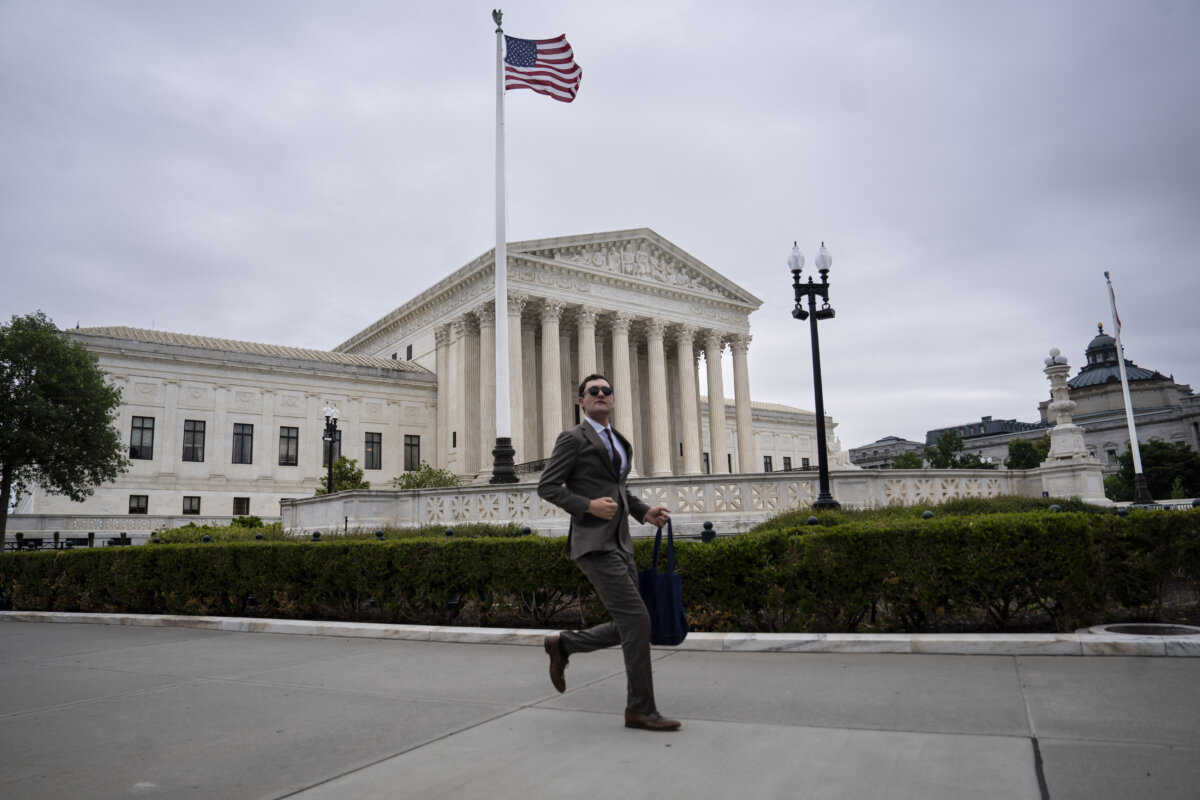

The U.S. Supreme Court on May 28 unanimously ruled that local last-mile delivery drivers, including those who never cross state lines, may qualify for an exemption from mandatory arbitration under a federal law.
A last-mile delivery driver is one who manages the final segment of the shipping process, moving goods from a distribution center directly to a retail store or a customer’s door.
The Federal Arbitration Act requires that arbitration clauses in employment contracts must be enforced unless the worker is a railroad employee, seaman, or any other class of workers participating in interstate commerce.
Companies often prefer arbitration to the courts, saying the process resolves cases with greater speed and reduced expense. Some consumer advocates prefer the courts because, in their view, the judicial system provides private citizens and consumers with more options and is less likely to side with the companies being sued.
Justice Neil Gorsuch wrote the court’s 9–0 opinion in Flowers Foods Inc. v. Brock.
According to the opinion, the petitioner, Flowers Foods Inc., is a major producer of packaged baked goods such as Wonder Bread that has bakeries in 19 states. To bring its products to market, the company relies in part on franchisees who purchase the distribution rights to the company’s products in specific geographic territories.
The respondent, Angelo Brock, is a franchisee in the Denver, Colorado, area. He picks up the company’s products from a warehouse in Colorado and delivers them to stores in Colorado without crossing state lines. Many of the products he delivers are produced outside Colorado and then shipped into the state.
In 2022, Brock sued the company in federal district court, claiming it had underpaid him and other distributors and, in the process, violated a host of federal and state laws. Brock argued he was effectively an employee of Flowers Foods but had been misclassified as an independent contractor so the company could avoid paying overtime and honoring employee protections guaranteed by law.
The company moved to force the dispute into arbitration, arguing that the Federal Arbitration Act generally requires courts to stay or dismiss lawsuits when the parties have agreed to settle their disputes through arbitration. Brock had signed a distribution agreement requiring that disputes go to arbitration, the opinion said.
The federal district court denied the company’s motion to move to arbitration, and the U.S. Court of Appeals for the 10th Circuit affirmed. The appeals court said Brock was a member of a class of workers engaged in interstate commerce, so the court lacked authority to force arbitration.
Gorsuch said that the Federal Arbitration Act “requires courts to enforce many private arbitration agreements. But not all.”
Section 1 of the act states that “nothing” in the law shall be used to force arbitration in disputes involving the “contracts of employment” of any class of workers “engaged in … interstate commerce.”
The company’s theory was that to be engaged in interstate commerce for the purposes of Section 1, a worker has to either cross state lines or interact in some way with a vehicle that does.
“That theory is incorrect,” Gorsuch said.
Gorsuch cited the 19th-century precedent of The Daniel Ball, which held that a vessel that operated exclusively on a river inside Michigan was nonetheless engaged in interstate commerce because it transported goods intended for other states.
The court previously ruled in another case that Section 1 “does not require workers to cross state lines,” he said.
“Nor, we now add, does [Section] 1 turn on a game of tag with vehicles that do. At least sometimes, a worker who transports goods on an intrastate leg of an interstate journey can qualify for [Section] 1’s exemption without satisfying either of those criteria,” the justice said.
Flowers Foods had asked the justices “to adopt a bright-line rule that an individual can never qualify for [Section] 1’s exemption unless he crosses state lines or interacts with vehicles that do.”
“And whatever other limits [Section] 1 may or may not contain, we do not see how the statutory text can support that one,” Gorsuch said.
The Supreme Court affirmed the ruling of the 10th Circuit.
 Friends Read Free
Copy
Facebook
Tweet
Friends Read Free
Copy
Facebook
Tweet