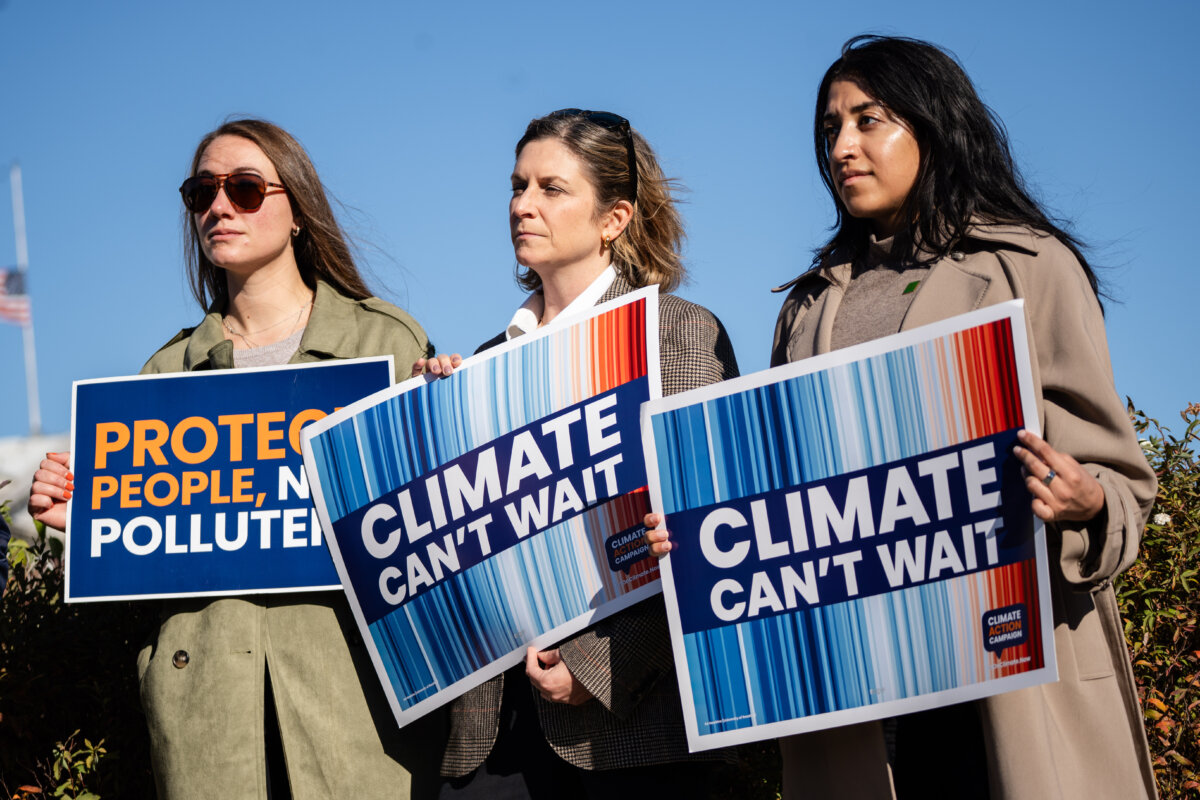

The U.S. Supreme Court will soon decide whether it will take up a pivotal climate lawsuit case that could have an enormous impact on energy companies—and energy costs—for all Americans.
The Court has scheduled a conference on Dec. 12 to decide if it will grant review in the case of Suncor Energy v. Boulder County, one of more than 30 climate lawsuits now proliferating around the United States in which states, cities, and counties accuse oil and gas companies of causing global warming and extreme weather.
In these cases, municipalities are demanding payments that could amount to billions of dollars to compensate them for alleged harm they suffered and expenses they will incur to protect their communities from floods, wildfires, hurricanes, tornadoes, and other weather events, which some scientists have said are caused by climate change due to increased greenhouse gases.
In 2018, Boulder County sued Suncor and Exxon Mobil, alleging that they violated state laws, created a public nuisance, and misled the public about the role their products have played in global warming.
However, some legal analysts say the real intent of climate litigation is to increase energy costs, which is in the interests of renewable energy companies, and reduce the consumption of oil, gas, and coal throughout the United States.
“Boulder’s lawsuit seeks to rewrite national energy policy by way of its state courts,” John Yoo, a law professor at the University of California–Berkeley, told The Epoch Times. “Nearly three dozen leftwing states and localities have adopted this strategy in recent years, trying to accomplish through litigation what progressive politicians have failed to accomplish in Congress.”
David Bookbinder, who was part of Colorado’s legal team, underscored the regulatory goal of climate litigation.
“Tort liability is an indirect carbon tax,” Bookbinder told attendees at an Oct. 10 Federalist Society webinar on climate litigation. “You sue an oil company, an oil company is liable, the oil company then passes that liability on to the people who are buying its products. In some sense, it is the most efficient way—the people who buy those products are now going to be paying for the cost imposed by those products.”
States versus States
While lawsuits like Boulder’s are currently being tried in local courts, legal experts say the costs, if plaintiffs win, will be felt by all Americans.
“The plaintiffs are seeking very significant damages, which, if awarded, would immediately create massive costs for American citizens,” Chris Mills, a constitutional attorney and founder of Spero Law LLC, told The Epoch Times. “Energy availability will decrease, and costs will increase.”
Energy companies have argued that regulating emissions across U.S. states falls under federal jurisdiction, subject to laws like the 1970 Clean Air Act, and they point to decisions such as that by the Second Circuit Court of Appeals in City of New York v. Chevron that have affirmed this argument. In May, however, the Colorado Supreme Court ruled that the suit against Suncor, Exxon Mobil, and other energy companies could proceed to trial in state courts.
Legal experts say that several fundamental constitutional questions are raised by this case, among which is the authority of one state over another state.
“The whole reason that the founders of our Constitution created the Interstate Commerce Clause, is because, even way back in 1787, they understood that among the states, there were going to be issues that the National Congress needed to address and that each individual state would not be able to address, and greenhouse gas emissions is exactly that kind of issue,” John Shu, a constitutional attorney who served in the administrations of President George H.W. Bush and President George W. Bush, told The Epoch Times.
“Constitutionally, I think the majority of this [Supreme] Court would not feel comfortable having Colorado or Hawaii or California dictate and mandate to Texas, Louisiana, New Mexico, or the Dakotas how to run their state.”
Voters’ Rights
Also at stake, experts say, are the rights of Americans to have a voice on issues as essential as energy policy through their elected representatives.
“The Founders vested in Congress the authority to determine best policies for the nation, not state courts pursuing ideological causes that voters and legislators have so far declined to adopt,” Yoo said.
Climate litigation deprives Americans of that right, legal analysts say.
“Under the Constitution, it should be the legislative branch that sets policy, not the judicial branch,” Shu said. “But what these plaintiffs want is for the [Supreme] Court to allow the state court system to set oil policy and greenhouse gas policy for the whole country.”
Whatever ruling the Supreme Court makes on the Boulder case will likely set a precedent for other, very similar cases being brought in other municipalities.
“If the Supreme Court takes the case and rules in favor of Suncor on the ground Suncor argues, it would likely end copycat lawsuits across the nation, as it would confirm that this is a federal issue to be resolved by Congress,” Mills said.
If the Supreme Court declines to hear the case or rules in favor of climate litigants, this could ease the way for a number of climate lawsuits to proceed to trial in local jurisdictions.
 Friends Read Free
Copy
Facebook
Tweet
Friends Read Free
Copy
Facebook
Tweet