
In a historic first, President Donald Trump used his State of the Union address as an opportunity to award the highest U.S. military valor decoration, the Medal of Honor.
The president recognized not one but two veterans of military aviation: Army Chief Warrant Officer 5 Eric Slover, and retired Navy fighter pilot Royce Williams.
Slover piloted a CH-47 Chinook troop transport helicopter through machine-gun fire during the Jan. 3 raid to capture wanted Venezuelan leader Nicolás Maduro.
Williams flew a F-9F Panther during a lengthy dogfight against multiple Soviet MiG-15 fighter jets during a mission near North Korea on Nov. 18, 1952.
“I’ve always wanted the Congressional Medal of Honor, but I was informed I’m not allowed to give it to myself, and I wouldn’t know why I’d be taking it,” Trump joked as he described the award-winning actions of Slover and Williams.
“It’s an honor to be in the same room with you. Thank you both very much,” the president added.
Through ‘Searing Pain’
While touting the successful raid he ordered to capture Maduro, Trump hailed the U.S. special operations forces who completed the mission.
“There were many heroes on that January raid to capture Maduro. Really great heroes,” the president said. “But the deeds of one warrior that night will live forever in the eternal chronicles of military valor.”
Trump explained how Slover had been the flight lead for the operation and had piloted the first CH-47 to touch down at a fortified compound where Maduro was staying in Caracas. As Slover prepared to set the aircraft down, Maduro’s security forces opened fire with machine guns.
“Eric was hit very badly in the leg and hip. One bullet after another, he absorbed four agonizing shots, shredding his leg into numerous pieces,” Trump said.
The Pentagon had previously acknowledged that seven U.S. military personnel were wounded in the Jan. 3 raid into Caracas, but provided no additional details about the circumstances or severity of the injuries.
Despite Slover’s injuries, Trump said he managed to maneuver his helicopter such that gunners on his aircraft could return fire on the enemy machine gun position and allow the ground force to safely set down and proceed with capturing Maduro.
“The success of the entire mission and the lives of his fellow warriors hinge on Eric’s ability to take searing pain,” Trump said.
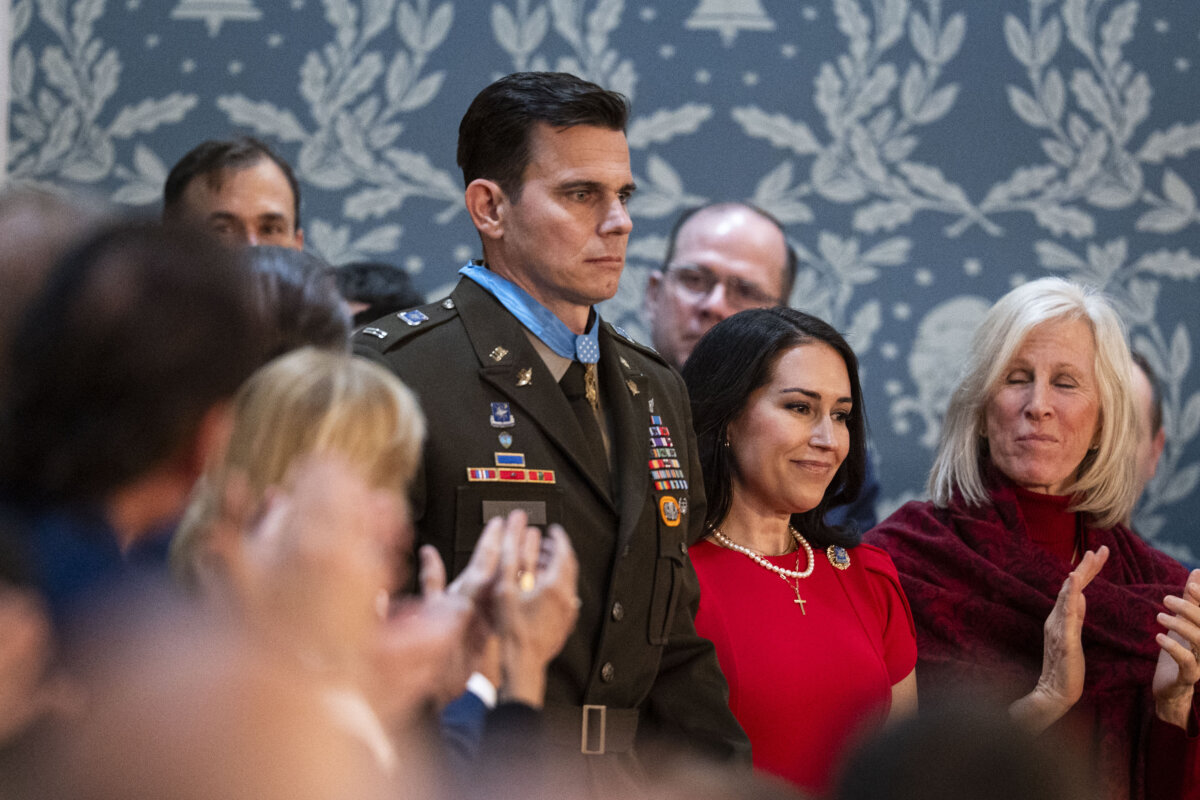
The president noted Slover is still recovering from his wounds, but was well enough to attend the address and accept recognition for his actions.
Amid the applause, Slover could be seen entering the House Chamber of the U.S. Capitol on Tuesday night with the assistance of a walker.
Lt. Gen. Jonathan B. Braga, the commander of the U.S. military’s most elite Joint Special Operations Command, placed the medal around Slover’s neck.
It was the first time in history that the highest military decoration for valor had been awarded during a State of the Union address.
Trump said 10 other military personnel who participated in the Caracas raid will also receive medals at a private White House ceremony.
The Longest Dogfight
Williams’s journey to Medal of Honor recognition was far longer in the making than Slover’s. For decades, he had been sworn to secrecy.
On Nov. 18, 1952, as a blizzard began to drive high winds and snow into their area of operations, Williams launched his F-9F Panther from the aircraft carrier USS Oriskany. His mission ran along the coast of North Korea, near its northern border with the Soviet Union.
As Williams’s patrol drew closer to the border, Soviet forces scrambled seven MiG-15 fighter jets, leading to a head-on confrontation.
In the early moments of the fight, Williams damaged one of the Soviet jets. His wingman pursued the falling MiG, leaving Williams alone to face the remaining Soviet fighter jets.
He was not only outnumbered but flying against what were considered technologically superior aircraft.
“The only thing I could do was out-turn them,” Williams has said of the match-up.
For 35 minutes, he desperately maneuvered and returned fire where he could. By the time his ammunition ran dry, Williams had managed to down four of the Soviet jets in what’s considered the longest dogfight in U.S. military history.
Williams’s own aircraft did not come through unscathed. His Panther had been hit 263 times during the mission, including by a 37mm cannon.
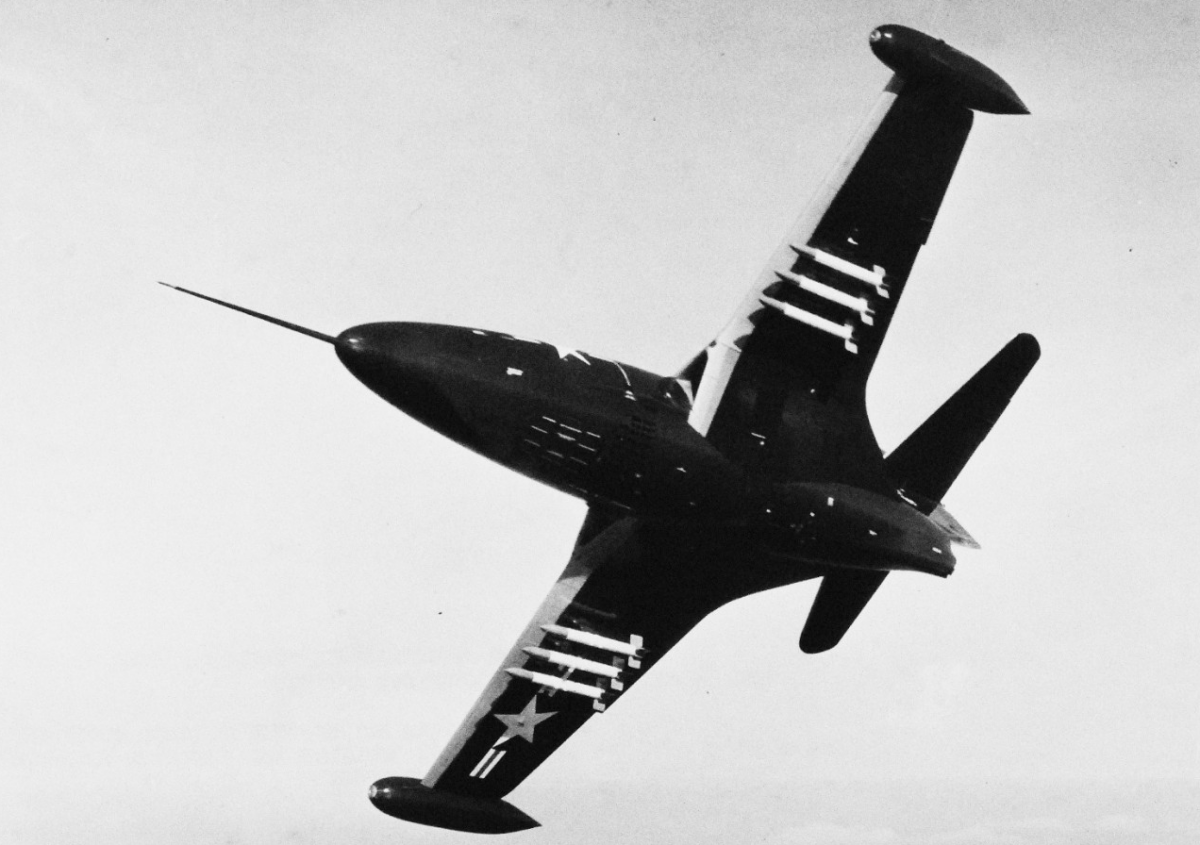
With his jet damaged and out of ammunition, Williams plunged it into a nearby storm cell, using the high winds to cover his retreat. He ultimately managed to limp his Panther back to the Oriskany.
According to a 2018 Navy account, the U.S. National Security Agency (NSA) had monitored Soviet communications surrounding Williams’s aerial battle. Only a matter of weeks old at the time of the November 1952 dogfight, the NSA feared that publicizing details of the incident would expose its intelligence-gathering capabilities.
Despite his impressive combat prowess, U.S. military leaders forced Williams to keep the air battle a secret.
It was only after the fall of the Soviet Union and the subsequent release of Soviet military records about the engagement that Williams was finally allowed to talk about his story.
Williams previously received the Silver Star in recognition of his actions during the perilous 1952 aerial battle. In 2023, his award was upgraded to a Navy Cross, the second-highest valor decoration for Sailors and Marines.
Rep. Darell Issa (R-Calif.) had led the push to upgrade Williams’s award to the Medal of Honor.
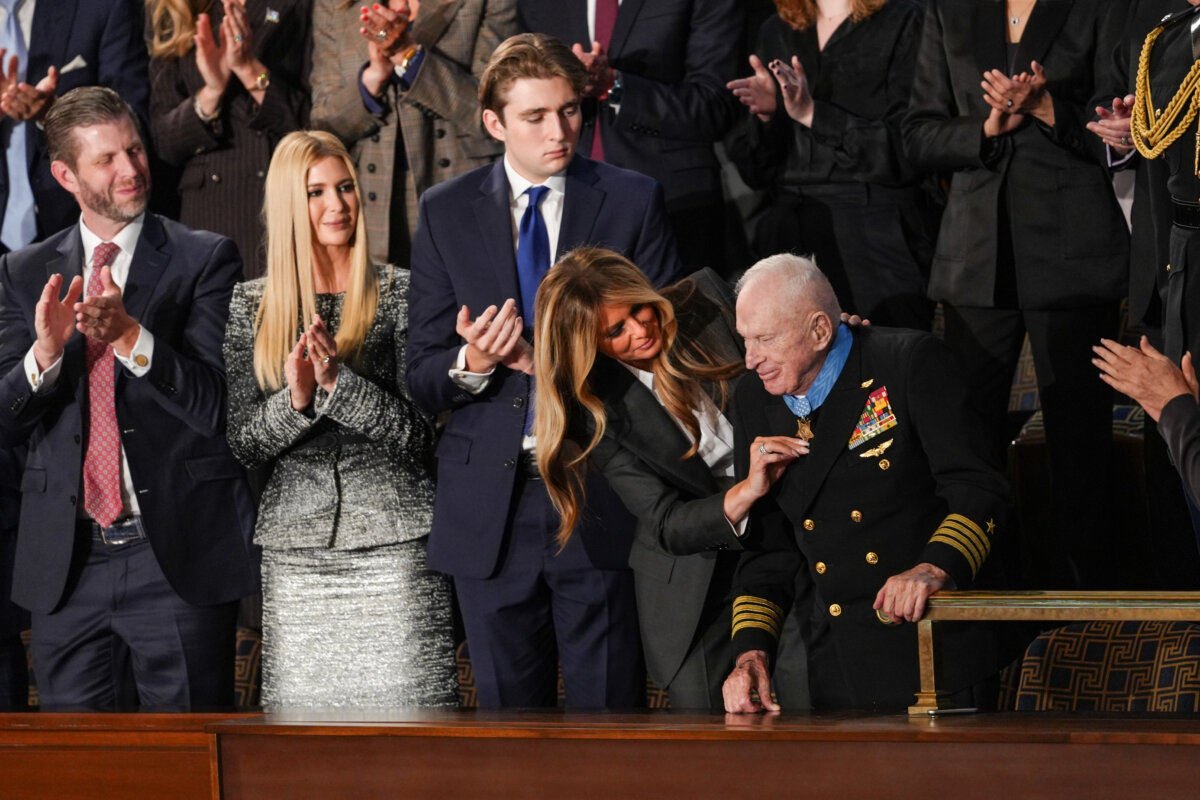
“Tonight, at 100 years old, this brave Navy captain is finally getting the recognition he deserves,” Trump said.
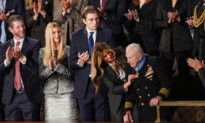
Amid a standing applause, First Lady Melania Trump placed the military decoration around Williams’s neck.
 Friends Read Free
Copy
Facebook
Tweet
Friends Read Free
Copy
Facebook
Tweet