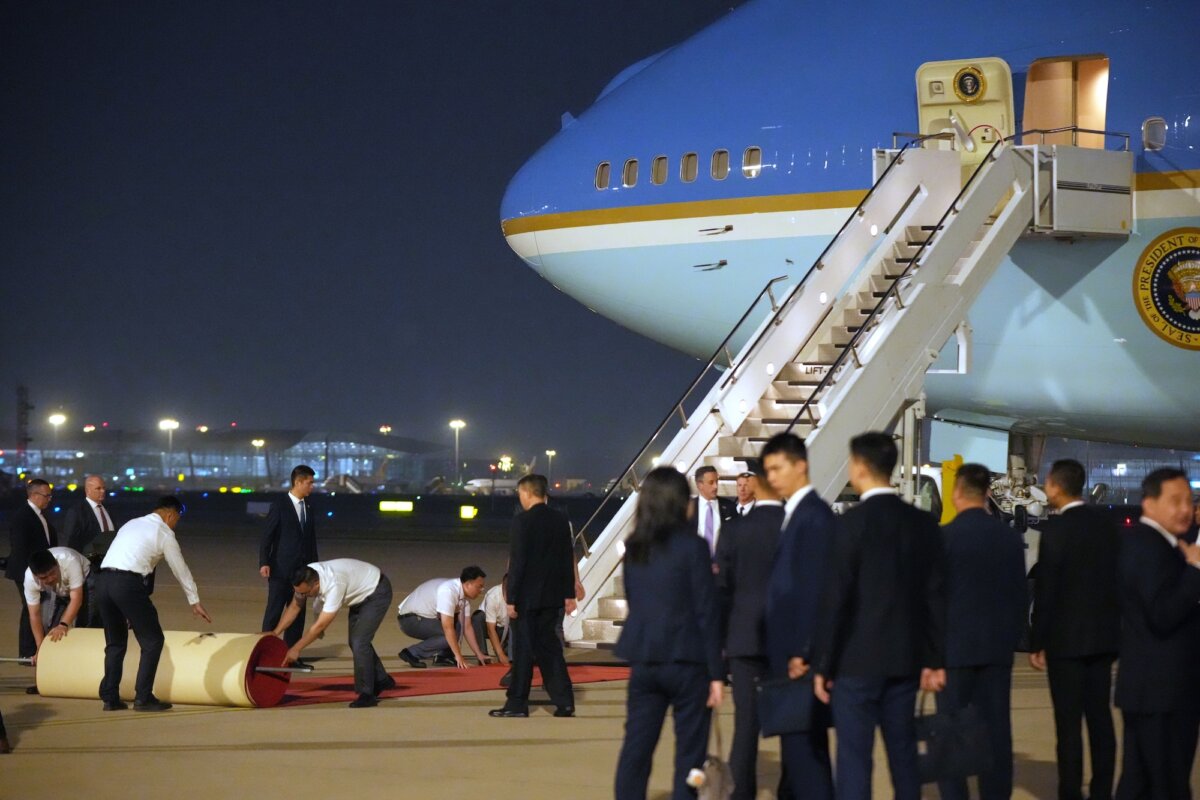
U.S. President Donald Trump has landed in Beijing for a two-day visit with Chinese leader Xi Jinping.
After landing, Trump walked down the red carpet, briefly giving a fist pump to a military honor guard and young Chinese flag-wavers, before his motorcade departed for his hotel.
He was greeted on the tarmac by Chinese deputy leader Han Zheng, U.S. Ambassador to China David Perdue, and other dignitaries.
The White House said Trump is expected to take part in an official state arrival ceremony on May 14, meet with Xi, sit for multiple interviews, and attend several other official events.
“It’s the first state visit of a sitting U.S. president to China since President Trump’s last visit in 2017,” the White House wrote in a May 13 post on X, adding that it was a “historic Summit.”
Ahead of the visit, China’s embassy in Washington outlined Beijing’s “four red lines” in China–U.S. relations, saying they “must not be challenged.”
The embassy said in a May 12 post on X that the red lines were: Taiwan, democracy and human rights, political systems, and China’s development rights.
In a May 13 post on Truth Social, Trump said that Nvidia CEO Jensen Huang “is currently on Air Force One” to join him on a two-day state visit to China. Tesla boss Elon Musk was also aboard.
Trump said he would also be joined in China by major business and tech figures, including Tesla’s Elon Musk, Apple’s Tim Cook, and BlackRock’s Larry Fink. Bosses from Blackstone Boeing, Cargill, Citi, GE Aerospace, Goldman Sachs, Micron, and Qualcomm are also going to Beijing.
In the social media post, the U.S. president said he was bringing the business figures to the “Great Country of China” and will be asking Xi to “‘open up’ China so that these brilliant people can work their magic, and help bring the People’s Republic to an even higher level!”
Chinese Vice Premier He Lifeng and U.S. Treasury Secretary Scott Bessent engaged in “candid, in-depth and constructive” exchanges on resolving economic and trade issues, according to Chinese state broadcaster CCTV on Wednesday.
The talks came as Washington continues to pressure China-linked networks over Iranian oil shipments.
On May 11, the Treasury’s Office of Foreign Assets Control designated 12 individuals and entities for helping the Islamic Revolutionary Guard Corps sell and ship Iranian oil to China.
The Treasury also warned that foreign companies and financial institutions risk secondary sanctions if they facilitate illicit Iranian commerce, including activity tied to China’s independent “teapot” oil refineries.
Bessent defended the move in a May 13 post on X, saying Washington’s “Economic Fury” campaign would continue targeting Tehran’s sources of revenue.
The Associated Press contributed to this report.
 Friends Read Free
Copy
Facebook
Tweet
Friends Read Free
Copy
Facebook
Tweet