
President Donald Trump said his administration would recommend that drug companies split certain childhood vaccines into separate doses.
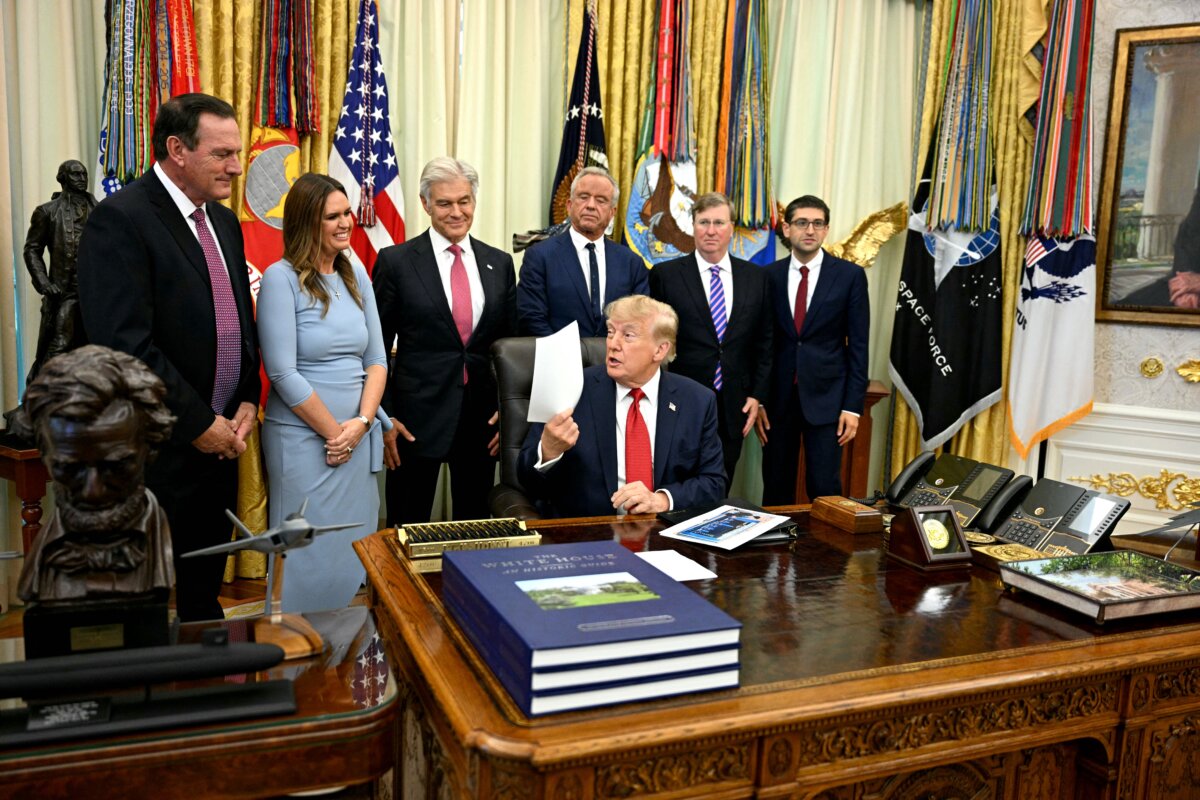
Speaking to reporters in the Oval Office on Friday, Trump said the doses would be administered six months apart, each containing 20 percent of the amount of the vaccine, to prevent “a tremendous amount” of different vaccines from being administered to children at once.
Trump did not specify which vaccines his administration intends to divide into smaller doses.
“So we’re going to recommend that they do five doses … and that they be given in six-month intervals so that a small amount of the vaccine gets pumped into the body,” he said.
Trump also said that certain vaccines had been taken out because they are not needed until children are much older.
“No reason to do it so early,” the president said, referring to the vaccines that had been removed from the childhood vaccine schedule.
“But the vaccine size would be much, much less and I think you’re going to see a massive reduction in autism,” he added.
Trump previously signed an executive order that called for spacing out childhood vaccines to provide children with what he described as “gold standard” protection.
The order, issued on Aug. 10, also recommends administering the measles, mumps, and rubella (MMR) vaccine in three single-disease shots in separate medical visits. The MMR vaccine is not currently available in three separate shots in the United States.
According to Trump’s order, the United States currently recommends more childhood vaccines than any other peer nation, with more than twice as many vaccine doses as some European nations.
“The scientific assessment also found that, instead of implementing vaccination mandates, most peer nations maintain high childhood vaccination rates through public trust and education.
“In the United States, by contrast, individual states set mandatory vaccination requirements that children must meet to attend school,” the president stated in his order.
The order directed the U.S. attorney general to take appropriate measures to support legal actions challenging state laws that conflict with states’ constitutional and federal statutory obligations related to “parental authority, religious freedom, disability accommodations, and equal protection” under the law.
This includes, where applicable under federal law, states’ obligations to provide religious and medical exemptions from childhood and adolescent immunization requirements, the order stated.
Dr. Dean Blumberg, chief of pediatric infectious diseases at UC Davis Children’s Hospital, said in a video posted on social media in early September that for many of the vaccines, if the vaccination is delayed, “your child remains vulnerable to that vaccine-preventable disease for a longer period of time, which means they are at risk for that.”
Jackson Richman and Troy Myers contributed to this report.
 Friends Read Free
Copy
Facebook
Tweet
Friends Read Free
Copy
Facebook
Tweet