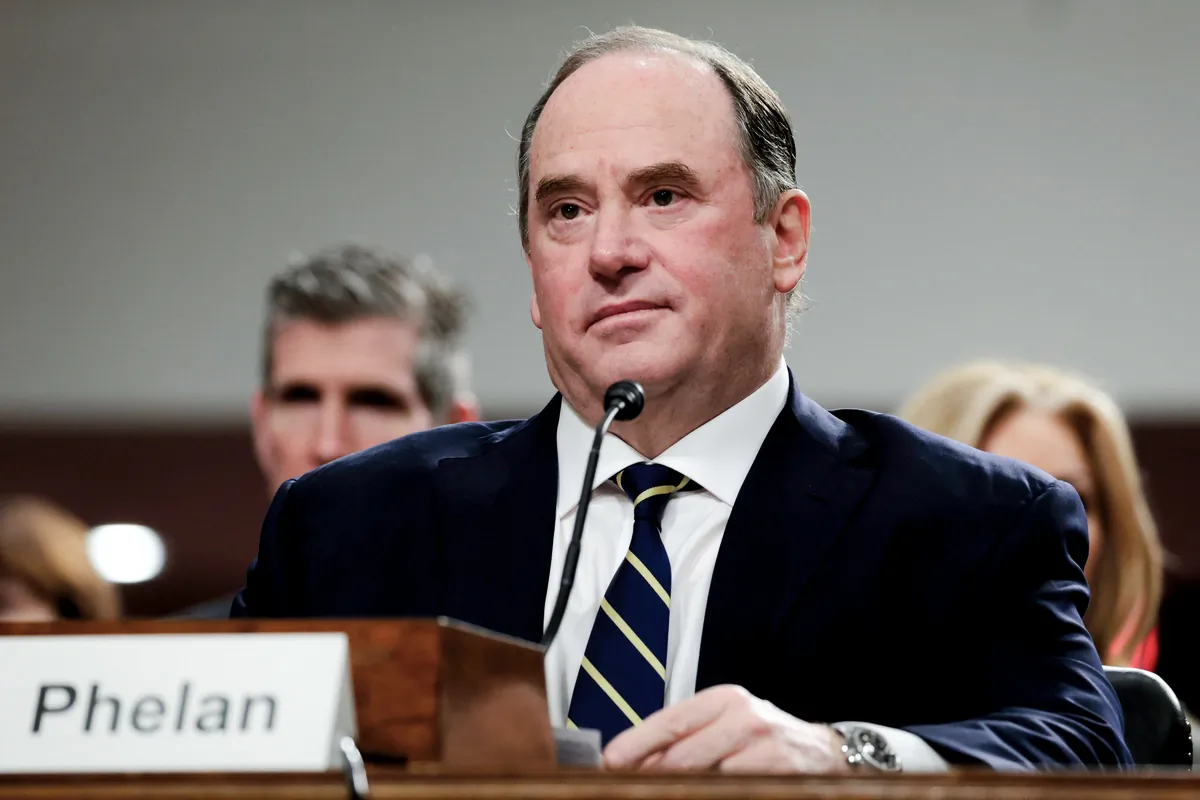

President Donald Trump said on April 23 that Secretary of the Navy John Phelan’s departure from his role resulted from “conflicts” he had with some officials over shipbuilding and ship procurement.
The Pentagon earlier said that Phelan would leave the administration effective immediately, but did not give a reason. Trump told reporters that Phelan is an “excellent guy” but he had not gotten along with some officials at the Department of War.
Trump did not name the officials Phelan was at odds with, but said that Secretary of War Pete Hegseth was not among them.
“I really liked him, but he had some conflict with, not necessarily Pete, with some other. He’s a hard-charger and he had some conflicts with some other people, mostly as to building and buying new ships,” he told reporters at the White House.
“Got to get along, especially in the military, got to get along, you know. And some people liked him, some people didn’t, and that’s usually the truth about everything.”
Pentagon spokesman Sean Parnell said in an April 22 post on X that Navy Undersecretary Hung Cao, a retired U.S. Navy captain, will assume the role of acting secretary following Phelan’s exit.
“On behalf of the Secretary of War and Deputy Secretary of War, we are grateful to Secretary Phelan for his service to the Department and the United States Navy,” Parnell said. “We wish him well in his future endeavors.”
The Pentagon did not say whether Phelan was removed or resigned from the position.
Phelan is the co-founder and chairman of Rugger Management, a private investment firm based in Palm Beach, Florida. Trump named him as Navy secretary in late 2024, and the Senate confirmed him in March 2025.
He was the first person in more than 15 years to lead the Navy without having served in any branch of the U.S. military. His connection to the military is through an advisory role for the Spirit of America, a nonprofit that works with troops and diplomats to deliver humanitarian aid to conflict zones.
In February, the Trump administration unveiled a comprehensive Maritime Action Plan aimed at reviving the U.S. shipbuilding sector, which has dwindled since World War II.
The document details a strategy that includes the establishment of maritime prosperity zones to attract investment, reforms to workforce training and education programs, growth of the U.S.-built and U.S.-flagged commercial fleet, creation of a dedicated Maritime Security Trust Fund financed partly by port fees on Chinese-made ships, and a decrease in regulatory burdens.
Kimberly Hayek and Jill McLaughlin contributed to this report.
 Friends Read Free
Copy
Facebook
Tweet
Friends Read Free
Copy
Facebook
Tweet