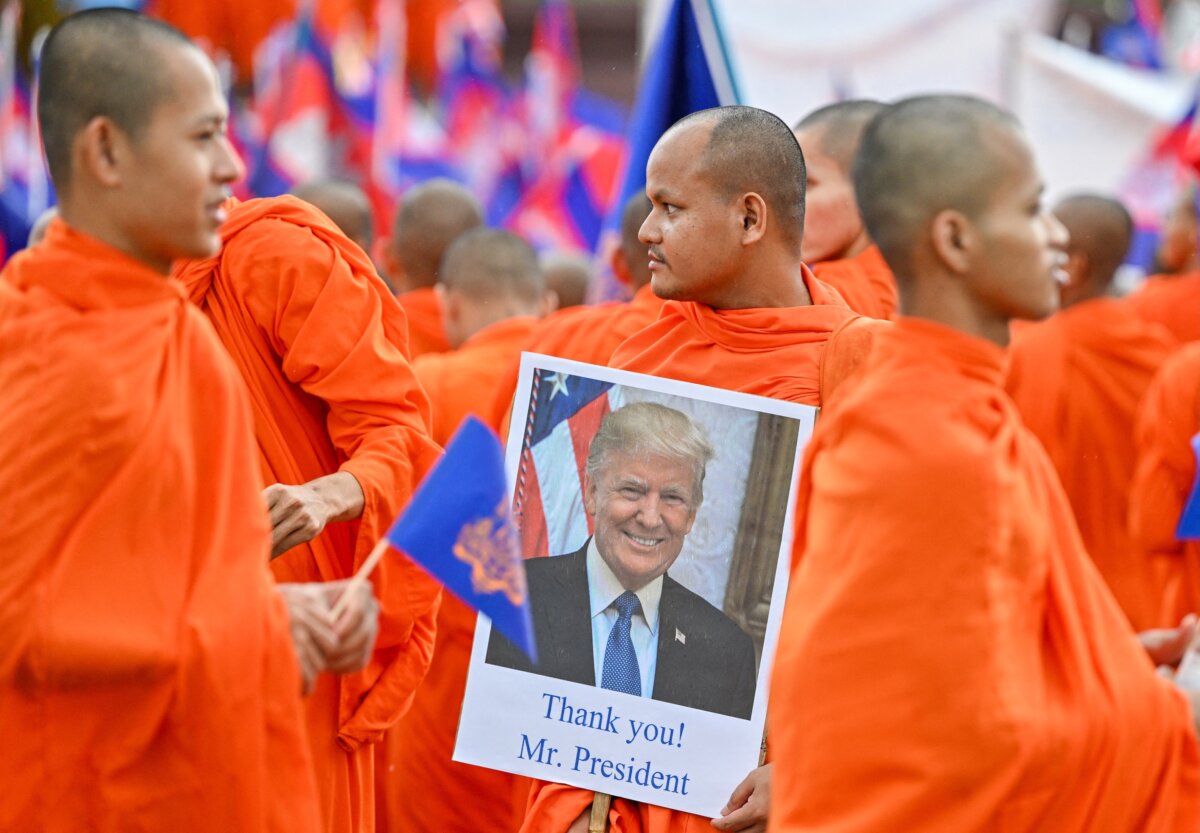

President Donald Trump has received the support of 70,000 Cambodian Buddhist monks for recognition by the Nobel Committee for his peacemaking efforts.
The monks said in an Aug. 19 public statement that they were wholeheartedly supportive of Cambodian Prime Minister Hun Manet in his nomination of the U.S. president for the Nobel Peace Prize earlier this month.
The nomination came after Trump’s intervention in the country’s recent border conflict with Thailand.
The Nobel Peace Prize is the highest-profile international award given to an individual or organization. It is issued to those who are believed to have done the most in that year to “advance fellowship between nations.”
Trump was able to help break through a standstill in efforts to end the heaviest fighting between Thailand and Cambodia in over a decade, which led to a cease-fire that was agreed to in Malaysia on July 28.
Officials from both Pakistan and Israel have also nominated Trump for the award due to his actions in support of peace for their countries amid their regional conflicts.
In June of this year, Pakistan nominated Trump for the prize, calling him a “genuine peacemaker” due to his role in working to avoid a conflict between India and Pakistan.
The Pakistani government said on June 21 in a social media post that Trump played a key role in reversing the India–Pakistan crisis that was put in motion by the terrorist massacre of 26 Indian tourists near Pahalgam in India-controlled Kashmir on April 22.
India accused Pakistan of supporting the terrorists, which Pakistan denied. Eventually, both of the nuclear-armed countries agreed to the terms of the U.S.-mediated cease-fire that took place on May 10 following three days of cross-border attacks.
The Pakistani government said Trump showed “decisive diplomatic intervention and pivotal leadership during the recent India–Pakistan crisis.”
“At a moment of heightened regional turbulence, President Trump demonstrated great strategic foresight and stellar statesmanship through robust diplomatic engagement with both Islamabad and New Delhi which de-escalated a rapidly deteriorating situation, ultimately securing a ceasefire and averting a broader conflict between the two nuclear states that would have had catastrophic consequences for millions of people in the region and beyond,” it stated.
Trump told reporters just days after the cease-fire that he threatened to end all U.S. trade with both nations unless they agreed to stop fighting.
“I said, ‘Come on, we’re going to do a lot of trade with you guys. If you stop it, we’re doing trade. If you don’t stop it, we’re not going to do any trade,’” Trump said.
“We stopped the nuclear conflict. … It could have been a bad nuclear war. Millions of people could have been killed.”
Israeli Prime Minister Benjamin Netanyahu also made his nomination in July via a letter presented to Trump during a White House meeting.
Netanyahu, who has long had a positive working relationship with Trump, cited the U.S. president’s efforts to achieve peace with Iran and to secure a cease-fire deal with terrorist group Hamas over the conflict in the Gaza Strip.
“He’s forging peace, as we speak, in one country, in one region after the other,” the Israeli leader said as he handed the letter to Trump. “So I want to present to you, Mr. President, the letter I sent to the Nobel Prize committee. It’s nominating you for the peace prize, which is well-deserved, and you should get it.”
 Friends Read Free
Copy
Facebook
Tweet
Friends Read Free
Copy
Facebook
Tweet