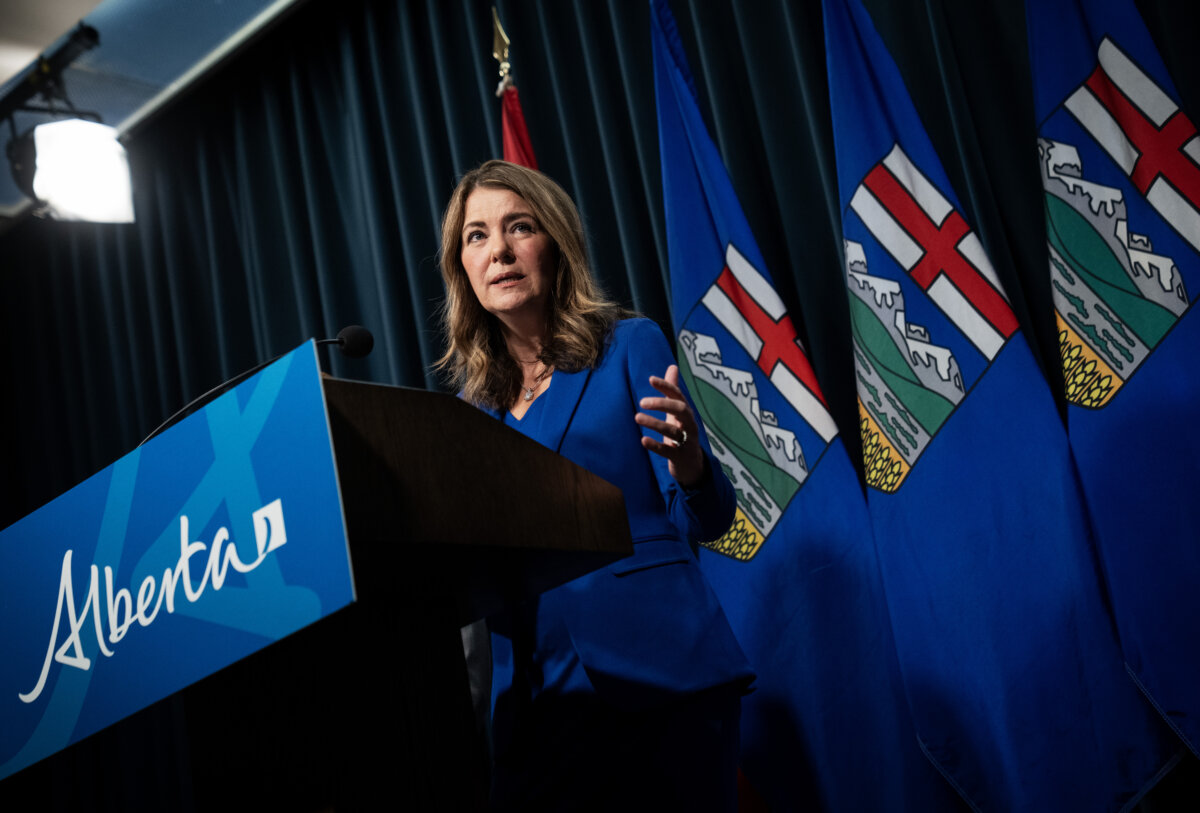

Alberta Premier Danielle Smith says her government will consider new legislation pending the outcome of investigations into allegations that a separatist group breached the personal information of more than 2.9 million Albertans.
Smith made the comment May 1 following a statement from Alberta’s chief electoral officer saying legislative changes her government made last year prevented his agency from acting sooner. The province’s privacy watchdog likewise has called for reforms in privacy laws in a separate statement.
Smith said protecting Albertans’ personal information is of “the utmost importance” to her government, and that those who are eventually found responsible for the breach “should be held accountable under the law.”
“We understand both Elections Alberta and the RCMP are looking into this matter thoroughly and we will wait for the results of those investigations before commenting further and assessing whether any future legislative changes need to be considered,” the premier said on social media.
Earlier this week, Elections Alberta announced it is investigating the Centurion Project, a third-party advertiser supporting Alberta independence, for publicly making available on its website the names and addresses of every Albertan on a recent voter list.
On April 30, a judge from the Court of King’s Bench in Edmonton ordered the advocacy group to remove the voter database, after Elections Alberta sought an urgent injunction, alleging the voter information was distributed in breach of Alberta election law.
According to statements made in court by Elections Alberta, the list, which contains voter names, addresses, and voter identification dating back to last year, was initially legally given to the pro-independence Republican Party of Alberta (RPA).
Alberta’s Election Act permits electoral lists to be provided to political parties, candidates, constituency associations, election officers, and MLAs. Third parties are not permitted to obtain copies of such records.
Privacy Laws
Lawyers for Elections Alberta said in court it was unclear if a party official gave the list to Centurion Project or if it was obtained through other means. The April 30 court order required both the advocacy group and RPA, within four days of the order, to provide Elections Alberta with the identities and contact information of all those who they allowed to access the database, according to the agency.
The Epoch Times reached out to Cameron Davies, leader of the Republican Party of Alberta, for comment but did not hear back by publication time.
Alberta RCMP spokesperson Fraser Logan confirmed that an investigation into the matter is underway.
“The RCMP has initiated an investigation and is working with other law enforcement partners in the province to determine if any offence(s) have been committed respecting the dissemination or handling of the information contained in the voter list,” he said in an April 30 emailed statement.
When asked May 2 to provide comment on any new developments, Logan said there were no updates.
Meanwhile, the Centurion Project said in an April 30 statement that it has taken down the database until it can ensure it’s compliant with privacy laws.
“The Centurion Project was established to train volunteers to be better citizens by partaking in the political process,” said the statement, posted by the group’s leader David Parker on X. Parker, a long-time political organizer, has said the group’s goal is to mobilize Albertans who support separation from Canada in advance of a possible referendum this fall.
The statement added that the volunteers utilized the group’s app database to search for people they know, but they “did not have access to phone numbers or emails.”
The group also said it relied on an unnamed third party to provide the datasets for its platform, and it intends to “fully comply” with Elections Alberta’s investigation.
Alberta’s Privacy Commissioner Diane McLeod said the “unauthorized distribution” of electors list raises “deep concern.” She called on Smith’s government to amend privacy laws to give her jurisdiction over political parties.
“This incident demonstrates that it is high time for political parties to be made subject to PIPA [the Personal Information Protection Act],” McLeod said in a statement on April 30, noting that such a move is already in place in British Columbia.
The commissioner said personal information that became publicly accessible through the Centurion Project’s website put certain individuals at risk.
“Some examples might be those who work for law enforcement, who are public officials, who are fleeing intimate partner violence and other vulnerable individuals,” she added.
‘Reasonable Grounds’
Alberta’s chief electoral officer Gordon McClure said in a May 1 statement that a higher threshold was added to the province’s legislation last summer under Bill 54 that hampered his agency’s ability to start the investigation sooner.
Specifically, the bill, also known as The Election Statutes Amendment Act, 2025, has one change among others that “Prohibit[s] investigation of complaints where the election commissioner does not have reasonable grounds to believe the matter constitutes an offence under the act.”
Quoting his previous letter sent to members of Alberta’s legislative assembly last May, McClure said in his statement that the amendment means complainants would need to provide a “substantively completed investigation” before Elections Alberta can look into the matter.
In an updated timeline of events released by Elections Alberta on April 30, it said it started looking into the alleged privacy breach on April 27 after receiving “credible information.” It said McClure then wrote a cease-and-desist letter to the Centurion Project on April 28, followed by sending representatives to the group’s meeting on April 29 to ensure the letter was received and the database was not being accessed.
In a social media post on May 1, Alberta NDP Leader Naheed Nenshi said the delayed investigation raised many questions, noting that journalists had alerted Elections Alberta “weeks earlier” about the issue. He called for an emergency legislature committee meeting for McClure to explain further, and called on the United Conservative Party (UCP) government to reverse the provisions in Bill 54.
“The UCP government must reverse Bill 54’s provisions that came into effect in 2025 and weakened Elections Alberta’s investigative powers,” Nenshi said. “Elections Alberta must provide Albertans with a clear public update on the status of this breach.”
Justice Minister Mickey Amery’s office said any suggestion the legislation stopped Elections Alberta from investigating was “completely inaccurate.”
Heather Jenkins, Amery’s press secretary, said in a statement that the act says investigations can take place if the elections commissioner has reasonable grounds to believe there was an offence, following receipt of a complaint or on its own initiative.
Paul Rowan Brian and The Canadian Press contributed to this report.
Editor’s note: This article has been updated to include comments from Alberta RCMP.
 Friends Read Free
Copy
Facebook
Tweet
Friends Read Free
Copy
Facebook
Tweet