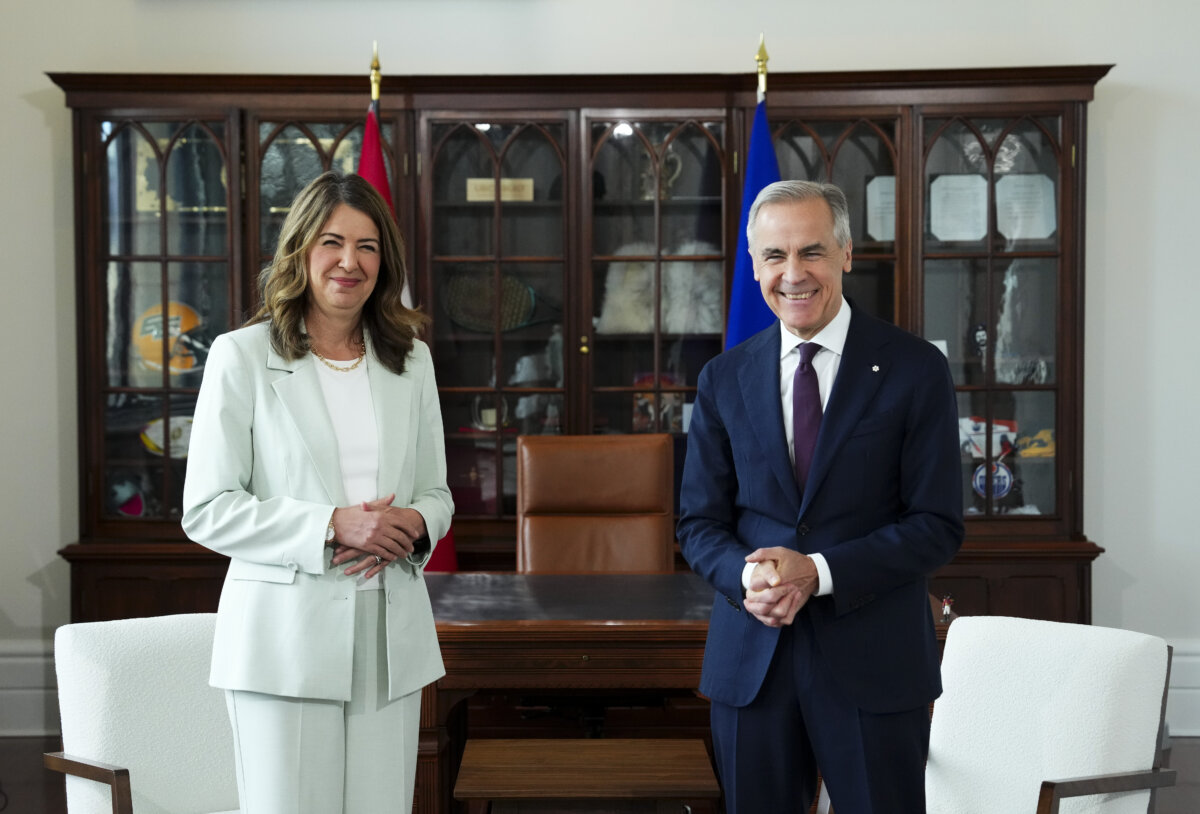

Alberta Premier Danielle Smith says talks with Prime Minister Mark Carney ended with important steps toward an agreement on a new West Coast pipeline, boosting her confidence that a key agreement between Ottawa and Alberta could be signed within days after months of delays.
“Today, Prime Minister Mark Carney and I made significant progress towards reaching an agreement on a West Coast pipeline and carbon pricing,” Smith said in a May 8 statement on X.
Smith said work still needed to be done to “get to the finish line” but she is now “much more confident this will be completed well before Alberta’s west coast pipeline submission to the Major Projects Office next month.”
A memorandum of understanding to be signed between the two governments outlines the conditions to be met before a new pipeline to the West Coast of British Columbia can be approved. The original deadline to complete the MOU was April 1, but that deadline has since been moved to July 1.
Prior to her meeting with Carney in Ottawa, Smith said Albertans were becoming “a little impatient” with slow progress on the pipeline, and she hoped the two sides would move forward with the agreement “in the next number of days.”
Carney said last week that a new pipeline was now “more probable than possible,” citing the war in Iran as a factor, which has pushed oil prices toward US$100 a barrel and damaged key energy infrastructure.
Speaking at the Canada Strong and Free Conference in Ottawa later in the day, Smith said the meeting with Carney left her “much more confident” that the memorandum could be signed soon.
Smith said pipeline talks would have been different if the federal Conservatives had won the last election, but that “there’s a compromise we have to make” to reach a deal.
“We have a Liberal government where their carbon tax objectives are a much higher priority,” Smith said.
The construction of a pipeline is tied to the creation of the Pathways Alliance carbon capture project to compress CO2 into liquid form and ship it through a pipeline to an underground storage facility. The memorandum of understanding would also require Alberta to increase its industrial carbon pricing system to a minimum of $130 a tonne, while the province had frozen its pricing at $95 per tonne through 2026 in May.
Smith told reporters at the conference that the industrial carbon pricing had been a “big issue” and she hoped to have “something more firm to announce here very soon.” She said Ottawa’s proposal of $170 per tonne by 2030 had been “completely unachievable” and would have resulted in oil and gas production caps.
The Alberta premier also said there won’t be a private sector proponent for the pipeline until there is “some certainty” that the pipeline will get built.
“So don’t be surprised that there isn’t somebody coming forward yet on the submission,” she said. “But in order to get it built, there will have to be a private sector proponent who will build it, or a consortium of them.”
When Smith was asked about Cenovus CEO Jon McKenzie’s recent comment that Canada is no longer competitive in the oil and gas sector, Smith said that was “not true.” She said Canada does have a higher cost to develop its energy because it needs to be transported by pipeline, but many countries have a renewed interest in Canadian energy because of the energy shocks caused by the Iran war.
“Yes, carbon prices will make us [pay a] slightly higher cost than than other jurisdictions, but we’re trying to land the price at a level where it’s not going to make an enormous difference in those investment decisions,” Smith said.
 Friends Read Free
Copy
Facebook
Tweet
Friends Read Free
Copy
Facebook
Tweet