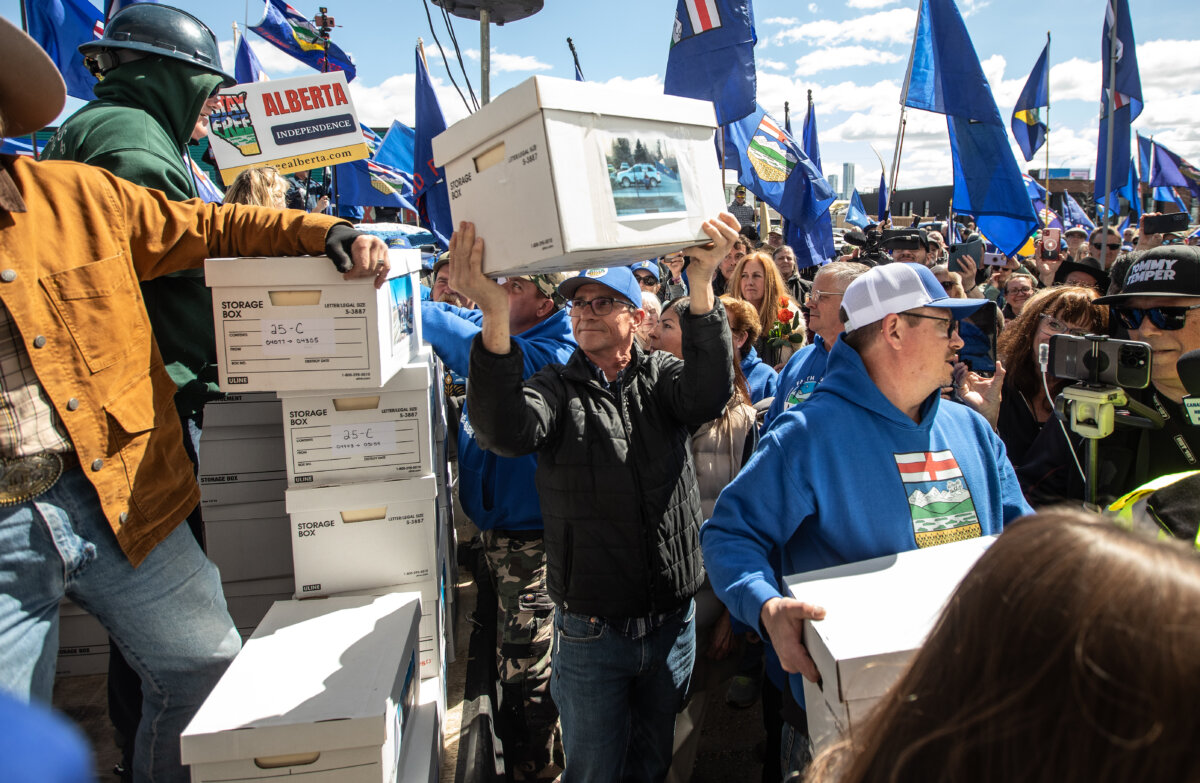

Stay Free Alberta, a separatist group behind a petition for a referendum on Alberta’s separation from Canada, is appealing a court decision that ruled against Elections Alberta’s approval of the petition.
The appeal document, which was filed with Alberta’s Court of Appeal on May 15, says Mitch Sylvestre, leader of the separatist group, is challenging Alberta Court of King’s Bench Justice Shaina Leonard’s entire May 13 decision. The document was posted to social media on May 16 by Jeffrey Rath, another leader of Stay Free Alberta.
Leonard had ruled that the province’s chief electoral officer, Gordon McClure, made an error in law by approving the petition, which had garnered more than 300,000 signatures. She said McClure failed to consider an earlier decision that found Alberta’s separation from Canada would violate First Nation Treaty rights.
She also ruled that the provincial government failed in its duty as a representative of the Crown to consult with the applicants Athabasca Chipewyan First Nation, Blood Tribe, Piikani Nation, and Siksika Nation, which launched the initial legal proceeding against the referendum in January.
Sylvestre had said earlier this month that the petition garnered 301,620 signatures, surpassing the required 177,732 signatures needed by May 4 to trigger a referendum on separation. However, Leonard’s decision means Elections Alberta won’t proceed to validate the signatures for the potential referendum this year.
The appeal document says Leonard’s decision invalidates the citizen initiative process, nullifies the completed petition process, and interferes with legislated democratic participation rights.
It includes 14 grounds for appeal, including erroneously concluding that McClure’s interpretation of the Citizen Initiative Act was “unreasonable” and that McClure’s decision triggered the Crown’s duty to consult.
Stay Free Alberta is also arguing that Leonard failed to properly distinguish between “democratic expression, political processes, and legally operative Crown conduct,” and rendered reasons and conducted proceedings “in a manner giving rise to concerns regarding procedural fairness and the appearance of impartiality.”
Alberta Premier Danielle Smith condemned Leonard’s decision last week, saying her government would be appealing the ruling.
“Although our government does support Alberta remaining in Canada, we think that today’s decision by the court will deny the opportunity to well over 300,000 Albertans to have their petition verified by Elections Alberta,” Smith said at a press conference on May 13, noting she believes the decision is “incorrect in law and anti-democratic.”
She said the issue shouldn’t be decided by a “single judge” and should be democratic. “We want to hear from Albertans. That’s what we think democracy is,” Smith said.
Smith had previously said a referendum on Alberta’s separation from Canada would be held later in 2026 if the petition met the legal requirements.
She is facing calls to put the separation question on a ballot herself and has said she will meet with her cabinet and United Conservative Party caucus to decide next steps to pursue an appeal of the court ruling.
Commenting on the Alberta petition on May 14, Prime Minister Mark Carney said the “best place” for Alberta is to remain in Canada. He noted that while referendums are a necessary process in democracies, the federal government also must ensure they follow the rules.
“Ultimately, Parliament has a role in making the judgment about the question,” Carney told reporters, noting that the Clarity Act requires any separation question to be clearly defined.
Alberta-based lawyer Keith Wilson, who supports Alberta independence, previously told The Epoch Times that an appeal by Stay Free Alberta and the UCP government could take anywhere from several months to a year or more.
A poll by Pollara released last month indicated that Alberta independence support was at 27 percent, the highest level recorded by the research firm in five years. It also indicated that 58 percent of those who supported separation still considered themselves proud Canadians.
An Angus Reid poll in February reported that 29 percent of Albertans said they were in favour of Alberta separation, and that support for separation among UCP supporters had grown to 57 percent.
Matthew Horwood and Paul Rowan Brian contributed to this report.
 Friends Read Free
Copy
Facebook
Tweet
Friends Read Free
Copy
Facebook
Tweet