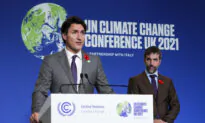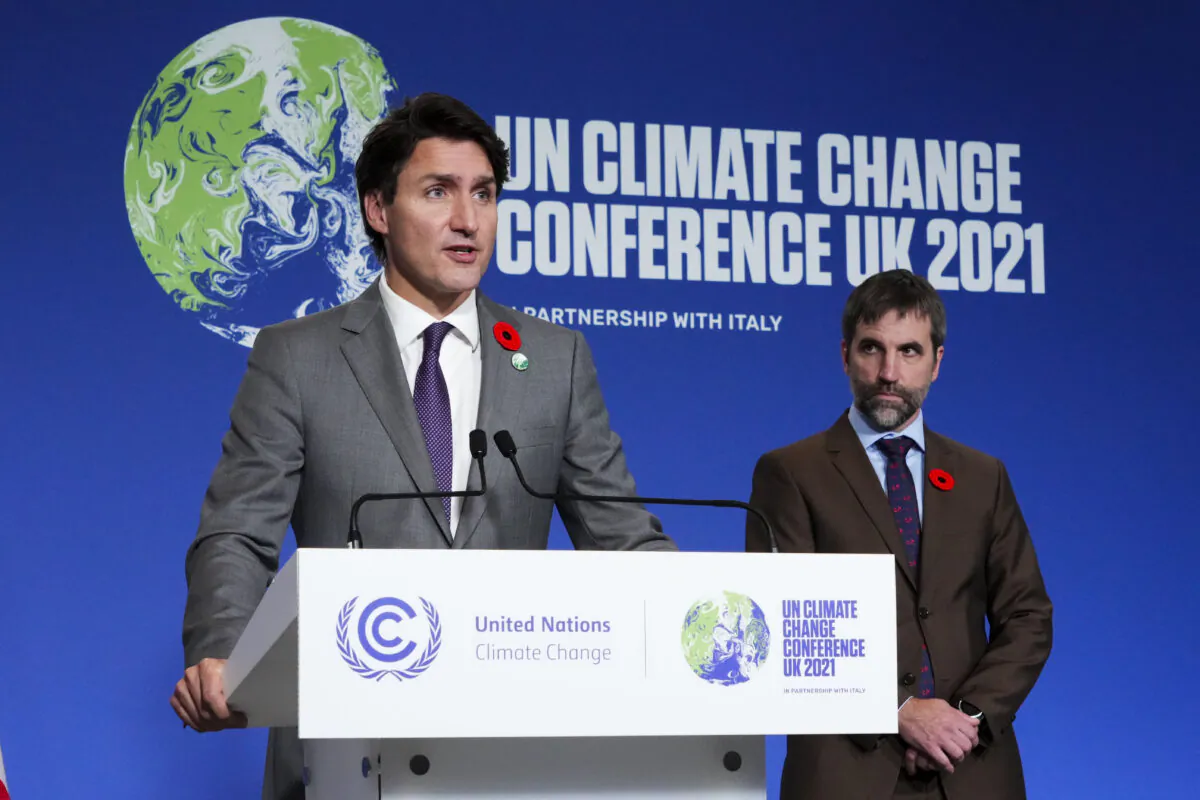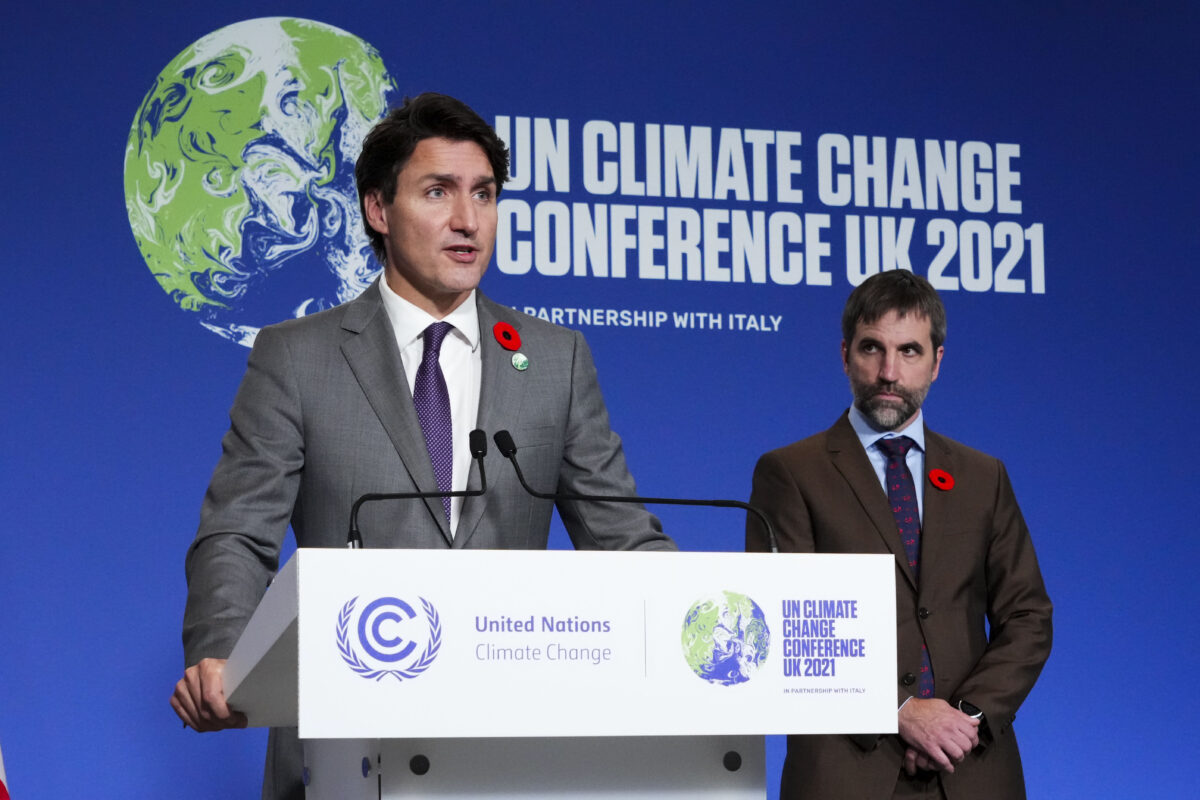

EDMONTON—Alberta Premier Danielle Smith has suggested that any consensus between Alberta and Ottawa on a climate agenda will depend on “reasonable” federal ministers. She made the remarks following a cabinet shuffle in which Steven Guilbeault, a former environmental activist, remained in his role as climate change and environment minister.
With a showdown looming over what Ms. Smith has called a de facto production gap on Alberta’s oil and gas sector and the federal government’s pending electricity regulations and oil and gas emissions cap, the premier said on a radio show that of the five cabinet ministers Alberta is dealing with, “four of them are reasonable, one of them is not.”
In an interview that aired July 29 on CBC Radio’s “The House” program, Ms. Smith said she hopes “the four reasonable ones [ministers] are able to carry the day, because we can have a deal with the federal government that is good for industry, good for the environment, good for consumers, good for the planet, good for our trade partners.”
“And it’s a matter of making sure Guilbeault is not the one who carries the day, because he’s the one, unfortunately, who is sending mixed messages and it’s not helpful,” added Ms. Smith.
The premier said that the prime minister’s decision to keep Mr. Guilbeault in the environment portfolio indicates “his colleagues are going to have to do a lot more to advocate for a balanced approach at the table. He shouldn’t be the only one out there deciding policy.”
Ms. Smith has repeatedly taken issue with the federal government’s climate policy led by Mr. Guilbeault, stating in a July 15 news release that Alberta “will not recognize any federally imposed emission-reduction targets for our energy and electricity sectors under any circumstances” unless such targets are consented to by the province.
She also said Alberta cannot achieve a net-zero electricity grid by 2030 as the federal government demands.
“[Industry] can’t get to 42 percent [reduction] in seven years. They’ve got pipelines that they need to build. They’ve got new technology they need to develop for carbon capture,” she told the program. “We also have to develop a brand-new regulatory framework for nuclear like that. That can’t be done in seven years.”
“We are not phasing out this industry. We’re not phasing out oil. We’re not phasing out natural gas,” she said. “We are phasing out emissions, and there’s a very big difference between the two.”
Differences
The Alberta premier has been critical of statements regarding fossil fuels made by Mr. Guilbeault recently during his meetings in Brussels with his counterparts in Europe, Mexico, India, Japan, China, and other countries on climate issues. The meetings were held in advance of the United Nations annual Conference of the Parties (COP) summit. COP28 is scheduled to take place from Nov. 30 to Dec. 12 this year in Dubai.
Ms. Smith said she was “alarmed to read the minister’s belief that oil and gas production is likely to be reduced by 75 percent by 2050.”
“This belief does not align with any credible forecast of future world energy consumption, which continue to see oil and gas dominating the energy supply mix for decades to come,” she said.
Mr. Guilbeault had said that COP28 could be the first to acknowledge “the need to phase out unabated fossil fuels.”
The federal government’s own data indicates that the energy sector is one of the biggest contributors to Canada’s economy. According to the 2021-22 annual report of the Canada Energy Regulator, in 2020 the sector made up 8.1 percent, or $168 billion, of the country’s GDP. It directly employed 293,000 jobs of the national workforce, while total employment, including indirect jobs, was estimated at 4.7 percent, or 845,500 jobs.
Alberta’s new minister of environment and protected areas, Rebecca Schulz, had an in-person meeting on July 19 with Mr. Guilbeault. In a statement after the meeting, Ms. Schulz said that “Alberta is aspiring to achieve a carbon neutral power grid and oil and gas sector by 2050. However, we [Canada and Alberta] need to agree on how we get there.”
 Friends Read Free
Copy
Facebook
Tweet
Friends Read Free
Copy
Facebook
Tweet