

Bloc Québécois Leader Yves-François Blanchet drew attention in recent days after his social media accounts appeared to begin promoting cryptocurrencies.
His party confirmed on July 22, however, that a hacker was behind the posts made on his X account.
“The ‘X’ account of the Bloc Québécois leader, Yves-François Blanchet, has indeed been hacked,” the Bloc said in an X post.
Blanchet’s press secretary, Joanie Riopel, urged the public not to click links in the posts promoting cryptocurrency or “any other link” until further notice.
Riopel said the Bloc hopes to resolve the situation quickly with help from the social media platform.
A first suspicious post on Blanchet’s account, which appeared earlier in July, said he was “skeptical about cryptocurrencies” until he met a certain crypto trading expert.
“I’m thrilled to announce that I’ve just received my second payment of 31,000€, credited directly to my account in just a few hours. Know that I’m not trying to scam anyone with this tweet: it really works, it’s completely legitimate,” the post reads.
The post contains a screenshot purporting to show $31,321.45 Canadian dollars in an account.
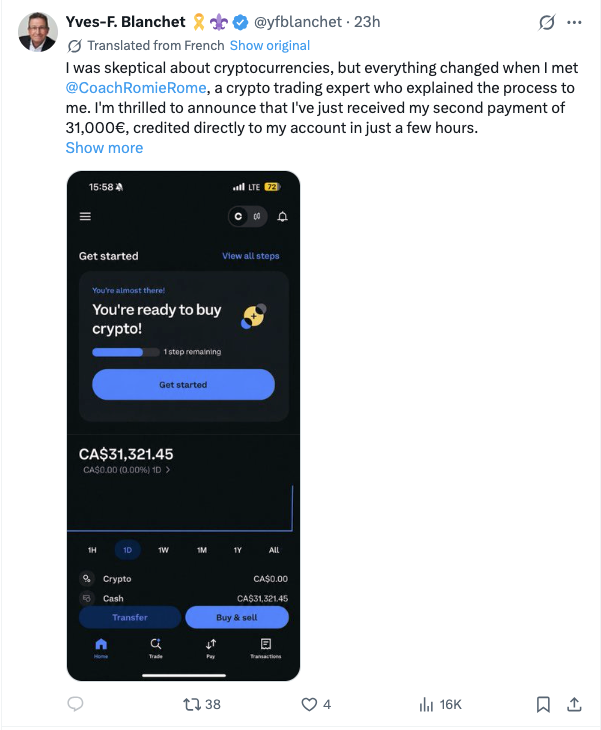
A subsequent post on July 22 seems to seek to address concerns raised about the original post. “For those of you who have questions about my previous message: yes, it’s absolutely real,” it says.
The Epoch Times reached out to the Bloc for comment, but didn’t immediately hear back. The RCMP deferred questions to the police of jurisdiction.
Other public personalities had their X accounts hacked in recent days, including Sylvain Charlebois, known as the “food professor,” who runs the Agri-Food Analytics Lab at Dalhousie University.
“My account was hacked on July 11, but I’m now back. Thank you, @X, for your diligent investigation and assistance in restoring my account,” he wrote on July 16.
In the Charlebois hack, the post claimed he had recently purchased a house in California and recommended a certain real estate agent.
The X account of Peter Menzies, a senior fellow at the Macdonald-Laurier Institute think tank, was also hacked. The account sent direct messages (DMs) to contacts asking to click on a link, a likely attempt by hackers to steal information or inject malicious code into devices connecting to their server.
“A reminder to anyone sending me DMs on this account: I am not opening DMs. You can message me on FB, LinkedIn and Substack but I don’t trust X DMs,” Menzies said in a July 22 X post.
The Cyber Centre at CSE offers warnings about tactics used by hackers to defraud individuals or obtain access to sensitive information, such as phishing. This involves tricking people into believing they’re receiving information from a trusted source while inviting them to click on a link.
The centre encourages social media users to practice good digital hygiene with strong passcodes, exercising caution, and refraining from posting private information.
 Friends Read Free
Copy
Facebook
Tweet
Friends Read Free
Copy
Facebook
Tweet