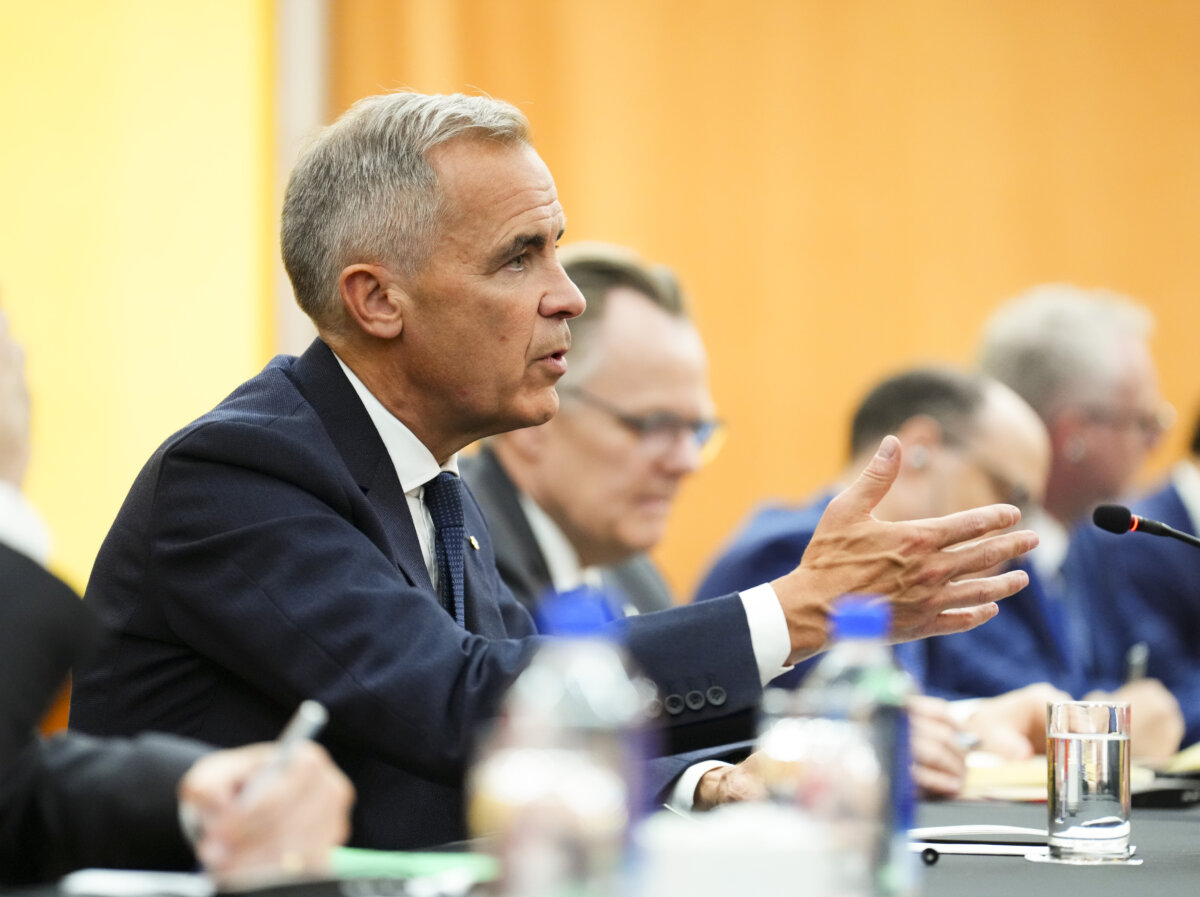
Prime Minister Mark Carney says he expects to meet Chinese leader Xi Jinping as the two attend an international forum in South Korea this week.
Ottawa is currently on a push to boost trade and revamp relations in Asia amid tariffs imposed by Washington.
Carney announced the plan for a meeting with Xi as he was attending the Association of Southeast Asian Nations (ASEAN) meeting in Malaysia on Oct. 27.
The prime minister is then travelling to Singapore before reaching South Korea for the Asia-Pacific Economic Cooperation (APEC) forum starting on Oct. 31.
“Relationships rebuild over time when they have changed for the worse. And so we have a lot of areas on which we can build,” Carney said of Canada-China relations.
Relations between Ottawa and Beijing deteriorated in late 2018 when Canada executed a U.S. extradition warrant for Huawei executive Meng Wangzhou, who was accused of fraud. China arbitrarily detained Canadian citizens Michael Kovrig and Michael Spavor for over 1,000 days in apparent retaliation.
Carney noted there had been no high-level contact between Canada and China since that time, until he met Chinese Premier Li Qiang in September on the margins of the United Nations General Assembly in New York.
Carney was asked by reporters whether increased engagement could mean Canada lifting restrictions on Chinese investments in Canada, which has been a request from Beijing.
In the latter part of the Trudeau Liberals’ tenure, Ottawa made it harder for Chinese entities to make acquisitions in Canadian sectors deemed sensitive, including critical minerals.
China accused Canada of “overstretching the concept of national security to suppress Chinese companies” in a statement issued after the foreign affairs ministers of the two countries met in July.
Carney said that the reset in relations is the start of a “broader” discussion. “There were greater restrictions that were in place given other issues in the relationship,” he said, without elaborating.
“We’re in the process of a resetting of expectations; of where the relationship can go, the extent to which we have different systems where the relationship can go, and where it won’t go, and that’s part of the discussion that has begun,” he said.
The prime minister said one area where progress can be made is around travel between the two countries, saying how there are currently “extreme restrictions” in place. He also noted the issues of agriculture and fishery goods.
Beijing imposed tariffs on these products after Ottawa placed duties on Chinese steel, aluminum, and electric vehicles in late 2024.
“We’re starting from a very low base, and we can move quite substantially before we start to get to sensitive areas,” said Carney.
When asked by reporters whether a Carney government could restart free trade talks with China, the prime minister said the discussions with Xi Jinping will be about “much broader issues” than trade and that he will be in a better position to answer that question as the relationship “evolves and deepens.”
“There’s no preset offer issue. This is the difference between relationship and transaction. We’re starting relationship building,” he said.
Diplomatic Push
Ottawa has been multiplying its diplomatic efforts on China. Agriculture Minister Heath MacDonald is in China from Oct. 27 to Nov. 3 to “strengthen agricultural collaboration,” according to his department.
Foreign Affairs Minister Anita Anand travelled there in mid-October, after which she said that Canada is in a “strategic partnership” with China.
“We must be nuanced in our diplomacy,” Anand told The Canadian Press in an interview. “We must stress our concerns relating to security and public safety on the one hand, and we must seek to build additional supply chains on the other. That is pragmatism.”
The intention of having such a partnership with China does not figure in Ottawa’s Indo-Pacific Strategy, released in 2022, which calls it an “increasingly disruptive global power.” The strategy does advance the concept, however, of challenging China in areas of disagreement while engaging on issues such as “climate change, biodiversity loss, global health and nuclear proliferation.”
Conservatives reacted to Anand’s strategic partnership comment, noting how during the election Carney had said China is Canada’s “biggest security threat.”
“These two things seem contradictory,” Tory MP Michael Chong said in the House of Commons on Oct. 23. “Can the minister reconcile these two things, or is this another example of the prime minister saying one thing during the election and doing another after?”
Carney had made his China threat comment during the leaders’ debate on April 17. The next day, Carney had elaborated and said China represents “one of the largest threats with respect to foreign interference.”
Concerns about foreign interference and transnational repression coming from China have been high in Ottawa in recent years, with a public inquiry looking into the topic extensively. The final report of the Foreign Interference Commission said that China is the “most active perpetrator of foreign interference targeting Canada’s democratic institutions.”
The issue surfaced in the last federal election, when a sitting Liberal MP was reported to have suggested his prospective Tory opponent, an outspoken supporter of Hong Kong democracy, be brought to the Chinese consulate to collect the bounty placed on his head by authorities.
Carney said Liberal candidate and incumbent MP Paul Chiang had a lapse in judgment but he kept him as a candidate. Chiang dropped out on his own after saying he had made a mistake with his comment about Tory candidate Joe Tay.
 Friends Read Free
Copy
Facebook
Tweet
Friends Read Free
Copy
Facebook
Tweet