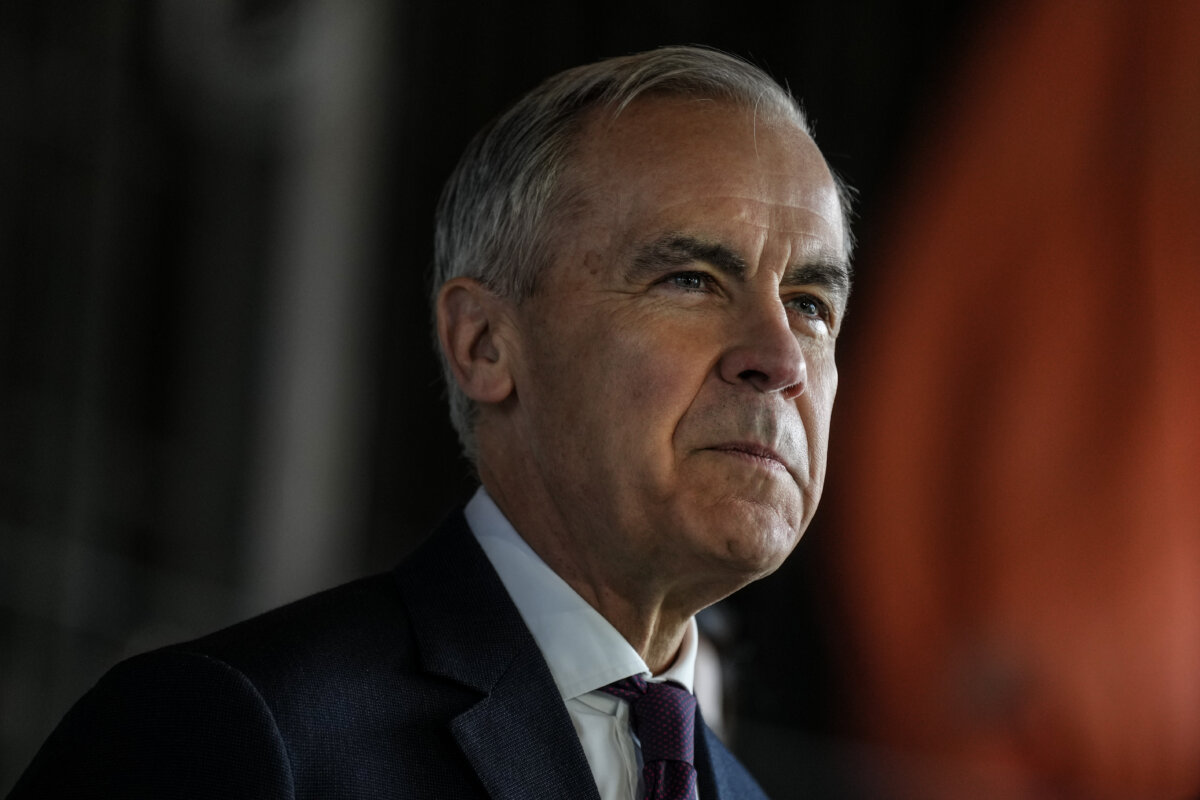

Prime Minister Mark Carney responded to Washington’s proposal to introduce 10 percent tariffs on countries that allow in goods produced by forced labour, saying most Canadian exports would remain exempt under the country’s trade agreement with the United States.
U.S. Trade Representative Jamieson Greer proposed the new tariffs on June 2, which would apply to dozens of countries that have allowed products made using forced labour into their supply chains. For Canada, the 10 percent tariffs would only apply to goods that don’t comply with the rules of origin in the Canada-U.S.-Mexico Agreement (CUSMA).
Carney told reporters in Parliament that the new tariffs are “not a surprise,” as the United States has been planning to announce them for several months. Carney said with the continued CUSMA exemption, Canada would continue to “have the best trade deal of any of the U.S. trade counterparts.”
Carney said Canada also has a “very strong legislative regime against forced labour in supply chains,” and shares Washington’s concerns about the practice. Carney said Ottawa is reinforcing policies on forced and child labour. He added that some of the measures had proven “not as effective” and said the government would introduce additional proposals in the House of Commons in the coming weeks.
Greer’s announcement came hours after a meeting with Canada-U.S. Trade Minister Dominic LeBlanc in Washington, D.C. LeBlanc said on X that it did “not come as a surprise,” given that the United States had “stated its intention to replace existing baseline global tariffs imposed under Section 122 when they expire in July.”
After the U.S. Supreme Court struck down many of President Donald Trump’s tariffs in February, ruling that the emergency powers law he had relied on did not authorize such measures, Trump vowed to pursue other mechanisms to impose new tariffs. He subsequently introduced a temporary 10 percent global tariff under Section 122 of the Trade Act of 1974, which can remain in place for up to 150 days unless Congress authorizes an extension.
The Canada Border Services Agency told the House of Commons international trade committee in November 2025 that, over the space of five years, Canada detained 48 shipments suspected of containing goods made with forced labour. The agency said 37 were released, two were prohibited, seven were re-exported and one was abandoned.
By comparison, the U.S. detained nearly 42,000 suspected shipments and denied nearly 23,000 from 2022 to 2026. The United States has taken action under the Uyghur Forced Labor Prevention Act, which was passed in 2021 to address forced labour in the Chinese province of Xinjiang.
Conservative MP and Foreign Affairs Critic Michael Chong said the new U.S. tariffs are “unjustified,” but that Conservatives are also “deeply concerned” about the findings of forced labour in Canadian supply chains.
“Prime Minister Carney has been unable to speak clearly on this issue and for six years the Liberal government has continually failed to stop products using forced labour from entering Canada. This failure is now putting Canadian jobs and trade at risk,” Chong said.
 Friends Read Free
Copy
Facebook
Tweet
Friends Read Free
Copy
Facebook
Tweet