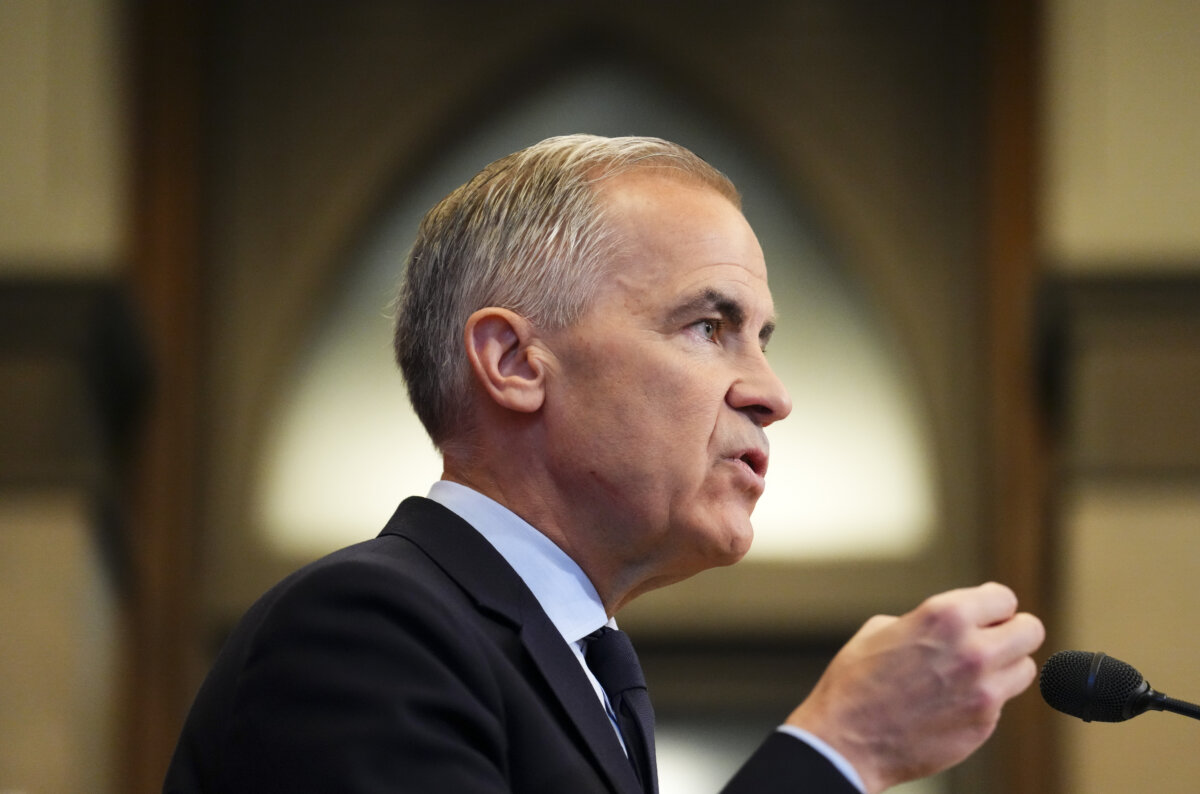

Prime Minister Mark Carney has responded to the news that the Canadian economy entered a technical recession by saying lower population growth and reduced government spending have contributed to “weakness” in the economy.
Statistics Canada reported on May 29 that Canada’s economy showed no growth in the first quarter of 2026 after negative growth in the last quarter of 2025. The country’s GDP declined for two consecutive quarters on an annualized basis, meeting the common definition of a technical recession.
Asked by reporters in Parliament on June 2 whether Canada was in a recession, Carney responded by saying his government had “been in the process of laying the foundations for a stronger, more resilient, more independent” Canadian economy. He said this involved the “difficult” work of making major investments, changing the way government operates, and securing trade agreements with other countries.
“As we do all that, the data is going to be uneven, and we will see some weakness,” Carney said.
Carney also said his government had tightened immigration policies, leading to slower population growth and, in turn, weaker economic activity. Canada’s population had increased by more than 3 million people from 2020 to 2025 due to immigration, but Ottawa began lowering its target immigration levels in 2024.
Budget 2025 stated that Canada would aim to admit 385,000 temporary residents next year and 370,000 in the following two years, while the 2024 immigration plan had said Canada would welcome more than 516,000 temporary residents for 2025.
Economists have said Canada came close to entering a technical recession back in 2023 but record immigration boosted consumption and GDP growth. The economy shrank by 0.3 percent in the third quarter of 2023 and then grew by just 0.2 percent in the fourth quarter of the year.
Carney also said his government has “reined in” spending by slowing the growth of direct program expenses, which is weighing on Canada’s economy. Budget 2025 said these expenses had grown by an average of 8.1 percent over the previous decade, but were projected to grow by just 0.5 percent until 2028.
Carney said the “foundations” are coming into place for a “stronger, more resilient economy” and household incomes are rising faster than inflation. “There’s more to be done without question, but they’re moving in the right direction,” he said.
Conservative Leader Pierre Poilievre said on June 2 that Carney had refused to answer reporters’ questions on the news of a recession for five days, and then could not “even answer a basic yes or no question” on whether Canada was in a recession.
“The single mothers who are having to turn back items at the checkout and grocery stores, and then go to food banks that have also run out of food—they deserve a prime minister who will look them in the eye and admit that there is a recession,” Poilievre told reporters in Ottawa.
Asked whether Canadians should blame Prime Minister Mark Carney or U.S. President Donald Trump for Canada’s recession, Poilievre said Canada stands out as the only G7 country currently in recession despite all member nations facing tariffs. He added that Mexico, which also shares a border with the United States, has avoided a recession, suggesting that factors beyond U.S. trade policy are at play.
“It seems that the other countries, despite Mr. Trump’s unfair tariffs, have been able to craft policies to avoid recession. It’s only here, under Mark Carney’s policies, that we find ourselves in a recession,” he said.
Poilievre’s had requested an emergency debate on Canada’s economy following the news of a recession, but this was denied by the Speaker of the House on June 1. The Conservatives also plan to introduce a motion in the House of Commons calling for Carney to “immediately present a plan to reverse all the economic policies of the Liberal government which have given Canada the G7’s worst economy.”
 Friends Read Free
Copy
Facebook
Tweet
Friends Read Free
Copy
Facebook
Tweet