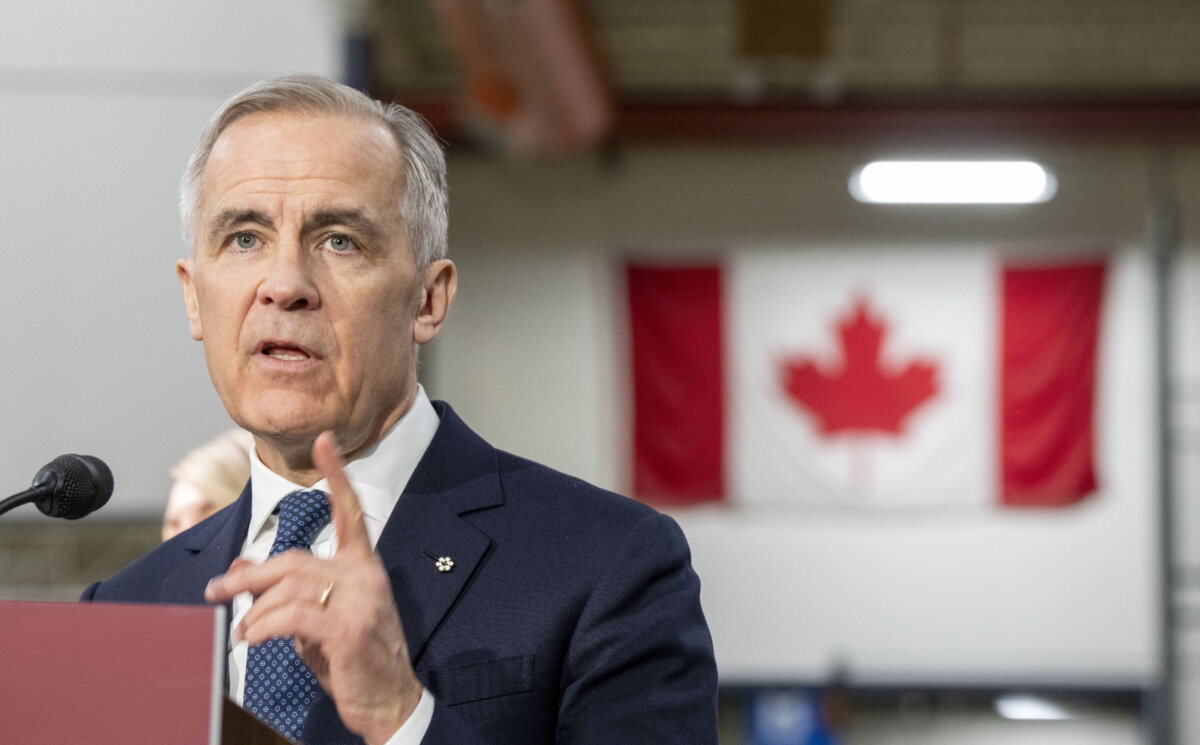

Ottawa is planning to ramp up domestic military spending to reduce outside dependence and create jobs as part of its new defence industrial strategy, Prime Minister Mark Carney says.
The prime minister announced Canada’s first-ever defence industrial strategy at a Feb. 17 press conference in Montreal, describing it as a plan to buy domestically, reduce red tape, and rearm Canada with less dependence on U.S.-made military equipment.
The strategy, with $6.6 billion in funding allocated over five years, also seeks to support small and medium-sized businesses in Canada as they venture into the defence industry, encouraging a reallocation of spending to favour equipment produced in Canada instead of relying on foreign military contractors, including American companies, Carney said.
“It’s a bold plan to get our armed forces what they need, when they need it,” he said. “It’s a bold plan to scale Canadian defence companies and to put hundreds of billions of dollars into strategic sectors of our economy.”
The government says the implementation of the strategy is expected to generate 125,000 jobs over a 10-year period, and is anchored on “Buy Canadian” principles.
“Buy Canadian will be the North Star toward a new way of doing business in defence acquisitions,” the government says.
Conservative Leader Pierre Poilievre said the new strategy will create more bureaucracy without adequately speeding up the procurement process.
“The days of having like 15- or 20-year procurement processes, they have to end,” Poilievre said.
Build, Partner, Buy
The strategy comes as Ottawa seeks to increase defence spending to meet its NATO commitments of 2 percent of GDP within the 2025–2026 fiscal year and 5 percent of GDP by 2035.
It says Canada requires “reliable infrastructure” in its northern regions and sufficient autonomy to manoeuvre in a world where “imperial conquest” could resurface, particularly at a time when “old alliances” are strained, although it is noted that Canada remains dedicated to a robust defence partnership with the United States.
Carney told reporters there are “many strengths” that come from Canada’s partnership with the United States, but the current relationship effectively leaves the nation dependent on its southern neighbour.
“It’s a dependency we want to change in a positive way by building up our defence capacities here and our other partnerships abroad,” he said.
The strategy advocates for the construction of equipment domestically whenever possible, followed by a preference for producing materials in partnership with allies, and lastly, acquiring them from foreign sources.
To do that, Ottawa is aiming to develop defence partnerships with the European Union, the UK, Australia, New Zealand, Japan, and South Korea, according to the strategy. When it comes to adversarial countries, the document does not reference China and includes only a single mention of Russia, which it describes as destabilizing the global order through its invasion of Ukraine.
Carney said the strategy “doesn’t mean isolation,” but a focus on “being strong enough to be a partner of choice rather than a dependent.”
“It means building a domestic defence, industrial base so we are never hostage to the decisions of others when it comes to our security,” he added.
Canadian Companies
As part of the strategy, Ottawa plans to collaborate with what the government describes as “Canadian champions” who effectively meet their budgetary and timeline commitments, in exchange for benefits including research funding, export promotion, financing, and access to testing infrastructure.
“They will be expected to deliver capability on time and on budget and support national sovereignty through their Canadian supply chains, while also ensuring continued value for money,” the strategy document says. It does not detail the government’s strategy to make sure these companies do not overshoot their budgets.
The document proposes that the proportion of defence-procurement contracts allocated to Canadian companies should rise from approximately 50 percent to 70 percent of total acquisitions, with the objective of strengthening Canadian manufacturing industries adversely affected by U.S. tariffs.
The strategy also seeks to boost Canada’s defence exports by 50 percent and to elevate total revenues of the Canadian defence industry by more than 240 percent.
It includes plans to boost “Canada’s edge in high-value” sectors like artificial intelligence, quantum, robotics, and autonomous systems, Carney said.
The prime minister was originally expected to announce the new defence industrial strategy last week, but he postponed that plan after a mass shooting in B.C. and rescheduled the announcement for Feb. 17. The details of the document were disclosed to the media this weekend and the strategy was officially released after Carney’s morning press conference.
The Defence Industrial Strategy was initially scheduled for release last year, but it has faced several delays before being leaked to the media over the weekend ahead of today’s official announcement.
 Friends Read Free
Copy
Facebook
Tweet
Friends Read Free
Copy
Facebook
Tweet