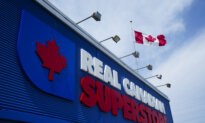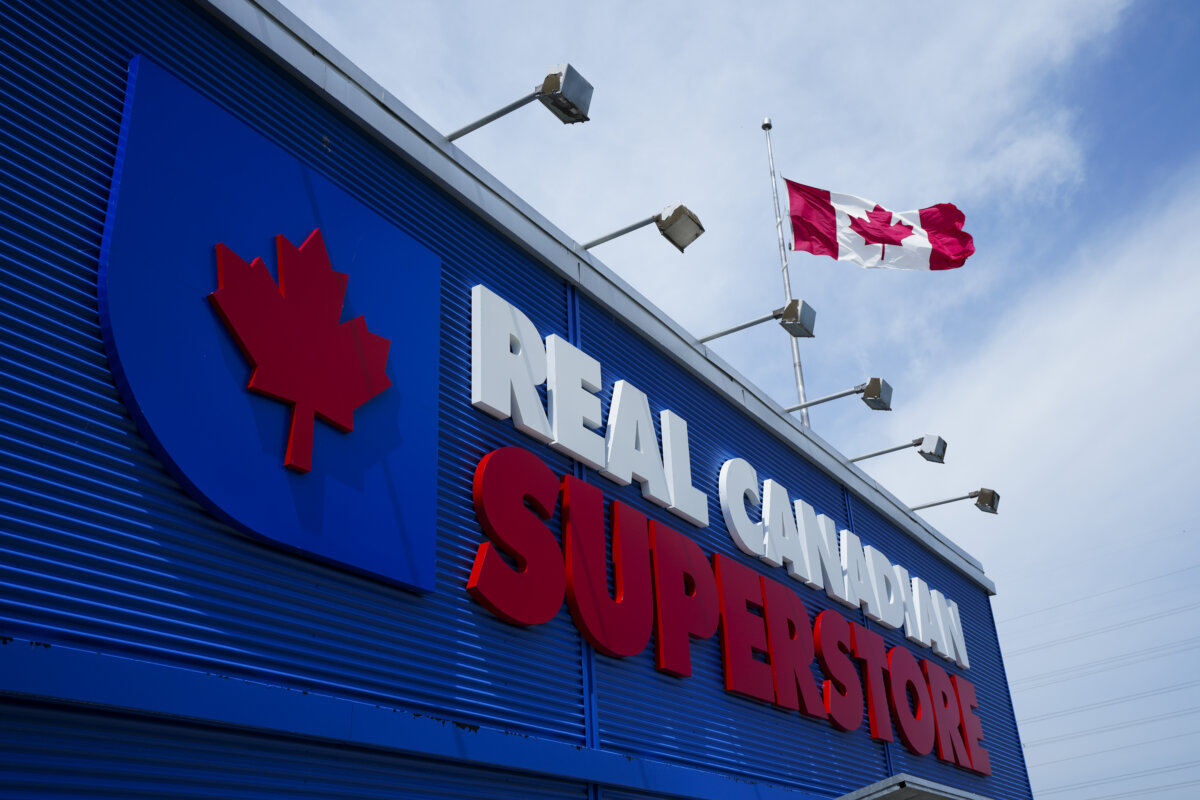

A Superstore owned by grocery chain Loblaws has been fined $10,000 by the Canadian Food Inspection Agency (CFIA) for displaying certain imported products in a way the agency described as “misleading,” giving the impression they were “Product of Canada.”
In a social media post on Feb. 17, the CFIA said the Loblaws’ subsidiary committed a violation under the Safe Food for Canadians Act “related to misleading Product of Canada product displays.”
The store in question is Real Canadian Superstore (Store No. 1033), located at 51 Gerry Fitzgerald Dr. in Toronto, according to the company’s website.
The CFIA’s post did not specify which products prompted the fine but included a link to its website explaining how the agency can enforce actions, such as with an administrative monetary penalty, for non-compliance “that could put Canadians at risk or damage Canada’s international reputation.”
A statement from the food regulator likewise did not specify which products were involved, though it noted that the Superstore had used “maple leaf advertising decals” alongside foreign products.
“In this instance, the penalty related to an in-store retail display with maple leaf advertising decals placed next to a product information tag for products not originating from Canada. This created a product advertisement that is misleading to consumers regarding the origin of the product,” the CFIA told The Epoch Times in an email on Feb. 21.
The agency added that the $10,000 penalty, issued on Jan. 15, was related to a violation under subsection 6.1 of the Safe Food for Canadians Act, which pertains to “inaccurate labelling of foods packaged, labelled or advertised by a retailer.”
For food products claiming to be a “Product of Canada,” the CFIA states on its website that the claim is only valid “when all or virtually all major ingredients, processing, and labour used to make the food product are Canadian.”
“This means that all the significant ingredients in a food product are Canadian in origin and that non-Canadian material is negligible,” it added, noting that foreign ingredients must make up less than 2 percent of the product.
A “Made in Canada” label, meanwhile, can only be applied to products “when the last substantial transformation of the product occurred in Canada,” even if some ingredients are imported from other countries.
‘Potential for Human Error’
The Epoch Times contacted Loblaws to inquire about the products that triggered the penalty and how they were displayed to consumers, but did not hear back before publication time.
In an earlier statement to media outlets, Loblaws said the company and its subsidiaries take their “labelling and signage responsibilities seriously” and are committed to meeting regulatory requirements, while noting the challenges of figuring out an item’s origins.
“With thousands of products in our stores, many of which are sourced from different countries regions throughout the year, information can change quickly. While we work hard to keep everything up to date, there are times when signage may not be refreshed as quickly as inventory is replenished,” the statement said.
The grocer added that even though it has processes in place to support accuracy of its labelling, “there is still the potential for human error.”
“That’s why we’re continuing to strengthen our processes,” said a Loblaws spokesperson. “We’re sorry for any confusion this may have caused.”
‘Buy Canadian’
The CFIA’s Feb. 17 announcement of the penalty against Real Canadian Superstore comes at a time when the “Buy Canadian” movement has gained momentum over the past year amid trade tensions between Canada and the United States.
Major grocers, including Loblaws and Sobeys, have since added the maple leaf symbol to their shelves to indicate which products had Canadian origins. Loblaws took a step further by introducing a “T” symbol to mark products that have experienced price hikes due to U.S. tariffs.
In March 2025, as the U.S. tariffs on Canadian exports came into effect, the CFIA reported seeing an increase in complaints about items being mislabelled as products of Canada or missing information about their country of origin.
A month earlier before the American levies came into force, food regulation experts also noted that determining an item’s origins can be complicated, as an item may be made with ingredients from elsewhere or made with some Canadian products but owned by an international parent company.
The CFIA statement on Feb. 21, 2026, said the inspection and penalty imposed on Real Canadian Superstore were not triggered by a consumer complaint.
“We use intelligence to target our efforts for maximum impact,” the agency said. “Over the last two years, that intelligence has pointed to potential issues with labelling accuracy, so we expanded our work in these areas.”
The Canadian Press contributed to this report.
 Friends Read Free
Copy
Facebook
Tweet
Friends Read Free
Copy
Facebook
Tweet