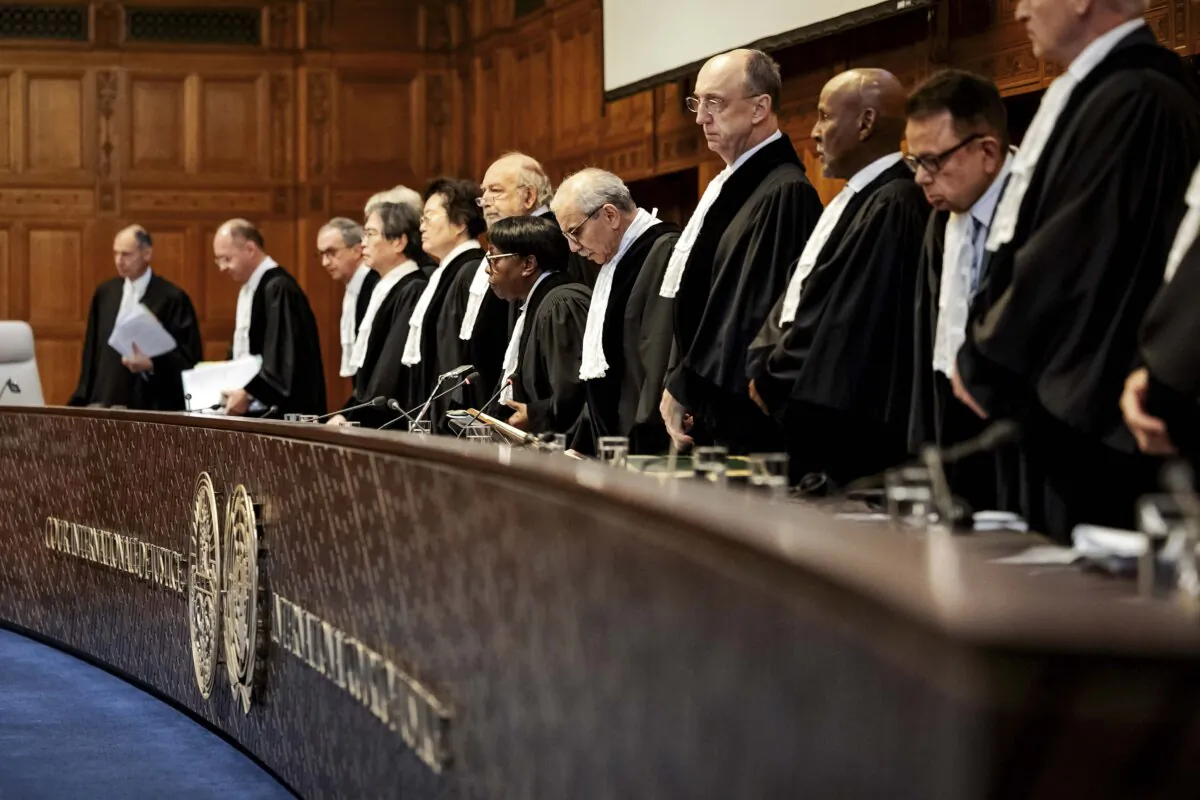

The International Court of Justice (ICJ) issued an advisory opinion on July 23 saying that countries could be in breach of international law if they fail to take adequate climate action.
Although the opinion is nonbinding, it is expected to influence climate-related litigation and global policy discussions. Legal experts say the ruling may provide a basis for countries to seek reparations for climate-linked damage.
“Failure of a state to take appropriate action to protect the climate system … may constitute an internationally wrongful act,” ICJ President Judge Yuji Iwasawa said.
“[There is] an existential problem of planetary proportions that imperils all forms of life and the very health of our planet.”
The case was brought by Vanuatu, a Pacific Island nation, and backed by more than 130 countries. Vanuatuan Minister for Climate Change Ralph Regenvanu welcomed the ruling, according to local media outlet PINA.
The ICJ said that all countries, not just those that are parties to climate treaties such as the Paris Agreement, have responsibilities under international law to help prevent environmental harm.
Where violations occur, countries could be required to halt the harmful actions, provide guarantees against recurrence, and offer compensation—provided there is a clear and direct link between the conduct and the damage caused. The court noted that these issues would need to be evaluated on a case-by-case basis.
Legal Pushback and Sovereignty Concerns
U.S. officials have long expressed skepticism about international rulings that attempt to shape domestic climate policy.
In January, U.S. President Donald Trump signed an executive order to withdraw the United States from the Paris Agreement for a second time. The withdrawal is expected to take effect in early 2026.
Trump also terminated all financial commitments under the U.N. Framework Convention on Climate Change, including the International Climate Finance Plan. The U.S. government said that recent international climate agreements did not reflect U.S. values or its true contributions to environmental goals.
Trump said that the Biden administration’s climate policies had raised domestic energy costs, worsened inflation, and ultimately benefited geopolitical rivals such as China.
He said that Beijing frequently signed global climate deals only to ignore their terms. China, a member of the Paris Agreement, was responsible for 30.1 percent of global emissions, while the U.S. accounted for 11.3 percent, according to data by the European Commission’s Joint Research Centre.
Responding to the ICJ opinion, White House spokesperson Taylor Rogers said, “As always, President Trump and the entire administration is committed to putting America first and prioritizing the interests of everyday Americans.”
Other nations have also objected to the idea that the ICJ, or any international body, can enforce obligations not explicitly agreed to in binding treaties.
In December 2024, during oral arguments at the ICJ, Maxim Musikhin, director of the Legal Department of the Russian Ministry of Foreign Affairs, questioned whether states could be held legally responsible for climate-related harm.
He said that under international law, it is virtually impossible to identify the responsible state, the specific wrongful act, or even the affected state in individual cases linked to the climate.
Musikhin also maintained that legal responsibility should not extend to future generations. He argued that individuals not yet born cannot be considered legal subjects and that harm to them cannot be clearly established, as it has not yet occurred and cannot be precisely predicted.
Legal experts say the ICJ’s advisory opinion may influence proceedings in national courts, investor-state dispute mechanisms, and other forums, particularly ahead of the COP30 climate summit scheduled for later this year in Belém, Brazil.
The Associated Press contributed to this report.
 Friends Read Free
Copy
Facebook
Tweet
Friends Read Free
Copy
Facebook
Tweet