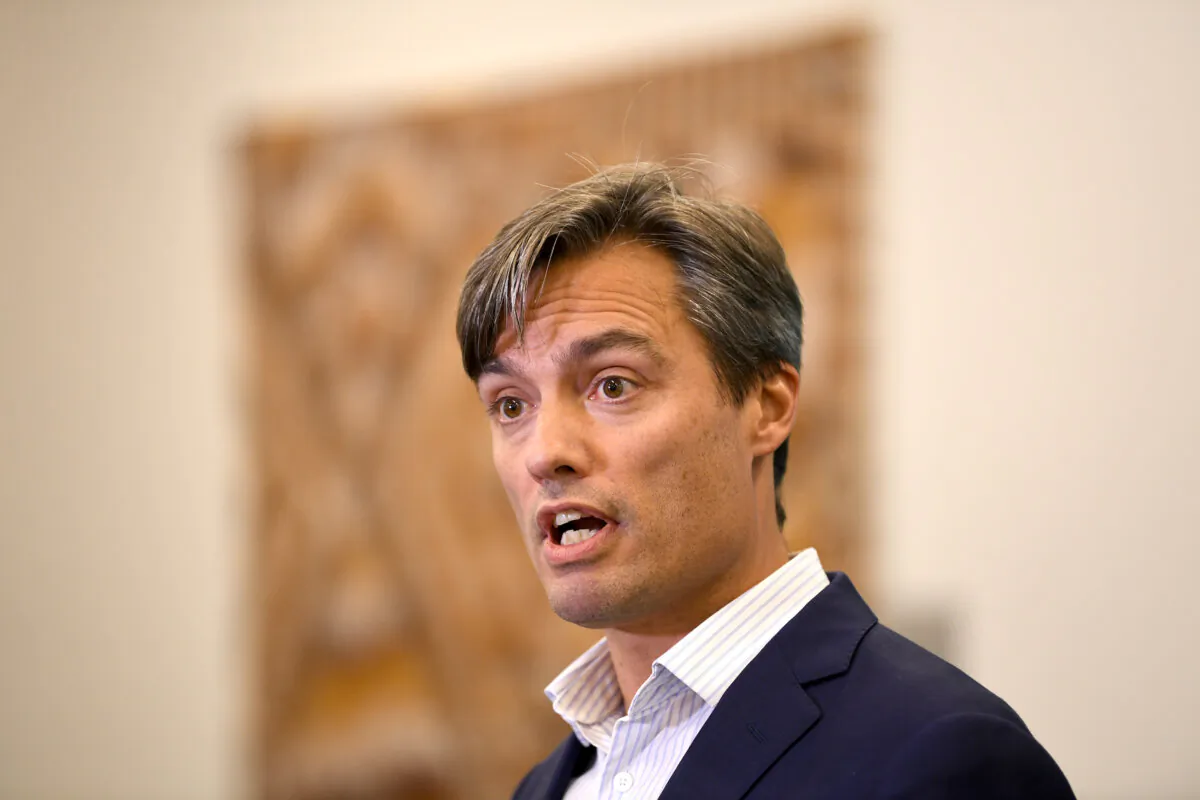

Former Deputy Chief Health Officer Dr. Nick Coatsworth has given a clear signal that he may enter politics, following weeks of speculation about his future.
The doctor—who became well-known for regular COVID-19 updates—acknowledged reports suggesting he is weighing a run for public office.
“I’m interested in the conservative side of politics. … I’ve seen over the past three decades of political interest, the healthiest democracy in Australia is served by a strong Labor Party and a strong Liberal Party,” Coatsworth told the ABC radio on Aug. 26.
“So I think if there’s anything that I can do to achieve the second, then that is on my mind over the next couple of years.”
Possible Run for ACT Senate
The remarks come after the Australian Financial Review reported that Coatsworth had addressed an invitation-only gathering of Liberal Party figures in Perth. The piece suggested he could be mulling a tilt at office, either in Western Australia or Canberra.
Although originally from Perth, Coatsworth has lived in Canberra since 2016 and confirmed he has spoken with ACT Liberals about a potential Senate run.
If he contests at the federal level, he would face Labor Finance Minister Katy Gallagher and independent Senator David Pocock.
The married father-of-three is currently the Ambassador for Health Reform at the Australian Patients Association and a regular medical commentator on Channel Nine.
Policy Support
Away from electoral speculation, Coatsworth has been vocal on policy issues.
During the pandemic, Coatsworth was critical of the heavy use of lockdowns and strict vaccine mandates.
Last week, he endorsed Health Minister Mark Butler’s proposed reforms to the National Disability Insurance Scheme (NDIS), which include a $2 billion program aimed at steering children with mild autism toward mainstream services rather than automatic NDIS entry.
Writing on X, Coatsworth praised Butler’s National Press Club speech.
“Speaking about the NDIS, he has articulated the core values of the program, its transformational benefits and the acute challenge of sustainability and erosion of social licence,” he said.
“Most importantly, a new mainstream approach to developmental delay and neurodiversity has been advanced, named Thriving Kids. An important shift worthy of support across the political spectrum.”
Coatsworth has also weighed in on the growing problem of specialist fees, which he said are pushing ordinary Australians to financial distress.
He said patients have reported gaps as high as $15,000 for surgery and $300–$400 for first consultations, with Medicare rebates covering only a small share.
“One of the things that we’re deeply concerned about at Patients Australia is the emergence of so-called administrative fees … those fees are invisible,” he said.
To address this, Coatsworth urged new laws requiring all practitioner charges—itemised and non-itemised—to be made visible to government and insurers. He argued it would help prevent hidden billing practices and give policymakers an accurate understanding of out-of-pocket costs.
He also called for the immediate rollout of the Medical Cost Finder, a long-promised online tool aimed at helping patients compare charges.
“We haven’t seen it yet,” he noted, pressing both major parties to deliver on their commitments.
 Friends Read Free
Copy
Facebook
Tweet
Friends Read Free
Copy
Facebook
Tweet