
Ontario Premier Doug Ford says a provincial judge’s ruling barring the Region of Waterloo from clearing a homeless encampment on a future transit project site is the “most ridiculous” decision he has ever seen.
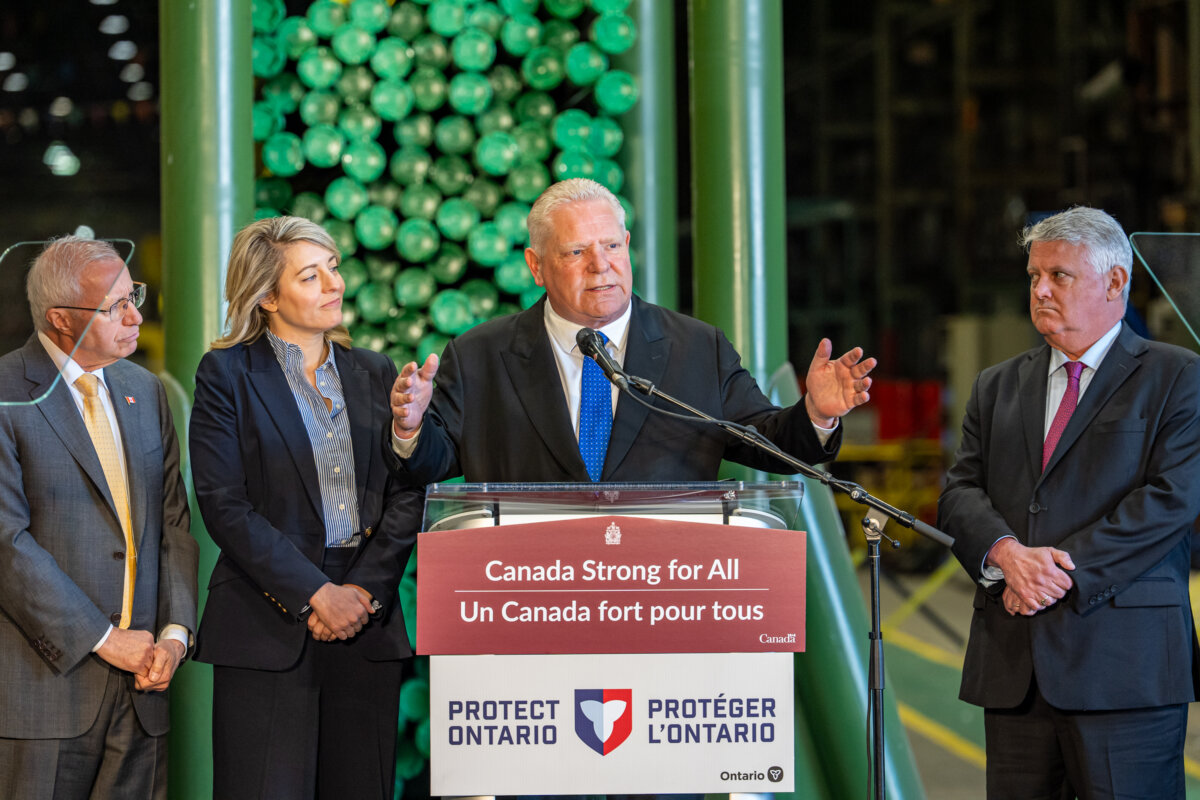
Ford was asked about the ruling by Justice Michael R. Gibson of Ontario’s Superior Court of Justice during an unrelated press conference in Sault Ste. Marie on May 22.
Gibson found in a decision released May 21 that a local bylaw created to allow Waterloo Region to evict about two dozen homeless people from a parking lot encampment in downtown Kitchener violates their rights under the Charter of Rights and Freedoms.
The Epoch Times reached out to the region for comment but did not immediately hear back.
The gravel lot at 100 Victoria Street North is to be used for storing construction vehicles and materials while the Kitchener Central Transit Hub (KCTH) is being built. The hub is a project between Waterloo Region and transportation agency Metrolinx that will combine several services, including GO Transit, VIA Rail, and inter-city bus service, into one central location. Scheduled to begin work in 2026, the KCTH is expected to be completed in 2030.
Ford expressed his displeasure with the court’s ruling, saying the judge’s decision will not only stall the project, but also prioritize the rights of a few dozen people over millions of future transit riders.
“It’s the most ridiculous ruling I’ve ever seen,” Ford told reporters, while noting that he has a “great deal of respect” for judges.
“But [Gibson] comes out with this cockamamie idea that they’re going to … hold up transit. So for what, 30 people, they’re going to hold up millions and millions of riders, communities and everything.”
‘Only Remaining Safety Valve’
In his 88-page decision, Gibson said the encampment in downtown Kitchener is “currently the only place” in the region where homeless people can legally set up a tent or structure.
“No one should romanticize or be starry-eyed about the Encampment,” the judge wrote. “It is a miserable and desperate place. But it represents the only remaining safety valve for the Region’s homeless as a refuge of last resort.”
There has been a marked escalation in homelessness and the presence of encampments since the COVID-19 pandemic, leaving cities and towns across Ontario struggling to deal with both the unhoused and an escalating number of drug overdoses.
In December 2021, homeless people began setting up tents on the Kitchener site, which caught the attention of Waterloo Region. Since 2022, the region has tried to dismantle the encampment through the courts, but has not been unsuccessful.
In January 2023, an Ontario Superior Court justice ruled that the legal remedies sought by the region deprived encampment residents of their rights to life, liberty, and security of the person. The justice found there were more homeless people in the region than available shelter beds.
Gibson in his May 21 decision noted that Waterloo Region has more than doubled its operating budget since 2022 for homelessness programs and services, from $30.9 million to $65.5 million, with corresponding increases in capacity.
“Despite this, the challenges have continued to grow,” he wrote, adding that the number of homeless people in Waterloo has risen from 1,085 in September 2021 to 2,371 by October 2024.
The judge ruled that the region cannot remove the 100 Victoria Street site unless it can provide “an alternative lawful encampment site of last resort, or a tenting protocol that facilitates access to essential services and healthcare on par with the current encampment.”
Gibson pointed to Ontario cities such as London and Thunder Bay that have created lawful designated encampment zones. He said should Waterloo Region proceed with similar measures, it could request a review or further direction from the court.
‘In His Backyard’
Gibson acknowledged that the proposed construction of the transit hub is “a genuine public interest,” but maintained that the project could still be completed “while respecting the rights” of encampment residents.
Ford suggested having the encampment residents set up camp at Gibson’s residence.
“I wish I could get that guy’s address and send 50 encampments in his backyard and see how he likes it,” the premier said on May 22.
In 2024, Ford announced he would consider using the notwithstanding clause to prevent courts from interfering with municipalities’ efforts to dismantle homeless encampments. His announcement came in response to a request from 12 cities asking the province for help in tackling both encampments and the addictions crisis.
In June 2025, the Safer Municipalities Act was passed in Ontario with the aim of clearing public spaces and ending the use of illegal drugs publicly. In January that year, the Ford government also announced a $75.5 million investment that includes measures to support homeless people in encampments with “access to reasonable alternative accommodation.”
At the municipal level, the councillors of Waterloo Region passed a site-specific bylaw for the 100 Victoria Street encampment site in April 2025, followed by an amendment in January of this year, with the goal of clearing the site this past April 1.
Ford said on May 22 that he had spoken with Waterloo Region chair Karen Redman, local mayors, and Attorney General Doug Downey about Gibson’s ruling.
Meanwhile, the Waterloo Region Community Legal Services, which represents the encampment residents, said in an update on its website May 22 that they are pleased with Gibson’s decision.
“We remain hopeful that the Region and all levels of government will move forward with thoughtful, lasting solutions to address homelessness,” it said.
Jennifer Cowan and The Canadian Press contributed to this report.
 Friends Read Free
Copy
Facebook
Tweet
Friends Read Free
Copy
Facebook
Tweet