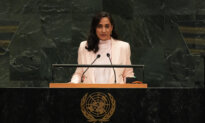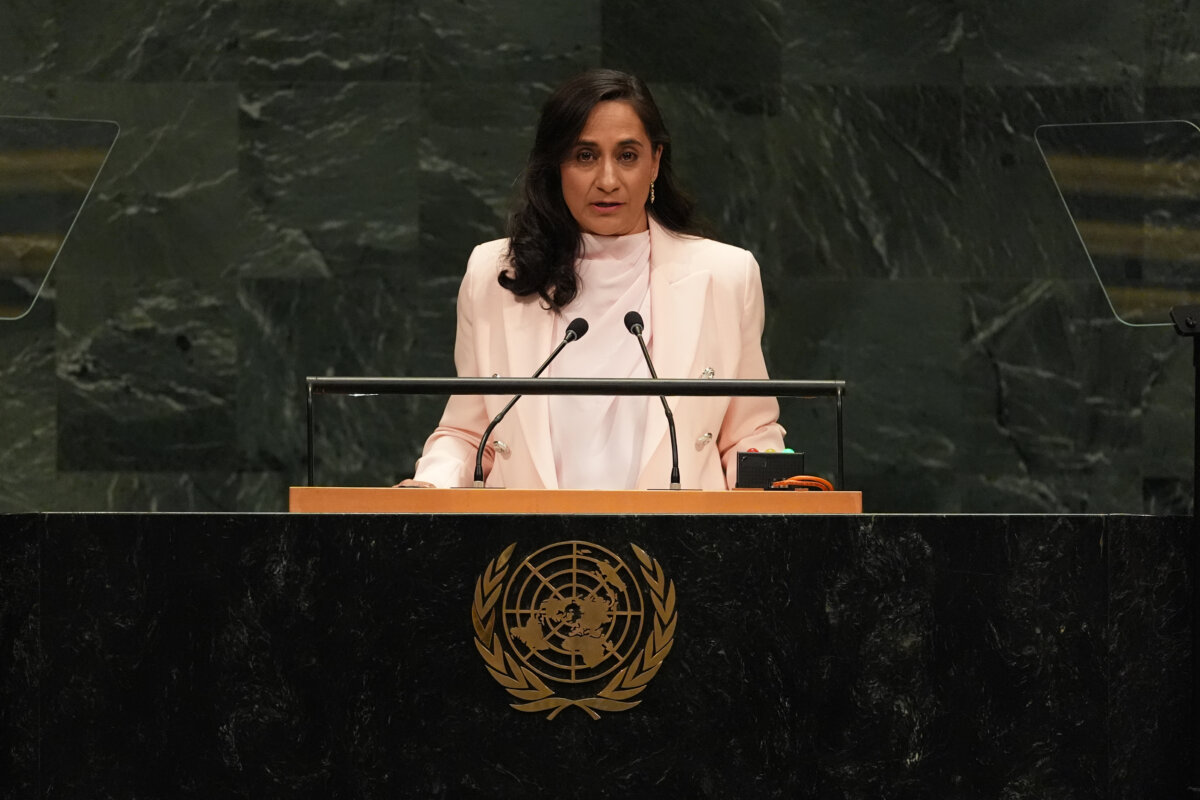

Foreign Affairs Minister Anita Anand said in her UN General Assembly address that Canada will pursue greater strategic autonomy and a more active middle-power role, echoing themes Prime Minister Mark Carney outlined at the World Economic Forum earlier this year.
“We are facing serious challenges in the global order, but at their core, Canadians and billions of others around the world want to live peaceful, prosperous, and predictable lives,” Anand said on Sep. 26.
Similar to Carney’s speech at the World Economic Forum (WEF) in Davos, Switzerland, in January, she levelled criticism at “great powers” with apparent references to the United States, while encouraging middle powers to “act collectively.”
“Great powers are walking away from global economic cooperation, dismantling economic integration,” she said, adding that the great powers show “disdain” for state sovereignty.
She also touted her government’s trade diversification efforts, naming China as one of the destinations with which her government is seeking to strengthen ties.
“We are exploring new opportunities with partners in the Indo-Pacific, the Gulf region, and Latin America. This includes building renewed partnerships with large economies like India and China,” she said.
“Canada’s goal is to achieve greater strategic autonomy—greater autonomy to make our own choices and to determine our own sovereign future.”
She said Canada believes in prioritizing coalition-building as an answer to global challenges, while adding that middle powers have a great role to play on the world stage.
“We are already forming these coalitions with small states, middle powers, and great powers alike,” she said.
“Middle powers are playing a key role in building the framework for the new international order, which is being established as we speak.”
Carney also spoke of the rivalry of “great powers,” and encouraged middle powers to band together. His speech in Davos came right after his visit to Beijing, where he indicated Ottawa wishes to pursue a “strategic partnership” with Beijing to be ready for a “new world order.”
In further indirect criticism likely directed at the United States and China without distinguishing between the two countries, Carney condemned measures such as the use of tariffs, which has been employed by both Washington and Beijing, and supply chain restrictions, which has been typically employed by Beijing.
“Great powers have begun using economic integration as weapons, tariffs as leverage, financial infrastructure as coercion, supply chains as vulnerabilities to be exploited,” he said.
U.S. President Donald Trump, who spoke at the WEF a day after Carney, criticized the Canadian prime minister for his speech, saying Carney “wasn’t so grateful” for the relationship with the United States, and revoked his invitation to be part of his newly formed Board of Peace.
 Friends Read Free
Copy
Facebook
Tweet
Friends Read Free
Copy
Facebook
Tweet