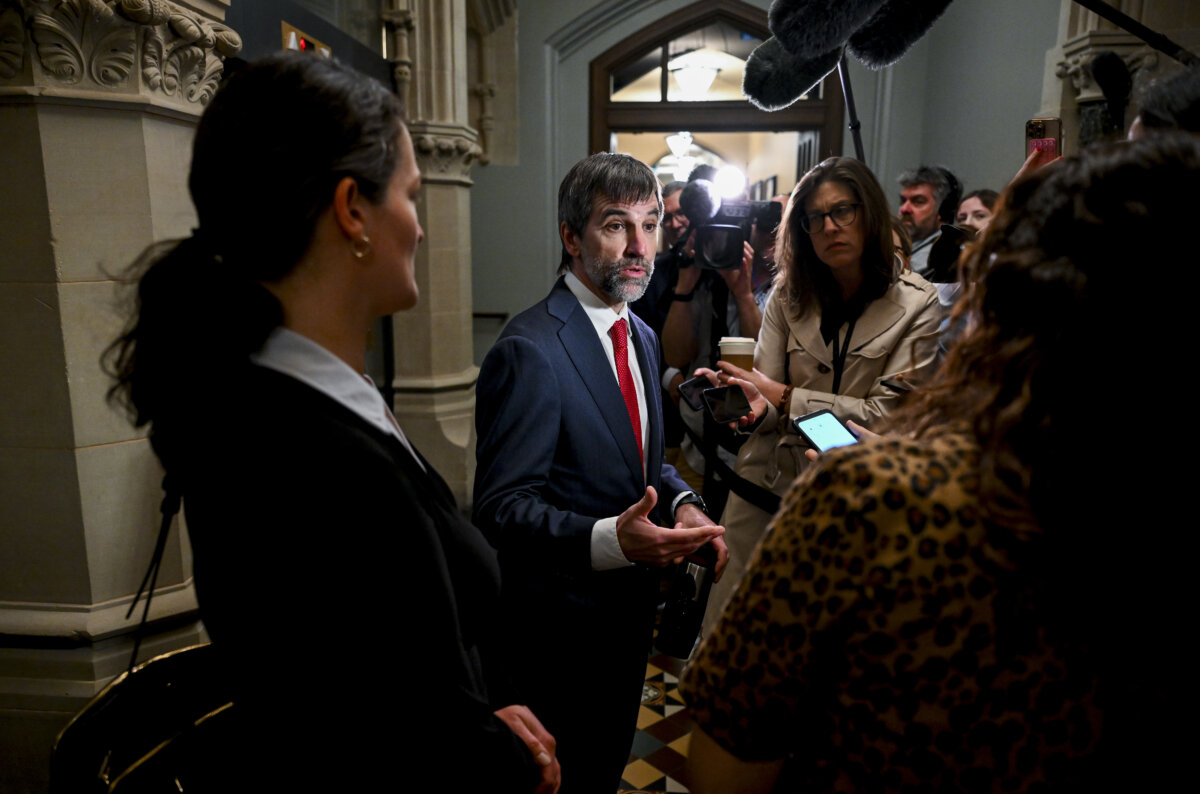

Liberal MP and former environment minister Steven Guilbeault says he is not the only member of the Liberal caucus concerned about the party’s shifting approach to climate policy under Prime Minister Mark Carney.
Guilbeault said in an interview with CTV News on May 27 that other Liberals are uneasy with the direction the government has taken on climate issues since Carney became prime minister.
“I think rightfully, some people—whether they’re Liberal caucus members, whether they’re Canadians at large—are wondering what is happening,” Guilbeault said on CTV’s “Power Play” with Vassy Kapelos.
The comments came the same day Guilbeault announced he will resign as an MP later this summer after “careful consideration” of his political future. He said he wants to “fight against climate change in a different way” outside of government.
When Guilbeault was asked later in the interview if other MPs were considering leaving, he answered that he was “not the only one who’s uncomfortable with what’s happening.”
Guilbeault served as minister of environment and climate change from October 2021 to March 2025. He later served as minister of Canadian culture and identity before resigning from cabinet late last year over his opposition to a memorandum of understanding signed by Carney and Alberta Premier Danielle Smith concerning pipeline development and net-zero emissions policies.
When asked if the MOU had led him to decide to quit politics, Guilbeault said it had.
“I wasn’t opposed to the idea of signing a memorandum of understanding with Alberta, but we shouldn’t do so at the expense of our plan to fight climate change,” he said.
Guilbeault said he disagrees “respectfully” with the approach that the Carney government is taking to the environment, as he does not believe the “markets will largely tackle the issue of climate change.” He said governments need to implement policies to reduce emissions and lower pollution, in addition to working with financial institutions and investors.
Guilbeault cited the Canadian Climate Institute as concluding Canada may only achieve an 18 to 21 percent reduction in greenhouse gasses by 2030—compared to an earlier 2024 estimate of a 36 percent reduction before 2030—because of the MOU.
“We’re not committing to being carbon neutral by 2050. We’re saying something like, ‘we’ll strive to be carbon neutral,’ but where we know that even that we won’t be able to achieve,” he said.
When Guilbeault was asked if the Liberal Party tried to persuade him to stay on as an MP, he said there was “some conversation with his office,” but the government was likely not “particularly pleased with the fact that I was being publicly vocal in my disagreement with the government on some of those issues.”
Prime Minister Carney reacted to Guilbeault’s resignation on May 27 by saying the two had “worked together closely in a variety of areas” and he had always enjoyed working with him. Carney also said in a statement that Guilbeault had always been “driven by his pursuit of a stronger, more inclusive, and more sustainable future.”
“Our government shares this commitment to climate ambition, climate competitiveness, and the preservation of Canada’s extraordinary natural heritage,” he said.
 Friends Read Free
Copy
Facebook
Tweet
Friends Read Free
Copy
Facebook
Tweet