
Iran said on Friday that it had launched a series of drone and missile attacks against U.S. military facilities in Kuwait, Bahrain, and Jordan, hours after American forces completed the 13th consecutive night of strikes aimed at degrading Tehran’s ability to threaten commercial shipping in the Strait of Hormuz.
Iran’s Islamic Revolutionary Guard Corps (IRGC) said it inflicted heavy damage at Ali Al Salem Air Base in Kuwait, according to a statement carried by Iranian state-run media outlet IRNA, which said that Iranian forces used “super-heavy” drones to strike a large ammunition depot and shelters housing U.S. personnel.
The claims could not be independently verified, and there was no immediate confirmation from U.S. or Kuwaiti officials regarding damage or casualties.
In a separate statement, the IRGC said it had destroyed the remaining section of a facility in Bahrain that it characterized as an intelligence data center belonging to U.S. technology company Amazon.
Tehran said the same facility had been targeted in an earlier operation. The assertion could not be independently confirmed.
Iran’s regular army separately said it targeted several U.S. positions in Bahrain and Jordan with drones, including aircraft hangars, maintenance facilities, and barracks.
Bahrain activated its warning sirens twice on Friday morning and urged residents to take shelter from detected incoming fire.
Gulf states hosting U.S. forces have faced repeated Iranian missile and drone attacks since the latest round of American strikes began.
The U.S. military has attacked Iranian military targets on consecutive days for nearly two weeks, prompting Tehran to retaliate against sites across the Gulf and wider region, including power and desalination plants.
President Donald Trump warned on Thursday that he’s considering ordering a more intense round of strikes against Iran to compel the country’s leadership to agree to a deal with the United States.
US Targets Iranian Threats
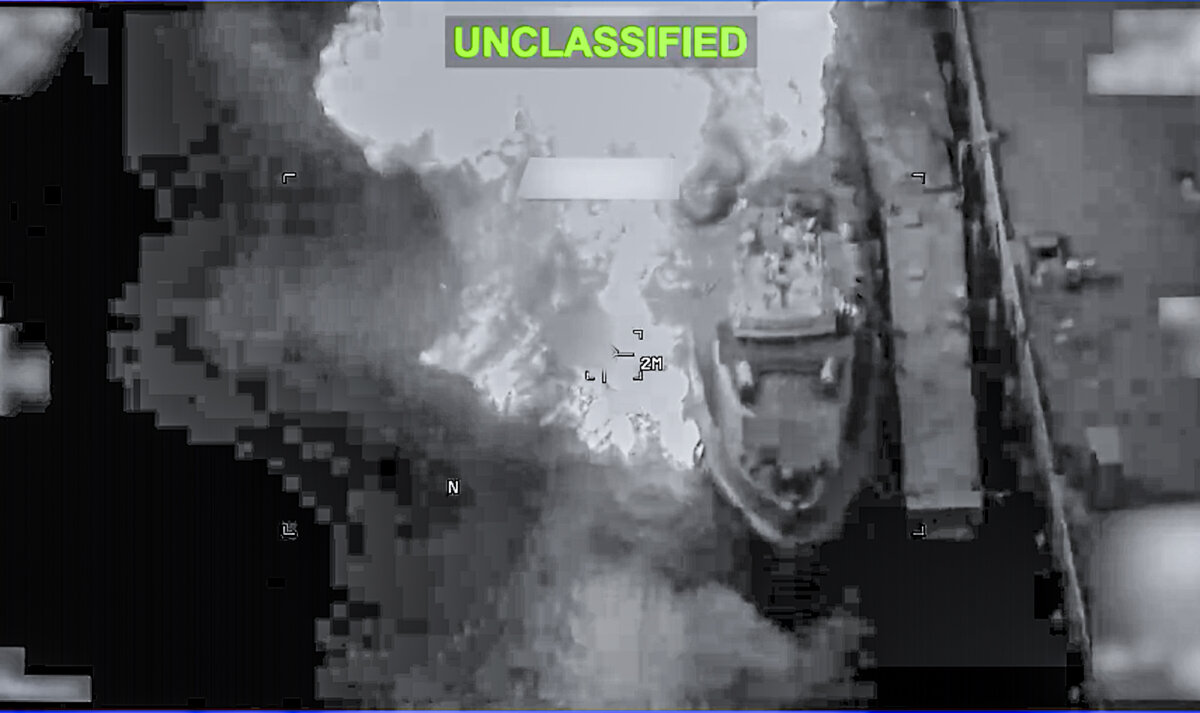
U.S. Central Command (CENTCOM) said early Friday that the latest American operation—the 13th consecutive round of strikes that concluded on Thursday evening—aimed to degrade Iran’s ability to menace commercial shipping in the Strait of Hormuz.
The attacks targeted Iranian military command centers, drone-storage facilities, communications networks, coastal surveillance sites, and maritime capabilities, according to CENTCOM.
“The international waterway remains open for transit despite recent attacks from Iran’s Islamic Revolutionary Guard Corps,” the command said of Hormuz.
“Commercial vessels continue to freely navigate the strait with U.S. military support.”
Despite U.S. efforts to support commercial shipping transit through the strait, tanker traffic remains sharply depressed, with ship-tracking data from Kpler showing just three vessels passed through the Strait of Hormuz each day from July 22 to July 24.
Roughly one-fifth of the world’s oil and gas supplies passed through the Strait of Hormuz in peacetime, with about 100 daily transits, according to data from the World Trade Organization.
Iranian state media reported that the U.S. strikes hit areas including Qeshm Island, Bandar Abbas, Isfahan, Khuzestan, and Fars province.
A series of explosions was also heard near a military base hosting U.S. forces in Irbil, northern Iraq.
An Associated Press reporter heard at least seven blasts at about 9:30 a.m. local time and saw several plumes of black smoke rising near or inside the base at the city’s airport.
It was not immediately clear what caused the explosions or whether the base had been directly hit.
Trump Weighs ‘Massive Attack’
Trump said on Thursday that he was nearing a decision on whether to launch a much larger attack against Iran.
“I am considering a massive attack. Bigger than ever before. I am close to making a decision. We are all set for it,” Trump told Axios, adding that Iran’s leaders “haven’t received enough pain yet.”
Trump also warned that Iran would be held responsible for any further attacks by Yemen’s Iran-backed Houthi terrorists after the group claimed it had struck the Saudi oil tankers Encelia and Layla in the Red Sea.
“If they do this again, the United States will hold Iran responsible, in that the Houthis are a Surrogate and/or Proxy of Iran, and major military punishment will be inflicted upon Iran and, of course, the Houthis, themselves,” Trump wrote on Truth Social.
The Houthi attacks raised the prospect of simultaneous disruptions at the Strait of Hormuz and the Bab el-Mandeb Strait, the gateway between the Red Sea and Gulf of Aden.
The move by the Iran-aligned Houthis could spell further trouble for the global energy market, already reeling from the Hormuz disruption.
Oil prices pulled back on Friday after jumping above $100 per barrel in the previous session. Still, they remained on course for substantial weekly gains as traders assessed the threat to two of the world’s most important energy-shipping routes.
Brent crude futures fell $3.44, or 3.4 percent, to $97.59 per barrel at about 8:22 a.m. ET.
The international benchmark settled more than 7 percent higher on Thursday, closing above $100 for the first time since May.
Despite Friday’s retreat, Brent remained on track for a roughly 10 percent weekly gain.
ING commodities strategists Warren Patterson and Ewa Manthey said oil prices were likely to move higher in the absence of de-escalation, with the latest disruptions potentially threatening more supply than at any previous stage of the war.
They said in a Thursday note that political pressure on the Trump administration to de-escalate would likely increase significantly if Brent approached $120 per barrel.
 Friends Read Free
Copy
Facebook
Tweet
Friends Read Free
Copy
Facebook
Tweet