Truckers and farmers have blocked roads and fuel infrastructure across Ireland in protest against soaring fuel costs and government taxes, while authorities warn that the army is being deployed to restore access.
Protest organizers say the demonstrations will continue unless the government engages directly and takes immediate action on fuel costs.
The unrest echoes the 2022 Canadian trucker protests over COVID-19 pandemic rules and the Dutch farmers’ demonstrations, which intensified across 2022–2023 over fuel costs and environmental rules.
Motorways Blocked
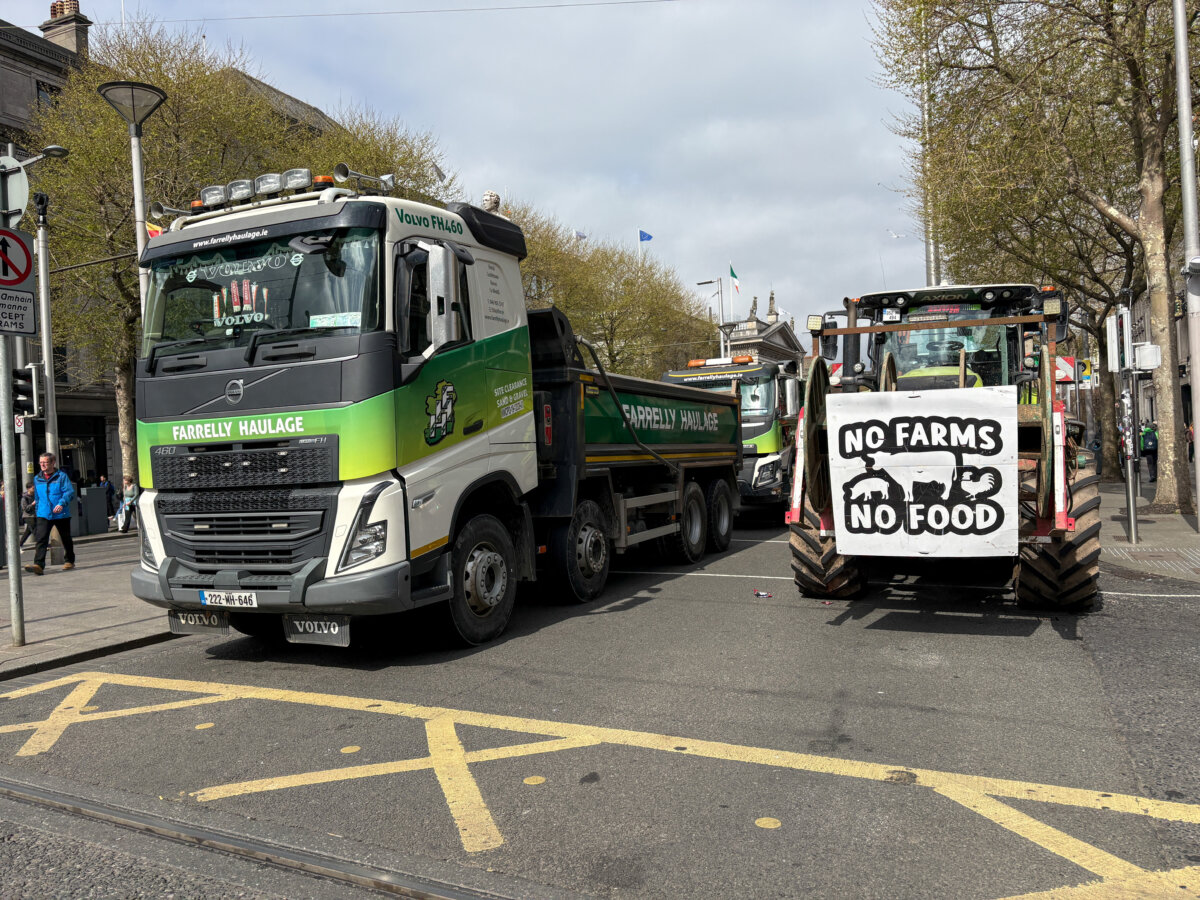
The Irish Times reported on April 9 that several coordinated, distinct protests are currently happening, including slow-moving convoys on motorways such as the M1 and M50 and blockades on key roads in Dublin.
Fuel protesters have also blocked the Whitegate oil refinery in east Cork.
A spokesman for the Irish Department of Justice, Home Affairs, and Migration told The Epoch Times by email that police have formally requested assistance from the Irish Defense Forces.
He also forwarded a statement issued on April 8 by Irish Minister for Justice Jim O’Callaghan, who said he had told Ireland’s police service, An Garda Siochana, that the “blocking of critical national infrastructure will not be permitted to continue.”
“Large vehicles blocking critical infrastructure will be removed,” he said.
“Owners of those vehicles should remove them immediately this morning and should not complain later about any damage caused to those vehicles during removal.”
Irish Minister for Transport Darragh O’Brien told Newstalk on April 8 that the government has ruled out negotiating with protesters, instead talking only with representative bodies.
‘We Don’t Want to Be up Here in Dublin’
John Dallon, a farmer from Castledermot in County Kildare and spokesman for the protesters, told The Irish Times on April 9 that they were calling for price caps on green and white diesel, the abolition of excise duty, and the suspension of carbon taxes during the ongoing Middle East conflict.
“We don’t want to be up here in Dublin,” Dallon said. “Everybody has work to do. But because of the situation, we are still here.”
He noted that the standoff could be resolved quickly if ministers agreed to talks.
“The government can clearly sort this out with a phone call and a meeting … and the city will be cleared,” he said.
Global oil price rises are now feeding into Ireland’s fuel costs. Shell CEO Wael Sawan warned on March 24 that a fuel crunch could soon spread from Asia to Europe amid continued disruption from the Middle East conflict.
Furthermore, fuel costs in Ireland are heavily influenced by taxation. Protesters say that a March 24 cut to excise duty of 15 euro cents (about 18 cents) per liter on petrol and 20 euro cents (about 23 cents) on diesel is not enough. Irish service stations have seen prices rising higher than 2 euros (about $2.34) per liter of unleaded fuel, a level last reached in 2022 at the start of the Ukraine conflict.
The carbon tax, a government levy applied to fossil fuels, is designed to reduce emissions and is set to rise annually until 2030, when it will reach 100 euros (about $117) per metric ton.
According to comparison site Bonkers.ie, the tax adds about 16 euro cents (19 cents) per liter of petrol and just more than 18 euro cents (21 cents) to diesel.
Images circulating on social media appeared to show military vehicles, including MOWAG armored personnel carriers, traveling in convoy near Limerick and the Port of Foynes, prompting speculation that they were being deployed in response to the protests.
However, the Irish Defense Forces said the footage was unrelated. In an April 9 statement on X, it said the vehicles were part of a routine mission-readiness exercise ahead of a U.N. Interim Force in Lebanon deployment next month.
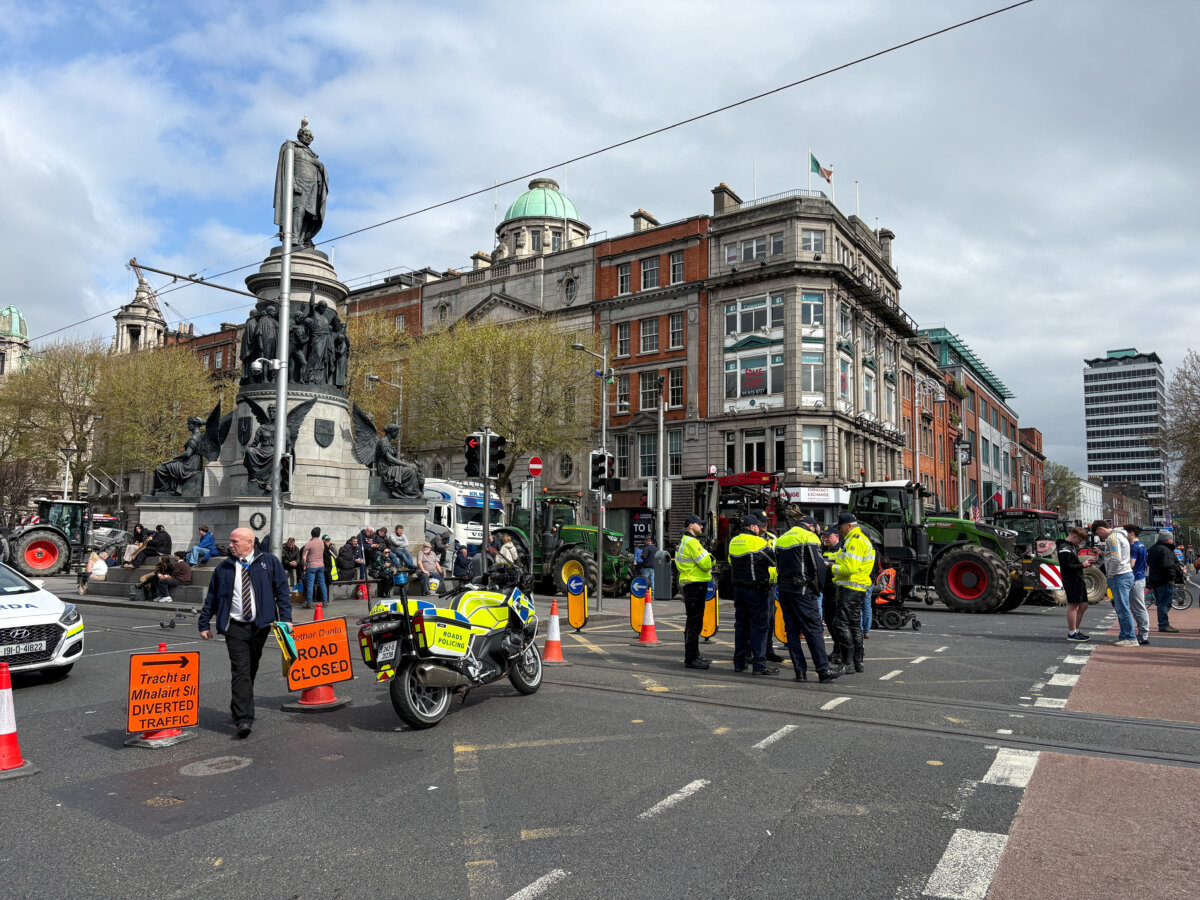 Police officers stand in the street as tractors block O’Connell Street in Dublin on April 8, 2026. (Conor Humphries/Reuters)
Protests ‘About Something Deeper’
Irish author and journalist John Waters told The Epoch Times that the situation in Ireland is “complex,” describing the country as “quite unique” compared with other European nations.
“Ireland has been extraordinarily obedient in the face of tyranny in the last few years,” he said.
“It doesn’t seem capable of summoning any kind of head of steam among the population.”
He said that this was largely because the population “is heavily propagandized to [by] the national broadcast … media, all of whom are bought and paid for by the government.”
However, he noted that these protests are “about something deeper.”
He said that “a lot of farmers have been … observing that they’re basically being driven off the land” and that farmers “are aware that they don’t have any friends anymore in government.”
“Essentially, there’s some kind of vague, unspecific, but determined threat to their livelihoods and to their right to produce food,” he said.
“That’s clearly an attempt to create conditions where people will be so desperate to get access to food and fuel that they will do whatever they’re told.
“That means, in this context, signing up to the Central Bank digital currency, which is coming, essentially finding themselves in a digital prison for life [along with] their children and their children’s children.”
“So I think quite a few people [are] aware of this,” he said. “They don’t necessarily talk about it. They’re talking about the diesel tax. … I think it speaks for other issues as well.”
Dublin City Councilor Gavin Pepper, who is at the protests, told The Epoch Times that they have “caused ripples all over the country in different parts.”
He said the farmers told him that “they’re not backing down.”
“I hope they don’t,” he said.
Police have warned that enforcement action will escalate if blockades continue.
In a statement to reporters at An Garda Siochana headquarters in Dublin’s Phoenix Park on April 9, An Garda Siochana Deputy Commissioner of Operations Shawna Coxon said protesters must “immediately cease blockades of such critical national infrastructure or face the full rigors of the law.”
“Despite our significant and prolonged engagement … it is clear that some people have significantly escalated an already difficult situation by targeting critical infrastructure such as fuel depots and refineries,” she said.
“These are no longer protests. They are blockades.
“These blockades are putting at risk supplies of food, fuel, clean water, and animal feed. These are critical for the nation and its people. This is not tolerable, and it is against the law.”
Reuters contributed to this report.
 Friends Read Free
Copy
Facebook
Tweet
Friends Read Free
Copy
Facebook
Tweet