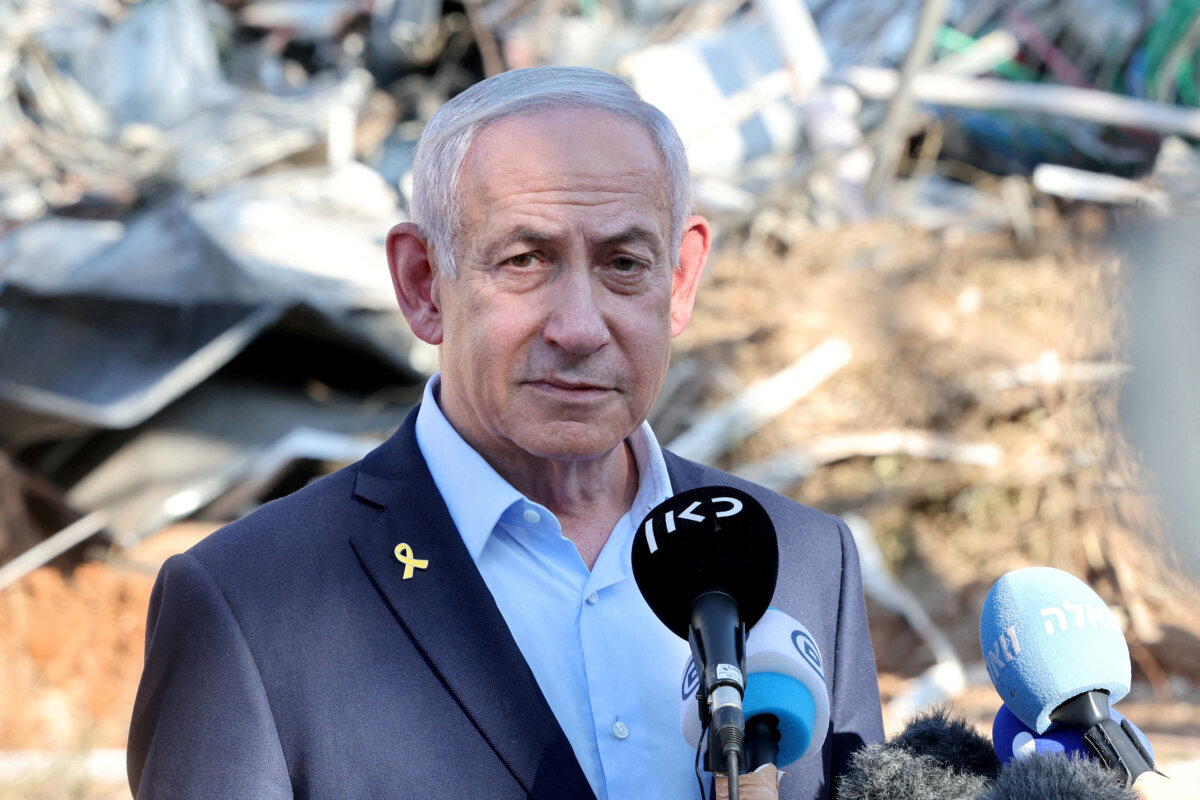

Israeli Prime Minister Benjamin Netanyahu said in a Fox News interview aired on March 2 that the U.S.–Israel military operation against Iran will not be “an endless war,” but that it could “take some time.”
Netanyahu also said that he doesn’t expect the military campaign—aimed at neutralizing Iran’s nuclear threat—to drag on for years.
“You’re not going to have an endless war,” the Israeli leader told the news outlet, saying the Iranian regime is at “the weakest point that it’s been since it hijacked Iran from the brave Iranian people 47 years ago.”
“This is going to be a quick and decisive action, and we’re going to create the conditions, first for the Iranian people to get control of their destiny, to form their own democratically elected government, which will make Iran a different Iran altogether,” he said.
Iranian Supreme leader Ayatollah Ali Khamenei was killed in the U.S.–Israel military attacks on Feb. 28, triggering retaliatory attacks from Iran and its regional proxies, including Lebanese-based armed group Hezbollah, which has targeted Israel.
Netanyahu said the operation seeks to pave the way for democracy in Iran for the good of the Iranian people and the region as a whole, but that it will be up to the Iranian people to decide their government.
“Iran has been the main engine of war over these years—95 percent of all the problems you see in the Middle East are generated by Iran,” he said.
Netanyahu said that military action was urgently needed to stop Iran’s nuclear weapons program, that he alleged Iran was rebuilding at new sites and underground bunkers that would make Iran’s “ballistic missile program and their atomic bomb program immune within months.”
“If no action was taken now, no action could be taken in the future,” he said. “We had to take action now, and we did. Otherwise, the Iranian mass murder regime would have immunity from future action.”
U.S. Secretary of State Marco Rubio said the United States’ objectives were similar.
“The objectives of this operation are to destroy their ballistic missile capability and make sure they can’t rebuild it, and make sure that they can’t hide behind that to have a nuclear program,” he told reporters on March 2.
He also warned Tehran that “the hardest hits” from the U.S. military on Iran are “yet to come.” The U.S. State Department has urged U.S. citizens living in Iran and its neighboring countries to leave immediately.
“I’m not going to give away the details of our tactical efforts, but the hardest hits are yet to come from the U.S. military,” he said. “The next phase will be even more punishing on Iran than it is right now.”
In retaliation for the U.S.–Israel strikes, Iran has launched a series of attacks on Israel and its neighboring Gulf nations, targeting U.S. and Israeli military bases in the region but also airports and hotels.
Those attacks drew condemnation from Gulf nations, including Oman, which has acted as a mediator in U.S.–Iran nuclear talks that ended without a breakthrough last month.
Ali Larijani, secretary of Iran’s Supreme National Security Council and a former Revolutionary Guards member, said the attacks were not targeted at those countries but the U.S. military assets they were hosting.
“When the bases located in your country are used against us, and when the United States carries out operations in the region relying on these forces, then we will target those bases,” he said on X.
Larijani said on March 1 that an interim leadership council will be set up to govern Iran until Khamenei’s successor is selected. The council consists of three members: President Masoud Pezeshkian, judiciary head Gholam-Hossein Mohseni-Eje’i, and Ayatollah Alireza Arafi.
 Friends Read Free
Copy
Facebook
Tweet
Friends Read Free
Copy
Facebook
Tweet