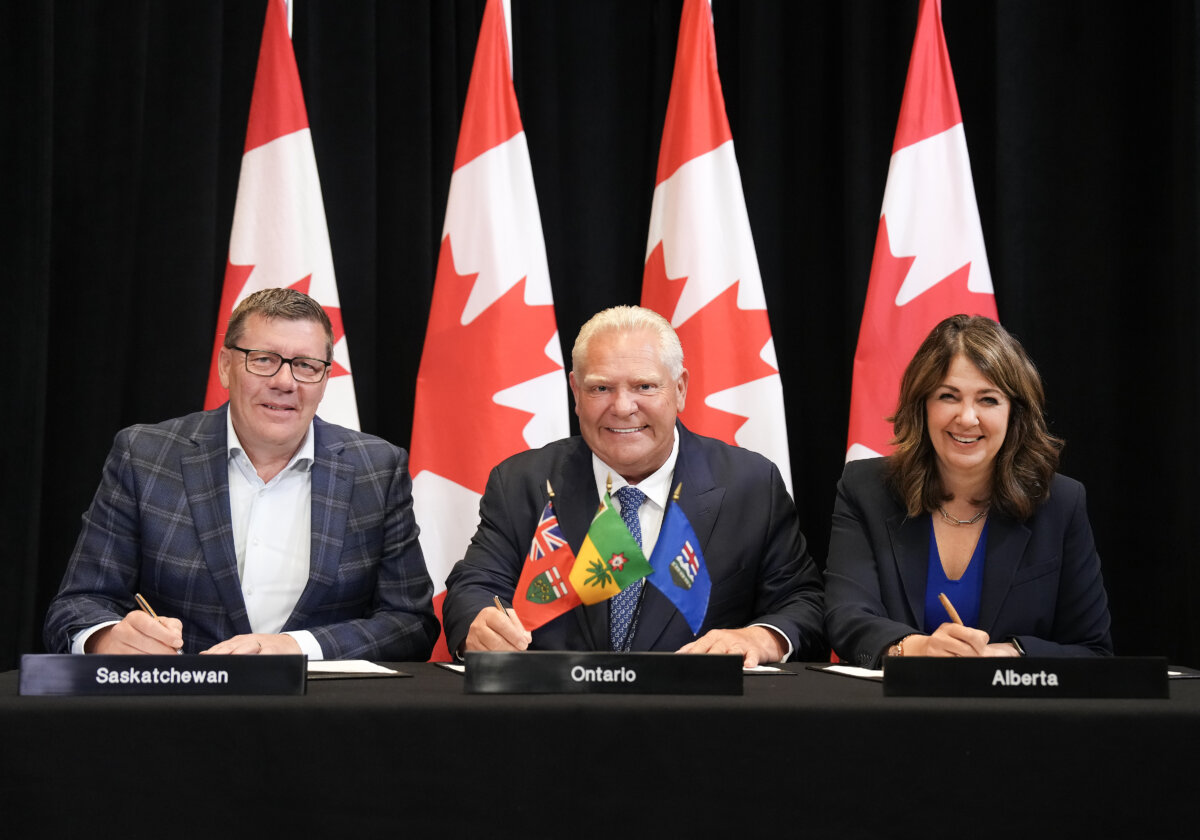

Alberta Premier Danielle Smith has been joined by the premiers of Ontario, Saskatchewan, and Quebec in calling for a “substantive role” in the selection of judges across different levels of courts in their provinces, as well as for the Supreme Court.
The four premiers sent a letter to Prime Minister Mark Carney on March 23 requesting reform in judicial appointments.
“We are calling for a new, collaborative approach, wherein our governments can meaningfully engage in filing judicial positions in our respective jurisdictions,” says the letter signed by Smith, Ontario Premier Doug Ford, Saskatchewan Premier Scott Moe, and Quebec Premier François Legault.
The premiers’ request pertains to appointments in the superior courts and courts of appeal, as well for the Supreme Court.
Under the federal judicial appointments process, the minister of justice “may consult” with provincial counterparts before selecting a candidate for the bench, but is not required to.
The premiers are asking that provinces be given a formal role in the appointment process, saying this would be in line with the principles of federalism. Federal judicial appointments should be made based on the recommendation and approval of provincial governments, the premiers say.
“The current model does not address the significant deficit of federal legitimacy of the superior court appointment process,” says the premiers’ letter to Carney. The letter says increasing involvement of the provinces would better reflect the diversity of each province and territory, and increase public confidence in the administration of justice.
Currently, government-appointed judiciary advisory committees established in each province and territory have the responsibility of assessing the candidates, with the power to appoint resting with Ottawa.
Justice Minister Sean Fraser rejected the premiers’ proposal when asked by reporters to comment on the issue on March 24.
“We haven’t changed our point of view that we believe that the judicial appointments process is functioning,” Fraser said before attending a cabinet meeting on Parliament Hill.
“We welcome provincial governments’ participation in that process and proactively reach out after we receive recommendations through the judicial advisory committees to test with our provincial counterparts whether they’ve got information about the reputation of the people we’re considering,” he said.
‘Meaningful Engagement’
The letter from the premiers comes a few weeks after Danielle Smith had called for Alberta to play a “formal and meaningful” role in the judicial appointment process.
Smith had written to Prime Minister Carney on Jan. 23, noting current vacancies on the Alberta Court of King’s Bench and the planned retirement of Supreme Court Justice Sheilah Martin. She said she expected “meaningful engagement” with Alberta before those positions are filled.
Smith told Carney her province would not provide the necessary funding to support any new judicial positions until engagement and collaboration take place.
The Alberta premier was joined in her latest call by conservative premiers in Ontario and Saskatchewan, and by Quebec Premier Legault, who will be stepping down after his CAQ party selects a new leader next month.
Ontario Premier Ford said he joined his colleagues in asking for reform in the appointment of judges given they are making “critical decisions on issues like bail reform, which directly impacts public safety in our province.”
Amid rising violent crime, the role of the courts and their enforcement of federal criminal laws have faced growing public and political scrutiny.
Under pressure from provinces, law enforcement, and Conservatives to enact reform, the Liberal government introduced Bill C-14, also known as the Bail and Sentencing Reform Act, which is currently being reviewed in the Senate. The bill aims to tighten bail rules to make it harder for violent and repeat offenders to be released on conditions.
Conservatives have also called for reforms to prevent non-citizen criminals from receiving lighter sentences. Several recent cases have seen judges give offenders lighter sentences in order to avoid negatively impacting their immigration status in Canada.
Tories have proposed a single amendment to the Criminal Code in their private member’s Bill C-220, which would prevent courts from taking into consideration the impact of a sentence on an offender’s immigration status.
 Friends Read Free
Copy
Facebook
Tweet
Friends Read Free
Copy
Facebook
Tweet