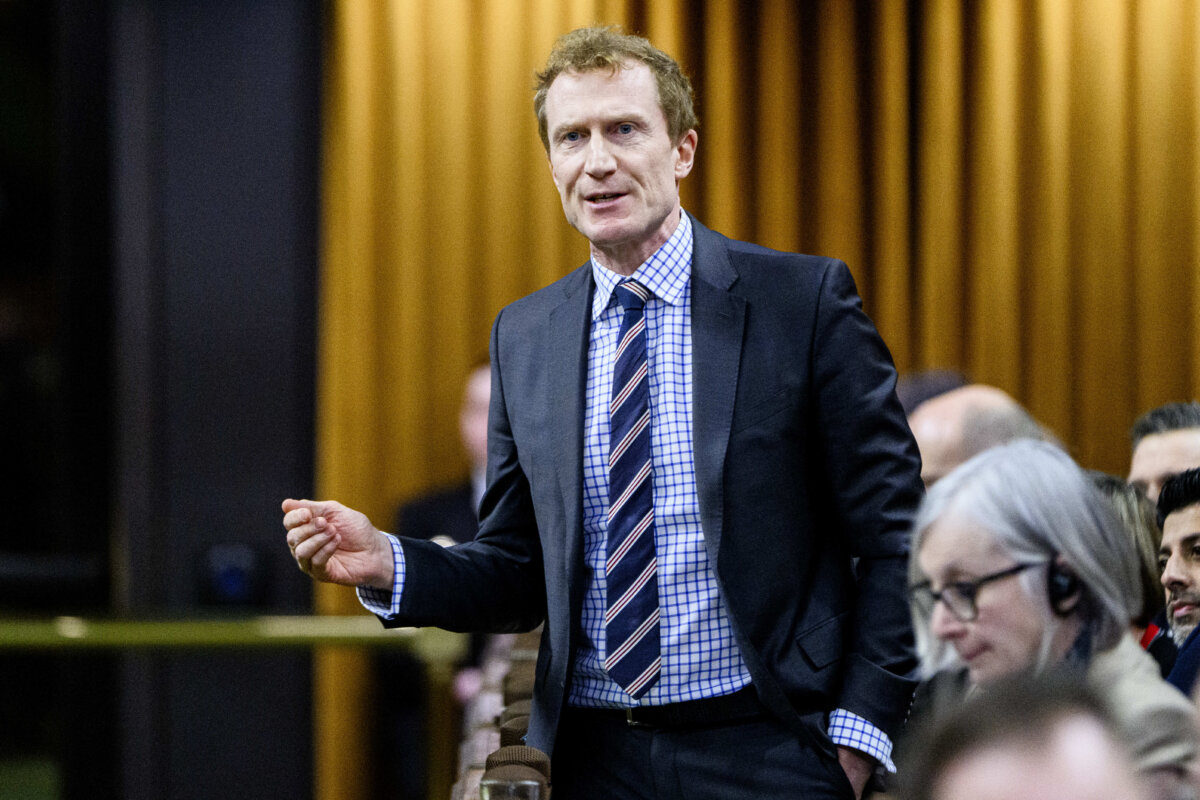

Ottawa is “very seriously” considering a social media ban for children and youth as a key part of addressing online harms, Culture Minister Marc Miller says.
Miller was questioned about the likelihood of such a ban by reporters in Ottawa this week, just days after members at the Liberal party convention in Montreal passed a non-binding resolution urging the government to establish 16 as the minimum age to access social media accounts.
“I respect and acknowledge the work that’s been done and the concern where that policy proposal came from,” Miller told reporters during an April 15 media scrum outside Parliament. “The grassroots have spoken. We do have to study that.”
Miller described the recommended ban as a potentially important tool, but said it would not address the larger issue of online harms.
“It’s clear that a ban or a moratorium on social media by kids, who we do need to protect, can be an important element, but it can’t be the only one,” he said. “I do think it could be an important layer, but it has to be seen as that and not as the answer to everything. Online harms don’t end as soon as you turn 15, or 16, or 17.”
The minister said there is no new information on the status or timeline for the introduction of a new online harms bill but that shouldn’t suggest it’s not a priority. He said legislation is in the works and the government is “seriously” thinking about adding a social media ban for children to the bill.
The upcoming legislation follows earlier federal efforts to regulate online harms, including Bill C-36 in 2021 and Bill C-63 in 2024, both of which did not pass before Parliament was dissolved.
Bill C-36 proposed a regulatory framework for harmful online content, but faced criticism over its scope, including concerns about definitions of harmful speech and the extent of proposed oversight powers.
The 2024 bill, also known as the Online Harms Act, placed a stronger emphasis on protecting children and addressing specific categories of harmful content. It proposed the creation of new regulatory bodies, including a digital safety commissioner and ombudsperson, and included amendments to the Criminal Code and human rights law, with stricter penalties for certain hate-related offences, including potential life imprisonment for crimes motivated by hatred.
Miller also noted that Liberal members voted at last weekend’s convention to regulate access to AI chatbots. He said as chatbots become more prevalent, their owners must bear responsibility if these platforms cause harm. Specific concerns raised included chatbots acting as “companions” that could reinforce harmful thoughts or encourage self-harm in vulnerable youth.
How much chatbots are addressed in the upcoming bill will depend on input from an expert advisory group formed last month, he said.
Recently achieving a majority government will make a difference when it comes time to present a new bill in the House, Miller added, but said the Liberals still hope to gain support from other parties.
Tories and NDP Weigh In
Representatives from the Conservatives and the NDP both expressed support for restrictions on chatbots and a ban on social media for children.
Conservative MP Michael Barrett said he supports a committee study and the opportunity to hear from experts on the topic. He said it is important to determine what such restrictions would look like and what ages the ban would cover.
“I think that when it comes to protecting young people from harms and from the risks that come with these social media platforms, with AI, I think that really everything should be on the table for consideration,” Barrett told reporters while leaving the House of Commons. “Parents have a big role to play as well, and we need to make sure that we set them up for success, and give them the tools to be able to to guide, teach, and protect their children.”
NDP parliamentary leader Don Davies said every parent in the country is concerned about their children accessing unsuitable content on the internet, and emphasized a need for government regulation in this area.
Davies said he didn’t want to comment specifically on age restrictions, but added that “some other countries are moving in that direction, so I think it’s something Canada should look at.”
Australia implemented the world’s first strict social media ban for children last December in a bid to protect the mental health of youth younger than 16. The law forces platforms like TikTok, Instagram, Facebook, Snapchat, and YouTube to take “reasonable steps” to block access, with potential fines up to $34.7 million for non-compliance.
Australia’s pioneering social media ban for youth is being used as a template by several other countries including France, Spain, Norway, Denmark, and Indonesia. The European Parliament is considering a minimum age of 16 for the entire EU and has created an age-verification app to allow users to prove their age without sharing personal data.
Similar restrictions are also being looked at in the UK and several U.S. states have already or are in the process of implementing legislation requiring parental consent for social media use by minors.
A national poll by Angus Reid last month found that such a ban would be supported by Canadians as well. The survey released on March 29 found that 75 percent of more than 4,000 respondents supported a ban in which those younger than 16 are prevented from setting up accounts on social media sites.
Eighty-eight percent of those surveyed said they would support a ban on TikTok, followed closely by 86 percent for X, 84 percent for Snapchat, and 77 percent for Instagram. A large majority—72 percent—also said they would like to see a ban on Facebook and Reddit, while only 48 percent wanted a ban on YouTube.
However, most individuals who favoured a total ban also said it is primarily the responsibility of parents to regulate their children’s social media activities, rather than that of the government, the survey found. The pollster called the results a “curious juxtaposition.”
Seventy-two percent of Canadians surveyed said parents should be primarily responsible for regulating teens’ social media use, not governments. That includes 70 percent of those who would support a full ban on social media use for those younger than 16.
The survey results appear to contradict the recommendation of the non-binding resolution put forward during the Liberal convention last weekend that Ottawa should enforce a ban rather than parents.
Justice Minister Sean Fraser told reporters the government isn’t bound by party members’ decisions and the law will reflect other feedback.
“We would give it the consideration that it deserves, but we want to make sure that we have the full benefit of the deep policy advice from people whose full-time job it is to understand the consequences,” he said on April 15. “Resolutions that are adopted by the party obviously have a broad base of political support, but they aren’t necessarily benefiting from the same level of advice and consideration.”
Public Safety Minister Gary Anandasangaree offered similar comments during April 15 media scrums. He said the government would take the will of the convention into consideration, but added that government policy is “informed by a range of different stakeholders.”
“This was a convention with over 4,500 people, a very loud voice and a very significant voice,” Anandasangaree told reporters. “But we’ve also heard from Canadians from coast to coast to coast on ensuring greater safety and security for kids.”
The Canadian Press contributed to this report.
 Friends Read Free
Copy
Facebook
Tweet
Friends Read Free
Copy
Facebook
Tweet