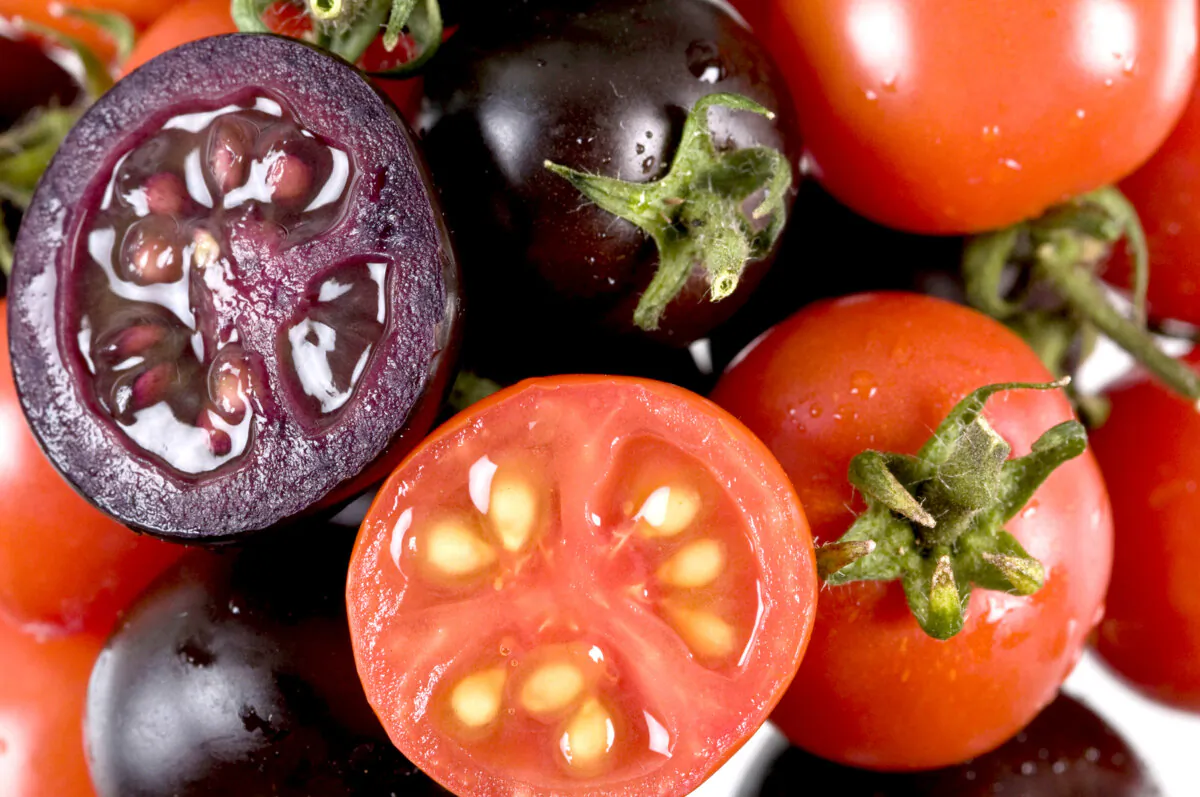

Farmers across Ontario and British Columbia have signed a statement raising concern over the possible sale of genetically modified (GM) seeds to small-scale producers and home gardeners in Canada, saying it could lead to the contamination of organic and traditional seeds.
The statement, signed by more than 160 farmers, comes as biotechnology company Norfolk Healthy Produce has signalled plans to sell purple tomato seeds in Canada by the end of the year. The genetically modified tomato, featuring purple fruit flesh, was approved as safe for consumption by Health Canada and cleared for environmental release by the Canadian Food Inspection Agency (CFIA) this past summer.
The company says the purple tomato represents a “remarkable breakthrough in nutrition,” as it contains more antioxidants than regular tomatoes due to the presence of anthocyanin pigments that give fruits like blueberries and blackberries their purple colour. The tomato’s ability to produce these pigments comes from two genes sourced from the snapdragon flower. The company says its product has been “meticulously reviewed” through regulatory processes to ensure safety.
Mel Sylvestre, a farmer at Grounded Acres Organic Farm in Gibsons, B.C., says the sale of genetically engineered (GE) seeds could jeopardize farmers’ ability to provide consumers with organic and other non-GM choices.
“If widely planted by gardeners across the country, these GE seeds pose an unnecessary contamination risk that could threaten heritage seeds and our tradition of seed saving,” Sylvestre said in a Dec. 16 press release by the Canadian Biotechnology Action Network (CBAN), a group that advocates for mandatory labelling of GE products.
Norfolk Healthy Produce began selling the seeds of its bioengineered purple tomatoes in the United States in early 2024, following regulatory approvals in 2022 and 2023. In Canada, the purple tomato was approved as a safe food by Health Canada and for environmental release by the CFIA, both on Aug. 12.
On its website, the company lists seeds available only in the United States. It did not respond to an Epoch Times inquiry about when it plans to start selling seeds in Canada. In an email to CBAN, the company said it hopes to begin sales before the end of the year.
“We are still working on the most efficient and cost-effective way to fulfill Canadian orders,” the company said in a Dec. 2 email reviewed by The Epoch Times. “We expect to be able to complete Canadian orders by the end of the year.”
Regulatory Approvals in Canada
Norfolk Healthy Produce submitted an application to Health Canada to approve purple tomatoes for food use on Sept. 10, 2024, and earlier this year, the health agency issued its approval after assessing its safety as a novel food.
Novel foods are new products without an established history of safe use as a food in Canada. To be approved for sale, they must undergo a mandatory pre-market safety assessment in which Health Canada scientists evaluate the product’s safety.
Health Canada evaluated the tomato for food use, while the CFIA assessed the potential impacts of growing it in Canada, granting approval for unconfined release on Aug. 12. Unconfined release means the organism can be released into the environment with few or no restrictions, usually for commercial growing and sale.
The agency has yet to issue a decision document summarizing its assessment of the tomato’s environmental safety.
The CFIA evaluated the purple tomato as a plant with novel traits, which are organisms with characteristics new to the Canadian environment. A plant with novel traits can only be authorized for unconfined release after the CFIA’s Plant Biosafety Office determines it does not pose a risk to the environment or human health.
The CFIA says its process to authorize plants with novel traits to be grown in Canada “is based on a rigorous, science-based environmental safety assessment.” Unconfined release includes a permission to cross the plant with novel traits with other plants to develop new varieties.
“This way, plant breeders are free to introduce a novel trait into different varieties of a crop that are adapted to meet the needs of farmers,” says the agency.
Norfolk Healthy Produce says the purple tomatoes offer a nutritious variety of the fruit and expand consumer options.
Concerns
The farmers’ statement, titled, “Protect Our Seeds From New GMOs” opposes the sale of GE seeds in Canada and was signed by 163 growers, according to CBAN. It reads, “We, farmers, gardeners and seed savers, oppose the sale of gene-edited and other genetically engineered seeds to small growers, market gardeners and home gardeners in Canada.”
It cites the risk of GE contamination as a concern along with the lack of mandatory labelling.
CBAN coordinator Lucy Sharratt says all genetically modified foods and seeds should be labelled to ensure consumer transparency.
“The federal government’s failure to require mandatory transparency on genetically engineered garden seed creates unnecessary risks for farmers and will add to consumer concerns,” she said in the Dec. 16 release.
Canada does not require mandatory labelling for genetically engineered food or seeds. The CFIA regulates novel plants based on their traits, not the techniques used to create them, which can include methods such as genetic engineering, gene editing, or traditional breeding.
 Friends Read Free
Copy
Facebook
Tweet
Friends Read Free
Copy
Facebook
Tweet