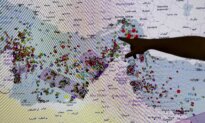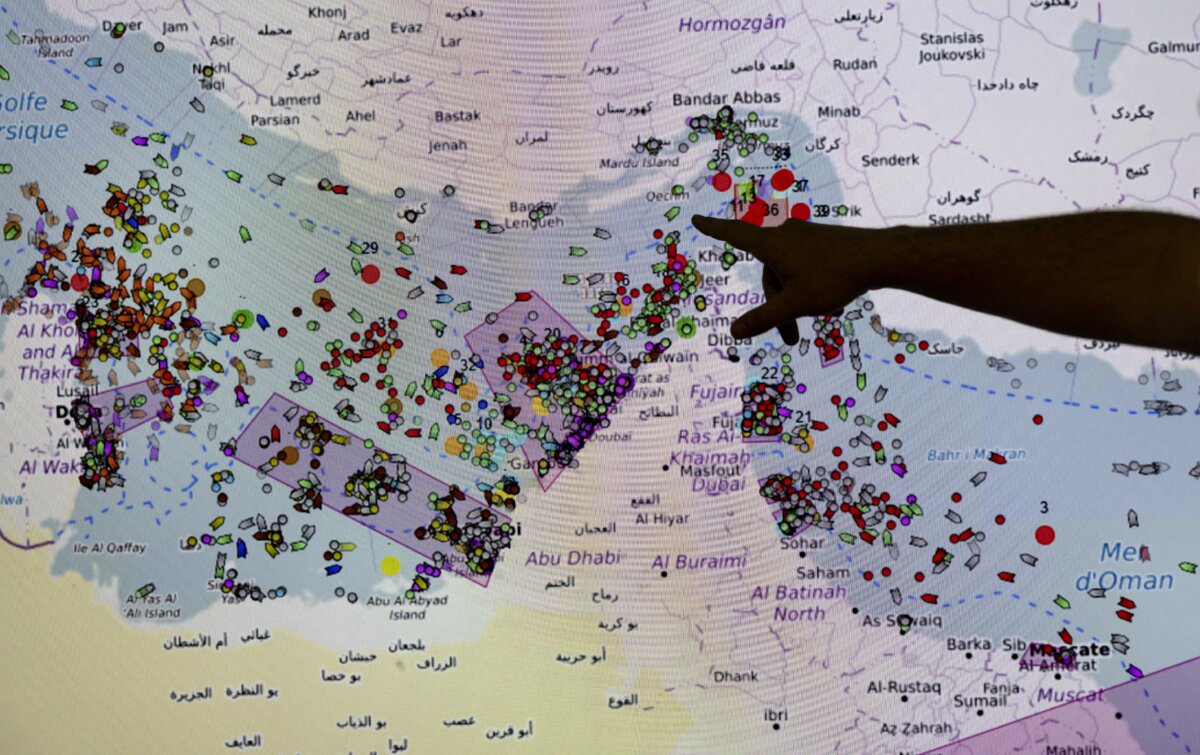

A maritime operations center said that the risk posed to commercial vessels traveling in the Strait of Hormuz is “severe” after multiple tankers were struck by projectiles in the waterway this week as the U.S. military responded by launching fresh strikes against Iran.
The U.S. Navy-led Joint Maritime Information Center (JMIC) on Tuesday raised the strait’s “threat level to severe” after three attacks were reported this week as well as Iran’s “sustained monitoring of commercial shipping and a continued intent to assert presence across key transit lanes.”
“Commercial traffic through the Strait of Hormuz remained steady, with vessels continuing to transit via both the southern Omani corridor and the northern Iranian-controlled route,” Tuesday’s notice said. “Reporting does not indicate a sustained increase in movements along the southern corridor; instead, traffic patterns appeared stable following the widening of the southern route. Use of the northern route continued, though overall volumes remained difficult to assess.”
It also noted that U.S. military assistance of commercial transits has proceeded without interruption despite the higher threat level in the strait.
It is unclear whether Iranian attacks and the U.S. military response will lead to another full-scale interruption of shipping traffic through the strait, which prior to joint U.S.–Israeli attacks on Iran on Feb. 28, was used to transit about one-fifth of the world’s oil and gas supplies. After the attacks, Iran moved to try and block traffic in the strait, sending gas and oil prices surging.
During remarks on Wednesday at a NATO summit in Turkey, U.S. President Donald Trump said that he believes an interim agreement with Iran may be finished.
“To me, I think it’s over. I don’t want to deal with them anymore,” he said.
“I’ll speak to our negotiators. They want to negotiate. They’re good people,” he said, referring to U.S. special envoy Steve Witkoff and his son-in-law Jared Kushner, who were involved in talks with Tehran.
“But they have to come back to me. As far as I’m concerned, it’s just a waste of time dealing with” the Iranian regime, he added.
Trump later said, “There is something wrong with them,” referring to Iranian officials. The U.S. president also reiterated his assertion that Iran cannot be able to obtain a nuclear weapon.
Late on Tuesday evening, the U.S. Central Command (CENTCOM) said that it launched strikes against Iran after ships were attacked while transiting the Strait of Hormuz. At the same time, the Trump administration revoked a sanctions waiver that allowed Iran to sell oil, as laid out under a memorandum of understanding signed between the two parties in June.
Iran’s top negotiator and its parliamentary speaker, Mohammad Bagher Ghalibaf, responded to the new round of strikes by claiming the United States violated the agreement.
“The era of bullying and extortion is over. It leads nowhere. We don’t fold,” Ghalibaf wrote in a post on X.
Iran has been holding a massive, days-long funeral for its former top leader, Ayatollah Ali Khamenei, who was killed early on in the conflict by U.S.–Israeli strikes. The country named his son Mojtaba Khamenei to the top leadership position in mid-March, but he has not been seen in public since then.
 Friends Read Free
Copy
Facebook
Tweet
Friends Read Free
Copy
Facebook
Tweet