Typhoon Jebi has been downgraded from a super typhoon and is forecast to make landfall in Japan on Sep. 4 local time, according to the National Oceanic and Atmospheric Administration (NOAA).
NOAA announced a forecast for the continuing weakening of Jebi over the next few days from what were category 5 winds when it was upgraded to a super typhoon on Aug. 31.
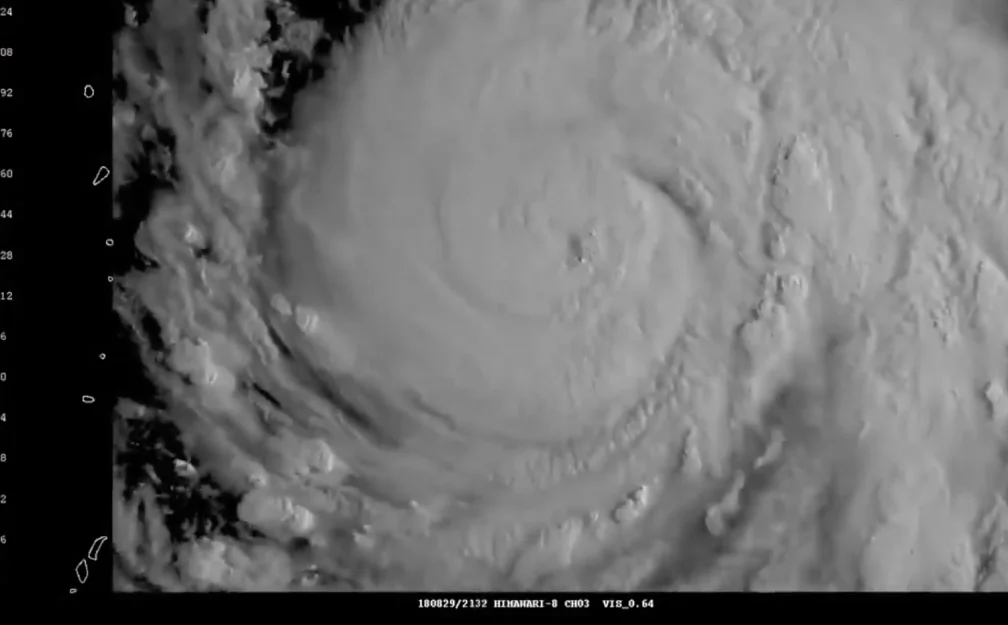
Check out this imagery #Himawari8 captured today of a 4-pointed star-looking cloud feature rotating in the middle of the eye of Super Typhoon #Jebi. The storm is expected to track northwest toward Japan in the coming week. More imagery: https://t.co/wNd7IzB944 pic.twitter.com/OGQMHZzPTz
— NOAA Satellites (@NOAASatellites) August 31, 2018
AccuWeather Senior Meteorologist Adam Douty said that although there is some weakening to be expected before landfall, Jebi would likely still be the equivalent of a category 3 hurricane upon landfall.
“Highest sustained winds at landfall can be about 175-210 km/h (110-130 mph), which will have the potential to cause significant damage,” he said. “Some wind gusts near the coast could be higher than this.”
Airlines have been forced to issue travel waivers due to Typhoon Jebi.
We’ve issued a travel waiver for September 3-5 due to the forecasted path of Typhoon Jebi. See full details here: https://t.co/QCt5ut617R.
https://t.co/QCt5ut617R— Delta (@Delta) September 1, 2018
Evacuations Underway
More than 20,000 Japanese residents living in the central and northeastern parts of the country have already received orders to evacuate, reported Newsweek.
Jebi expected to make landfall on Japan’s largest and most populous island Honshu, with the prefectures of Mie, Aichi and Shizuoka on the east coast most at risk from destructive winds, heavy rain, and flooding.
The big cities of Osaka, Kyoto, Nagoya, and even Tokyo are all at risk of being hit with Jebi’s destructive winds. The cities at risk will become clearer when the massive storm system makes landfall.
According to the Saffir-Sampson Hurricane Wind Scale, a Category 3 hurricane can cause major damage, even to well-built homes, and uproot trees and electricity polls.
The most destructive storm in U.S. history was a Category 3 storm. The destruction from Hurricane Katrina cost a total of US$161 billion, according to NOAA.
Heavy rain has caused a lot of death and destruction in Japan already this year. The country was hit by two typhoons and a severe tropical storm in August. Two hundred people were killed from landslides after torrential rain in July. The summer month also saw some 80 deaths due to a record-breaking heatwave.
 Friends Read Free
Copy
Facebook
Tweet
Friends Read Free
Copy
Facebook
Tweet