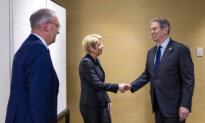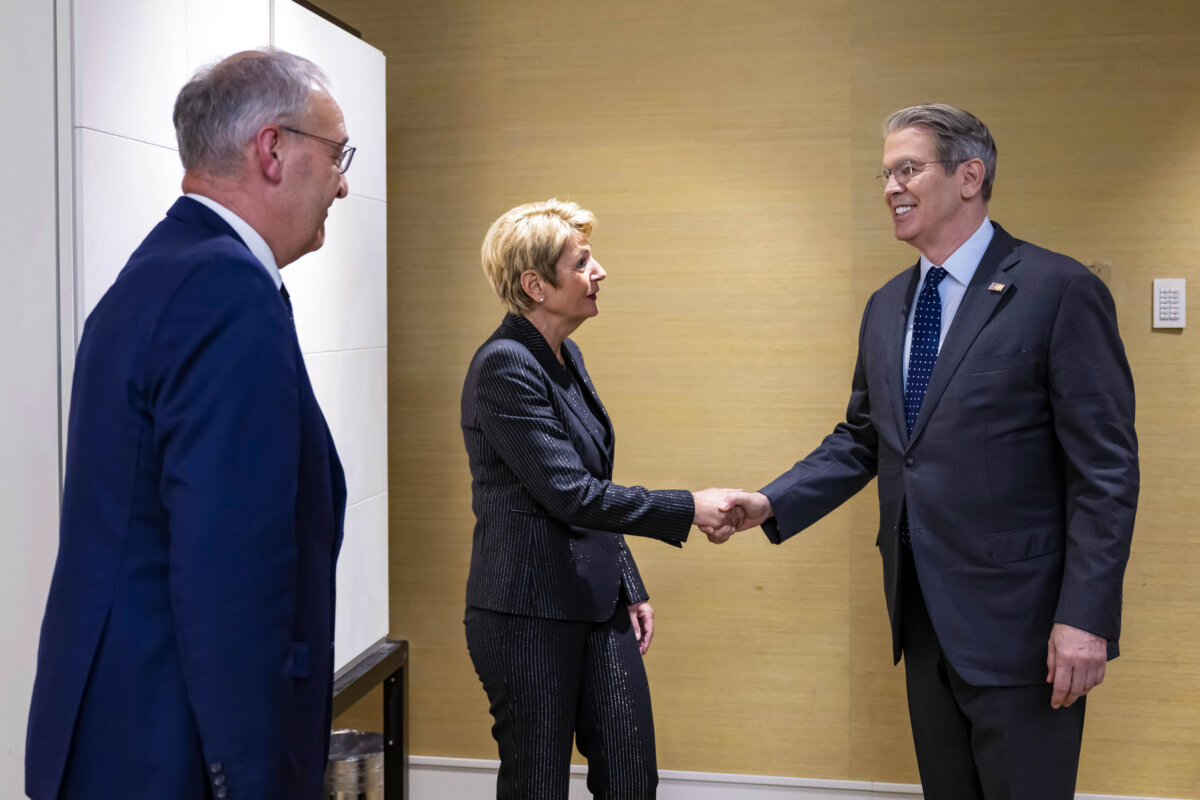

Swiss President Karin Keller-Sutter and Economy Minister Guy Parmelin will fly to Washington on Tuesday for talks aimed at avoiding the 39 percent tariffs U.S. President Donald Trump announced last week.
The 39 percent levy, announced on July 31, is set to take effect on Thursday and would mean Swiss companies face one of the steepest export duties. Only Laos, Burma (also known as Myanmar), and Syria have higher rates, at 40 to 41 percent. The 27-member European Union has tariffs of 15 percent. The UK negotiated 10 percent tariffs.
Keller-Sutter and Parmelin will “facilitate meetings with the US authorities at short notice and hold talks with a view to improving the tariff situation for Switzerland,” the Swiss government said in an Aug. 5 statement.
“The aim is to present a more attractive offer to the United States in a bid to lower the level of reciprocal tariffs for Swiss exports, taking US concerns into account.”
The government did not specify which parts or members of the U.S. government they were scheduled to meet, or whether a conversation with Trump was planned.
Hans Gersbach, an economist at KOF Swiss Economic Institute at ETH, a University in Zurich, said the Swiss delegation would have to offer something substantial to get the rate dropped.
“Something marginal won’t be enough, it has to be a significant number, which Trump can present to his supporters as a victory for his negotiations,” Gersbach said. “It’s crucial Keller-Sutter and Parmelin meet Trump and speak with him directly. He is the decision-maker.”
The Swiss government said on Monday it was ready to revise its offer to Washington to avoid the steep tariff.
The Federal Council, Switzerland’s collective head of state that functions in a similar way to a cabinet, held an emergency meeting that day and said it was ready to pursue negotiations beyond the Aug. 7 deadline.
Switzerland did not provide details of what extra incentives could be offered to secure a better deal, but it did say it was not considering any countermeasures against the United States.
On Monday, Parmelin suggested that one of the options could be Switzerland opting to buy American liquefied natural gas, and another could be further investments in the United States by Swiss companies.
The 39 percent levy would seriously harm the Swiss economy, with the United States being the country’s biggest export market for its pharmaceuticals, machinery, and world-famous watches.
For example, the American market accounted for 16.8 percent of sales of luxury Swiss watch exports in 2024, with sales amounting to about $5.4 billion.
Trump said on Friday that his main issue with Switzerland was the deficit, telling reporters the problem was that “we have a $40 billion deficit with Switzerland,” adding, “that’s a big deficit.”

Economiesuisse, the umbrella organization for the Swiss business sector, issued a statement criticizing the tariffs after they were announced on Friday, saying there is “neither justification nor any understandable reason why Switzerland should be subject to one of the highest tariff rates in the world.”
“Switzerland does not restrict the import of US products – neither through tariffs nor through other trade barriers,” the organization said. “Moreover, Switzerland is the sixth-largest foreign investor in the United States, with Swiss companies responsible for around 400,000 jobs in the US.”
On Monday, the Swiss stock market opened 1.9 percent lower, according to Bloomberg.
Reuters contributed to this report.
 Friends Read Free
Copy
Facebook
Tweet
Friends Read Free
Copy
Facebook
Tweet