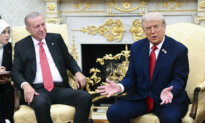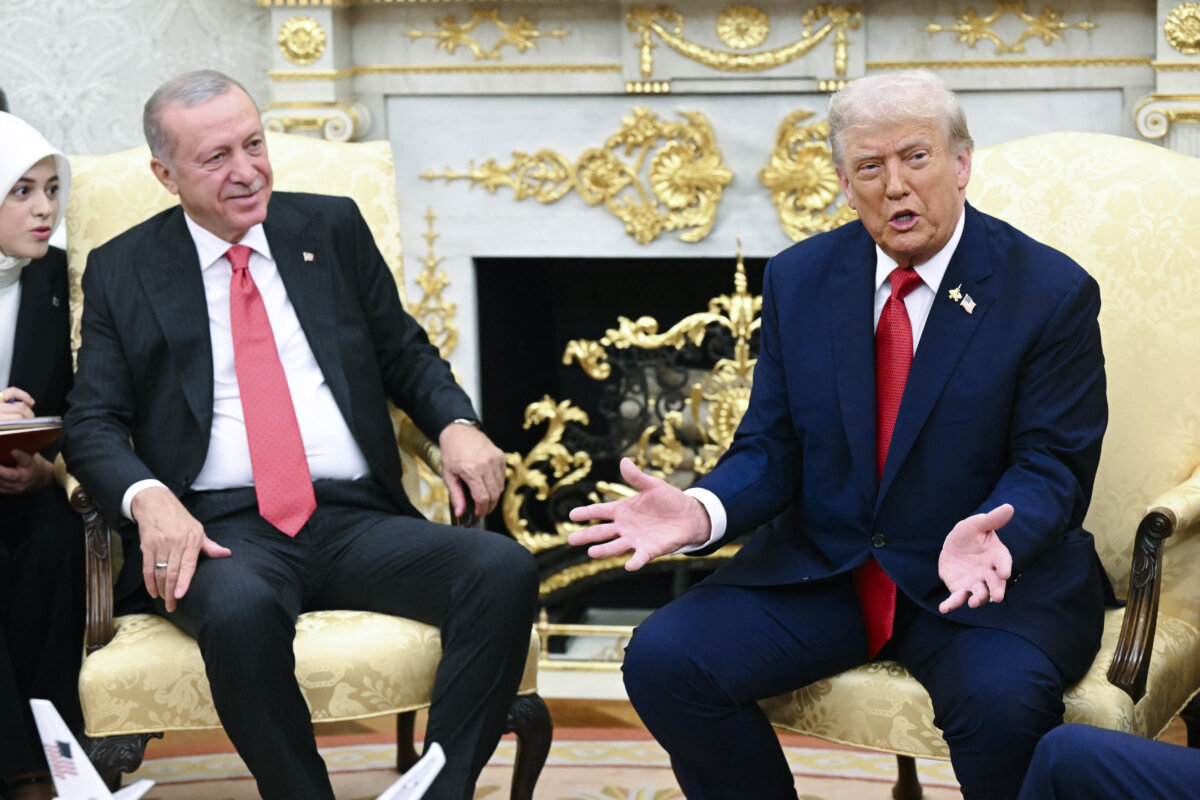

Turkish President Recep Tayyip Erdogan said on Jan. 2 that he had scheduled a phone call with U.S. President Donald Trump for the afternoon of Jan. 5.
“We will have another phone call with President Trump on Monday,” he told reporters in Istanbul, adding that the pair will discuss developments between Russia and Ukraine as well as the situation between Israel and the Palestinians.
Erdogan also said Turkish Foreign Minister Hakan Fidan will attend a meeting of the “Coalition of the Willing,” a group of nations backing Ukraine, in Paris in the coming days.
Israel–Gaza
Discussing the situation in Gaza, the Turkish leader hailed the success of a New Year’s Day rally he held on Istanbul’s Galata Bridge in solidarity with the people of the Palestinian enclave, saying it showed “Palestine was not alone.”
More than 500,000 attended the rally on the bridge spanning the Golden Horn, according to Turkish public broadcaster TRT.
Erdogan took aim at Israeli Prime Minister Benjamin Netanyahu in further comments on Jan. 2, labeling him a “Pharaoh” and saying his actions “will not go unpunished, because he incurred the curses of countless oppressed people, from the young to the old.”
“The suffering of children in Gaza, living in makeshift tents amid wind and rain, will not go unanswered, and Netanyahu will not avoid being held accountable,” Erdogan added.
The phone call between the two presidents is set to take place exactly a week after Trump met with Netanyahu at his Mar-a-Lago resort in Palm Beach, Florida.
Sale of F-35 Jets
During that meeting, the U.S. president told reporters he was considering “very seriously” selling F-35 jets to Turkey, despite the Israeli prime minister’s disapproval.
In November last year, Netanyahu said that he didn’t believe the United States would approve the transfer of F-35 fifth-generation fighter jets to Turkey, warning that the Jewish state would respond far more strongly to that move than to Washington’s agreement to sell the aircraft to Saudi Arabia.
“I understand that this possibility is very remote, if it even exists at all,” Netanyahu said in comments to the Abu Ali Express Telegram channel in Hebrew, and reported by the Jerusalem Post.
“Our position regarding the Saudi issue and the F-35, and Saudi Arabia is not a state of confrontation with us, would be that stance multiplied on steroids when it comes to selling F-35s to Turkey.”
During Trump’s first term as president, Washington removed Turkey, a NATO ally, from the next-generation fighter program after Ankara bought an air defense system from Russia.
American officials said they were concerned that Turkey’s use of Russia’s S-400 missile system could be used to gather data on the capabilities of the F-35 and that the information could make its way to Moscow.
Since its removal, Turkey has pushed to be readmitted to the project, which the United States and other NATO members developed.
Erdogan has said his nation plowed $1.4 billion into the program before it was suspended in 2019.
Trump hosted the Turkish president at the White House in September 2025 and, during the visit, spoke kindly of Erdogan, describing him as a friend.
Russia–Ukraine
Turkey has played a high-profile role in the diplomatic efforts to bring the war between Russia and Ukraine to an end.
Istanbul hosted three meetings between representatives from Moscow and Kyiv in 2025.
Those discussions were mediated by the United States and led to major prisoner exchanges, the return of fallen soldiers’ remains, and draft memorandums outlining each side’s positions on what kind of deal could end the war, which is nearing its fourth year.
Reuters and The Associated Press contributed to this report.
 Friends Read Free
Copy
Facebook
Tweet
Friends Read Free
Copy
Facebook
Tweet