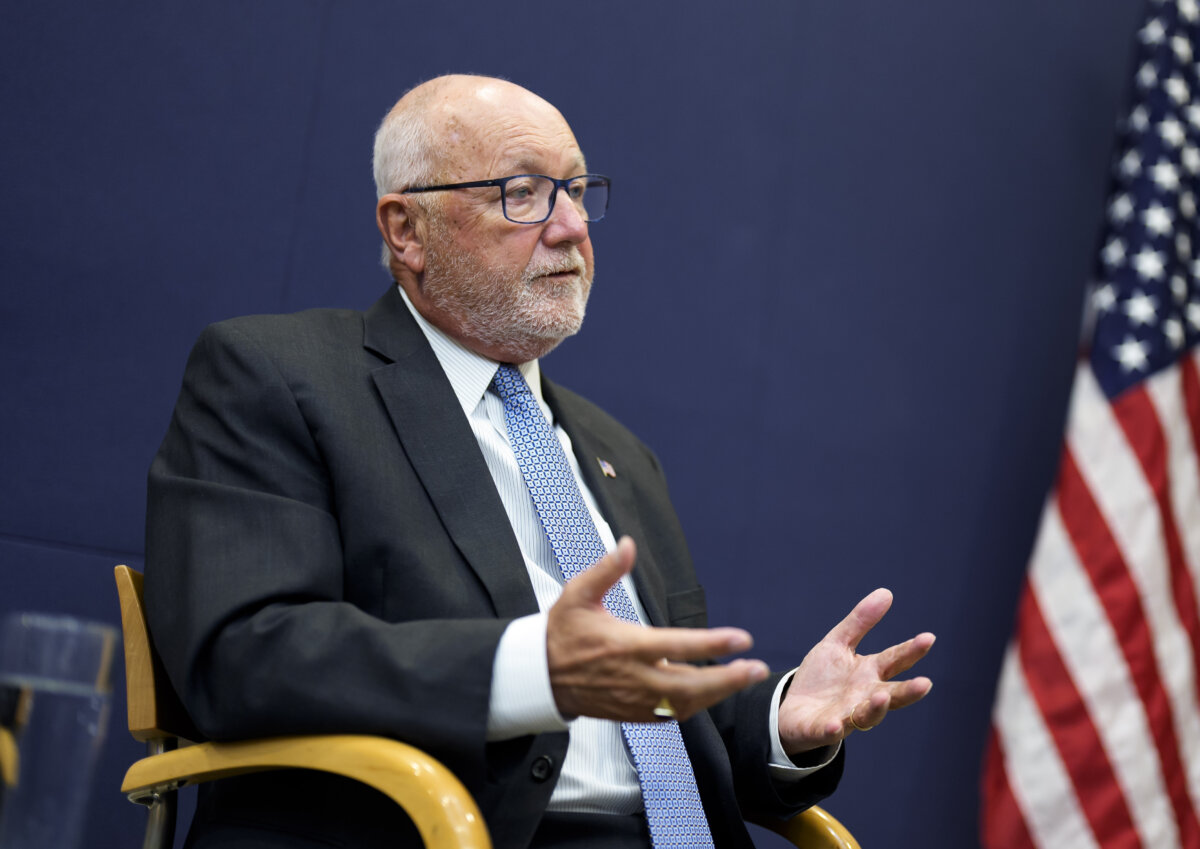

U.S. Ambassador Pete Hoekstra said parties to the North American free trade deal are unlikely to reach an interim agreement in the near term as the pact’s review date approaches.
“Obviously we’re not anywhere close to announcing any type of a framework or an interim agreement,” Hoekstra told CTV News in an interview aired on June 23.
Hoekstra said it’s up to U.S. and Canadian leaders to determine the next steps and chart a path forward.
On July 1, the parties to the Canada-United States-Mexico Agreement (CUSMA) must decide how to proceed with the continental trade pact. Canada and Mexico have formally signalled they want to extend the deal for another 16 years, whereas the United States has not announced an official position.
In recent weeks, U.S. President Donald Trump has suggested the United States may not renew CUSMA, could allow it to expire, or even withdraw from the agreement, arguing his country would be better off without it.
If no action is taken on or past July 1, the deal would remain in effect until 2036 with annual reviews, unless parties agree to extend it or one of them withdraws.
Hoekstra declined to clarify Trump’s stance on CUSMA amid mixed signals from Washington, saying the president would make his position known when he is ready. The ambassador said this could come before July 1 or “sometime in July.”
“I don’t think it will go into August, but I’ve been wrong before, and I could be wrong again,” he said.
When asked how Canada-U.S. trade talks compare with Washington’s negotiations with Mexico, Hoekstra reiterated his previous comments, saying no announcements are imminent.
“We’re not at a point where we believe that we’re close to even announcing a framework or an interim agreement,” he said.
The United States and Mexico held two rounds of formal bilateral talks on CUSMA in late May and mid-June, and another round is scheduled for July. The U.S. side did not announce similar formal talks with Canada, although Ottawa says discussions are progressing nonetheless.
Mexican President Claudia Sheinbaum said early this week Mexico has “insisted” that trilateral talks be held but that Washington has chosen to negotiate separately.
Trade talks between Ottawa and Washington were essentially frozen between November and early March.
The two sides were working on a sectoral deal in October following Prime Minister Mark Carney’s visit to the White House, but Trump scrapped it after the Ontario government ran an anti-tariff television ad campaign on U.S. networks. Trump accused the campaign of attempting to influence the U.S. Supreme Court as it reviewed the legality of some of his tariffs.
“I don’t think folks recognize the impact of what happened in October and November,” Hoekstra said. He said Canada-U.S. trade talks never got “back on track” in the same way negotiations progressed with Mexico.
Hoekstra provided additional details on the general terms of a deal agreed to by Carney and Trump but never finalized. Canadian officials said at the time it involved steel, aluminum and energy.
Steel and and aluminum are two sectors hit by universal U.S. tariffs slapped on the basis of national security grounds.
Hoekstra said the deal covered oil, uranium, auto parts, steel, and aluminum. “That would have been awesome. It really would have put the following seven months on very, very solid footing and say ‘okay now let’s start filling in the other parts,’ but as we all know, that didn’t happen,” he said.
The U.S. ambassador defended his country’s protectionist policies as a means to keep America “strong and prosperous” and said they weren’t aimed specifically at Canada. He added that Canada was one of only two countries to retaliate against U.S. tariffs, with the other being China.
Canada and Mexico were targeted by Trump tariffs imposed under emergency border security powers, with exemptions for many CUSMA-covered goods. In February 2026, the U.S. Supreme Court ruled that the law used to justify the tariffs did not authorize them, striking them down.
 Friends Read Free
Copy
Facebook
Tweet
Friends Read Free
Copy
Facebook
Tweet