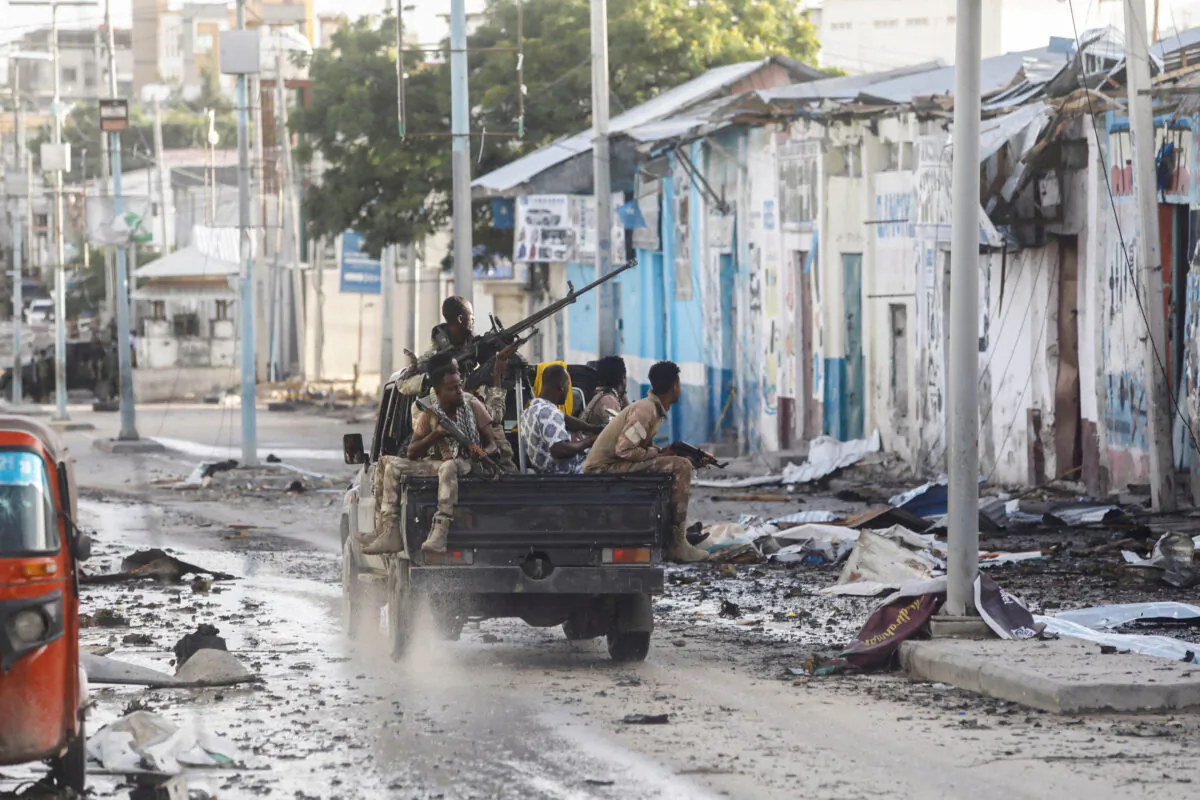

JOHANNESBURG—The United States military is rapidly scaling up attacks on al-Shabaab, the al-Qaeda affiliate in Somalia that’s currently the most powerful terrorist force in Africa, according to American officials and global security analysts.
While airstrikes take out terrorist leaders, a U.S.-trained Somali special forces unit called the Lightning Brigade is destroying jihadist bases across the conflict-ridden Horn of Africa region.
The main weapon used by the U.S. Army is an order from President Donald Trump that gives military commanders in Africa the power to launch airstrikes and operations to kill terrorists without requiring White House approval.
The targeting of al-Shabaab is happening amid growing sentiment from counterterror experts that the next major terrorist attack on Western targets is likely to be planned in Africa.
In a report to the U.N. Security Council on July 25, a panel of experts said the threat from ISIS, al-Qaeda, and their extremist affiliates remains “most intense in parts of Africa.”
Conflict analysts say the continent is now the scene of the world’s two major theaters of terror: the Sahel region, spanning West and East Africa, and the Horn of Africa, including Somalia, where terrorist organizations including ISIS and al-Qaeda are getting stronger.
“Military operations by the United States and its allies in your traditional theaters in the Middle East have forced al-Qaeda and ISIS to pivot to Africa,” Jasmine Opperman, a former intelligence operative for the South African military, said. “They’re building capacity in a place where anti-terror resources are sparse, and where it’s easy to hide in terrain like deserts, mountain ranges, and rain forests.”
The U.N. Security Council report said al-Shabaab and the Iran-backed Houthi terrorist group are “exchanging weapons” and that the Houthis are training al-Shabaab fighters in Yemen.
Al-Shabaab’s main base is Somalia, but U.S. and African intelligence agencies say it’s active throughout Africa, with sympathizers and funders across the continent and links to extremists across the Middle East.
According to testimony by U.S. Africa Command (AFRICOM) leaders to Congress, al-Shabaab rejects democracy and wants to unite the ethnic Somali-inhabited areas of Djibouti, Kenya, Ethiopia, and Somalia in an Islamic state.
Under al-Shabaab’s version of Sharia law, women and girls are denied education, and “unbelievers” and opponents are executed, including by beheading.
Experts on terrorist organizations in Africa say al-Shabaab has killed thousands of people since its formation in 2006.
The group characterizes the internationally recognized Somali government in Mogadishu as an illegitimate apostate authority controlled by foreign powers.
“Killing Western infidels, and especially Americans, is something al-Shabaab is dedicated to,” Opperman, who now advises several governments about terrorism in Africa, told The Epoch Times.
“Al-Shabaab has murdered more than 1,000 people since 2017, including American citizens and Somali government officials, mostly using car bombs and in suicide bombings.”
Opperman said al-Shabaab’s leaders are “searching to perpetrate an atrocity of international significance; something terrible that would define them and insert them into history,” such as al-Qaeda’s 9/11 attack on the United States.
According to U.S. security organizations, some of al-Shabaab’s founding members trained with al-Qaeda in Afghanistan.
Agencies including the FBI established links between al-Shabaab and senior al-Qaeda operatives in East Africa who masterminded the bombings of the American embassies in Kenya and Tanzania in 1998 that killed 224 people, including 12 Americans.
In 2013, al-Shabaab attacked the Westgate Mall in Nairobi, killing about 70 people, including several Westerners.
The jihadists attacked a university in northeast Kenya in 2015, slaughtering nearly 150 Christian students.
Al-Shabaab’s deadliest single attack to date took the lives of more than 500 people with a truck bomb in Mogadishu in 2017.
Selam Tadesse Demissie, Horn of Africa terrorism analyst for the South Africa-based Institute for Security Studies, said al-Shabaab is currently “resurgent.”
She told The Epoch Times that in 2025 so far, it has recaptured key regions in central Somalia, has tried to assassinate Somalian President Hassan Sheikh Mohamud, and is increasingly threatening the Somali capital of Mogadishu.
“The most dangerous thing about al-Shabaab right now is that it has built the logistics and financial resources that could allow it to soon mount something really spectacular,” Opperman said.
She described al-Shabaab as “one of the world’s most potent, disciplined, and sophisticated” terrorist groups.
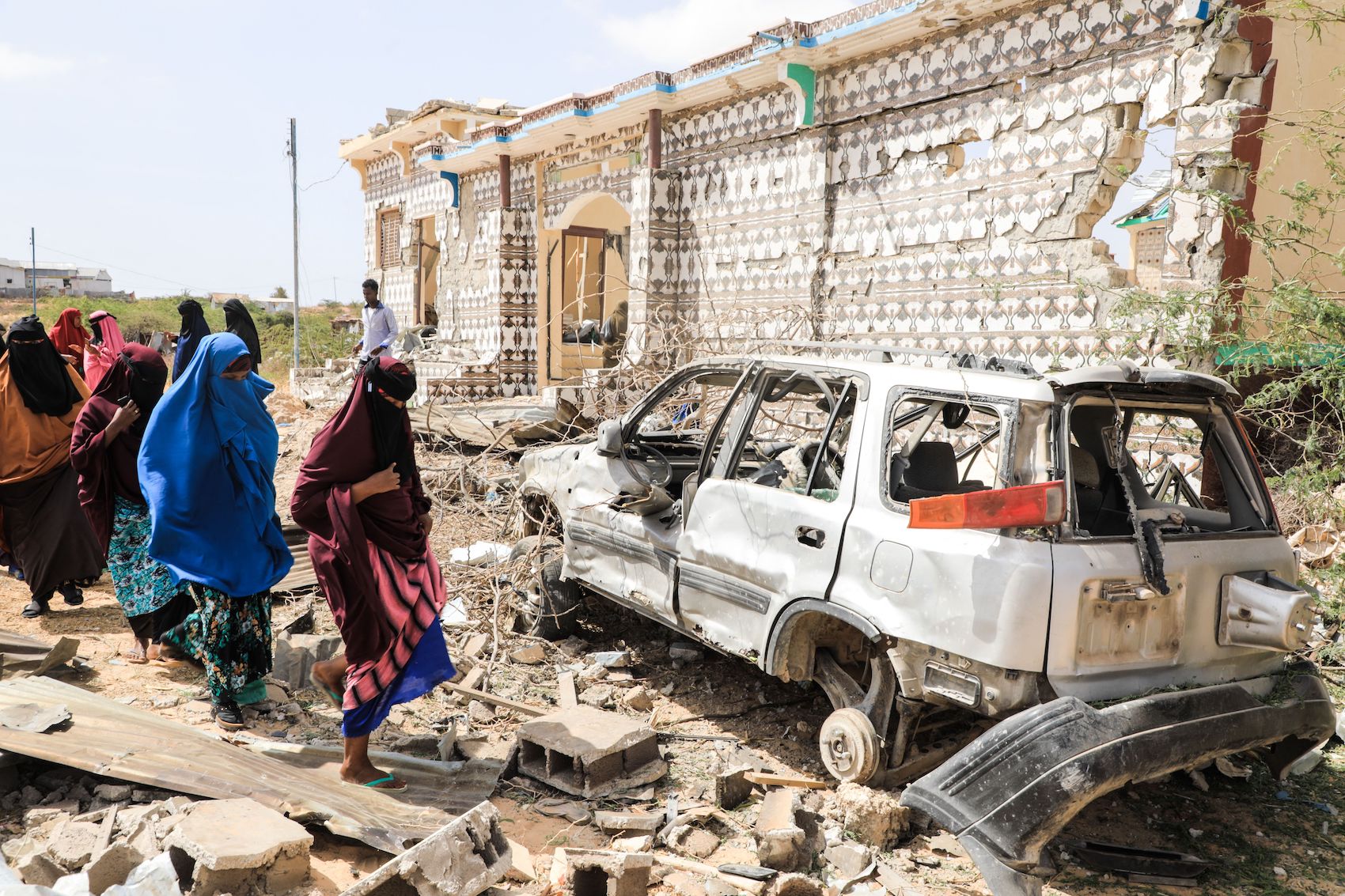 Women walk next to a destroyed house and the wreckage of a car following an explosion by al-Shabaab terrorists during an attack on a police station on the outskirts of Mogadishu, Somalia, on Feb. 16, 2022. (Hassan Ali Elmi/AFP via Getty Images)
“They’re no longer a bunch of fighters using homemade bombs and over-the-shoulder RPGs. They train regularly in the Middle East, and they’ve formed a tight alliance with the Houthis in Yemen,” Opperman said. “They’re buying top-notch weaponry, including missile systems and drones, and funds are being channeled to them from sleeper cells and front companies in countries like South Africa. Al-Shabaab has set itself up as a government-in-waiting, so there aren’t just military commanders; it has ministers of public works, ministers of defense, and so on.”
Demissie said a withdrawal of support from the African Union and the United Nations for the Somali government had created “political instability” and a “security vacuum.”
“Al-Shabaab is using new, softer tactics to exploit this,” she said. “It is winning citizens over by establishing local administrations to deliver basic services. It is allowing people and goods through checkpoints without demanding money from them. It is allowing protests and is projecting an image of accountability and governance.”
In short, Demissie said, al-Shabaab is increasingly seen as a credible alternative to Mohamud’s government.
Opperman said the Trump administration has recognized the threat posed by al-Shabaab.
“While the Americans reduce military resources in other conflict zones, they do the opposite in Somalia,” she stated.
“AFRICOM has formed a very effective alliance with Somali special forces, the Danab (‘Lightning’) Brigade. We now have a regular scenario where Danab fighters engage al-Shabaab on the ground, and provide intelligence to the Americans who then launch airstrikes using missiles and drones to kill terrorists and their leaders.”
AFRICOM’s website reveals a dramatic uptick in airstrikes on al-Shabaab and ISIS and killings of their leaders since Trump retook the White House in January.
In a July 28 press briefing, AFRICOM’s deputy commander, Lt. Gen. John Brennan, said counterterrorism in Somalia is “by far the biggest effort” of the American military in Africa.
“It’s our main effort at AFRICOM, to counter ISIS and al-Qaeda affiliates, external operations threats to our homeland,” Brennan said. “And we’re doing it the most fervently in East Africa. That’s where most of our people are. And we think it’s the biggest investment that we have.”
He echoed a 2022 AFRICOM assessment when he described al-Shabaab as “the largest, wealthiest, and most lethal al-Qaeda affiliate in the world today.”
“I think one of the most meaningful decisions the [Trump] administration has made was allowing us delegated, targeted engagement authority so that we can provide more proactive fire support to our partners on the ground,” Brennan said.
In March, Opperman said, the Trump administration relaxed restrictions on military airstrikes.
DefenseNews reported at the time that the U.S. president gave commanders more autonomy to make lethal decisions.
Defense Secretary Pete Hegseth confirmed the directive in a post on X.
“Judging from the number of drone strikes that have happened since March, AFRICOM wants to eliminate al-Shabaab’s leaders one by one,” Opperman said.
The latest AFRICOM airstrike, on July 25, killed several al-Shabaab members.
Demissie said AFRICOM typically doesn’t release numbers of fatalities as a result of operations, but data available to her indicate that U.S. and Somali forces have killed about 120 al-Shabaab terrorists so far this year.
In 2024, she said, the Biden administration approved just 10 airstrikes on al-Shabaab and ISIS in Somalia.
So far in 2025, under Trump, there have been about 30 “American-led” airstrikes in the country, Opperman said.
The Epoch Times is awaiting comment from AFRICOM.
“The Trump administration has been accused of taking its eye off the ball with regard to terrorism, but this certainly is not what we’re seeing in East Africa and the Horn of Africa,” Opperman said. “That says a lot about how serious the situation is in this part of the world.”
 Friends Read Free
Copy
Facebook
Tweet
Friends Read Free
Copy
Facebook
Tweet