
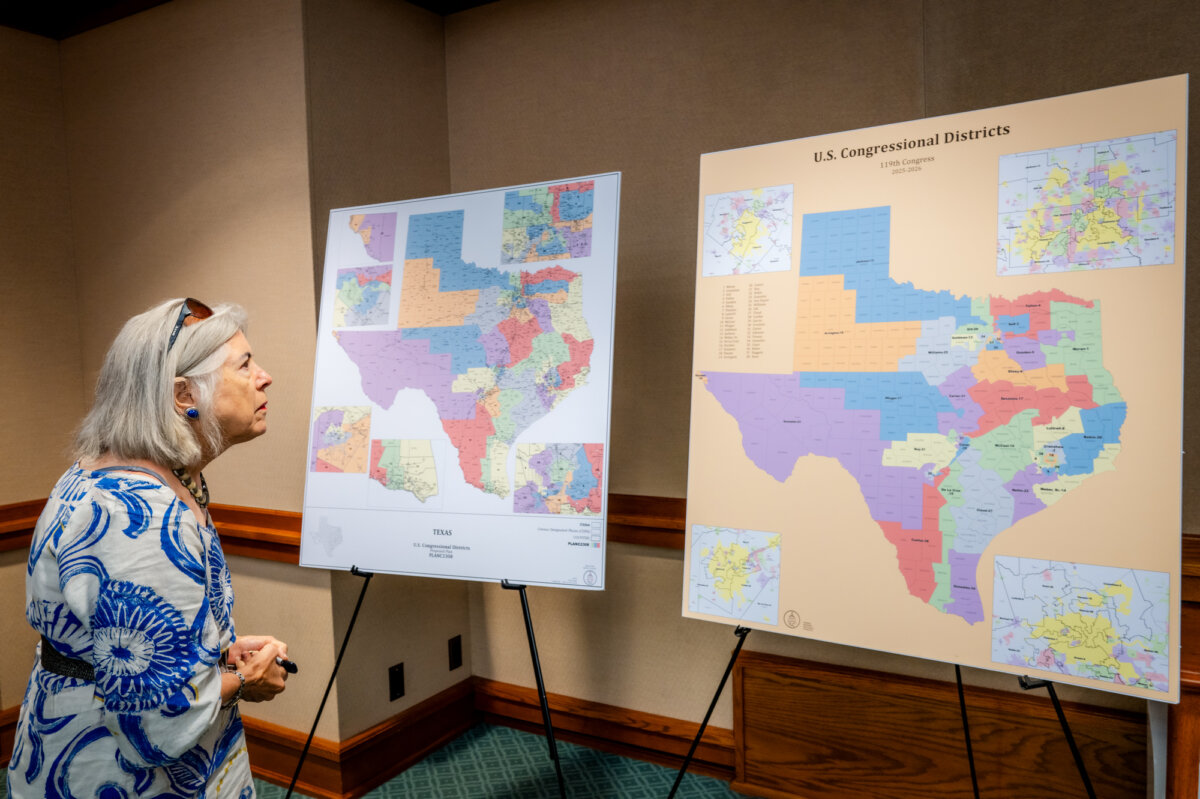

The United States’ highest court has greenlit the redrawing of election maps in Texas, siding with Republicans in a months-long dispute that could decide control of the U.S. House of Representatives in the 2026 midterm elections.
The U.S. Supreme Court on Dec. 4 ordered that the state’s efforts to redefine its electoral maps in favor of Republicans were purely partisan and not racially discriminatory, as had been ruled by a lower court.
On Nov. 18, a three-judge panel in U.S. District Court for the Western District of Texas ruled that the new map was racially biased in a lawsuit filed by the League of United Latin American Citizens.
This led to Texas taking the case to the Supreme Court, which on Nov. 21 granted an emergency request to temporarily block the ruling while it reviewed the case further.
The redistricting effort, backed by President Donald Trump, was initially taken up by Texas Gov. Gregg Abbott on July 24, following a letter from the Department of Justice warning that four congressional districts in the state were unconstitutionally drawn.
The letter stated that the borders of these districts had been drawn on the basis of racial demographics and were thus illegal under the Voting Rights Act.
A new map was then drawn, one that could deliver five more U.S. House seats to Republicans.
On Aug. 3, over 50 Texas House Democrats left the state in protest ahead of a planned vote on a draft of the new map, leaving the chamber unable to operate.
The Democrats returned two weeks later after Abbot had called for their arrest and potential removal from office, and the bill proposing the new map was passed into law.
In response, several Democrat-run states threatened to redraw their electoral maps in their favor.
California took it one step further, introducing Proposition 50, a bid to redraw five of its districts to favor Democrats, which voters approved in November.
Since then, a flurry of other states have retaliated to fight for control of the U.S. House in 2026.
Missouri in September led a Republican effort to redraw its districts, while North Carolina and Ohio Republicans did the same in October.
Democrats in Utah gained an extra seat in November when a judge struck down a Republican-created map that would have split the Democratic-majority Salt Lake City district in half.
Virginia is also moving to redistrict in favor of Democrats, and Colorado, Illinois, New York, Louisiana, and Maryland could follow.
Republicans in Florida and Indiana are also considering new maps.
Gerrymandering, as it is otherwise known, is an attempt to redraw electoral districts to favor one political party and has been used by both Democrats and Republicans every decade.
Since redistricting customarily follows the U.S. Census, which takes place at the start of each decade, it is uncommon for it to occur mid-decade, though Texas’s initiative has sparked the current reshaping across the country ahead of the 2026 midterms.
The term “gerrymandering” comes from a 1812 political cartoon about Gov. Elbridge Gerry’s redrawing of voting lines in Massachusetts that ended up with a district shaped like a salamander.
Matthew Vadum, Jackson Richman, and Joseph Lord contributed to this report.
 Friends Read Free
Copy
Facebook
Tweet
Friends Read Free
Copy
Facebook
Tweet


























