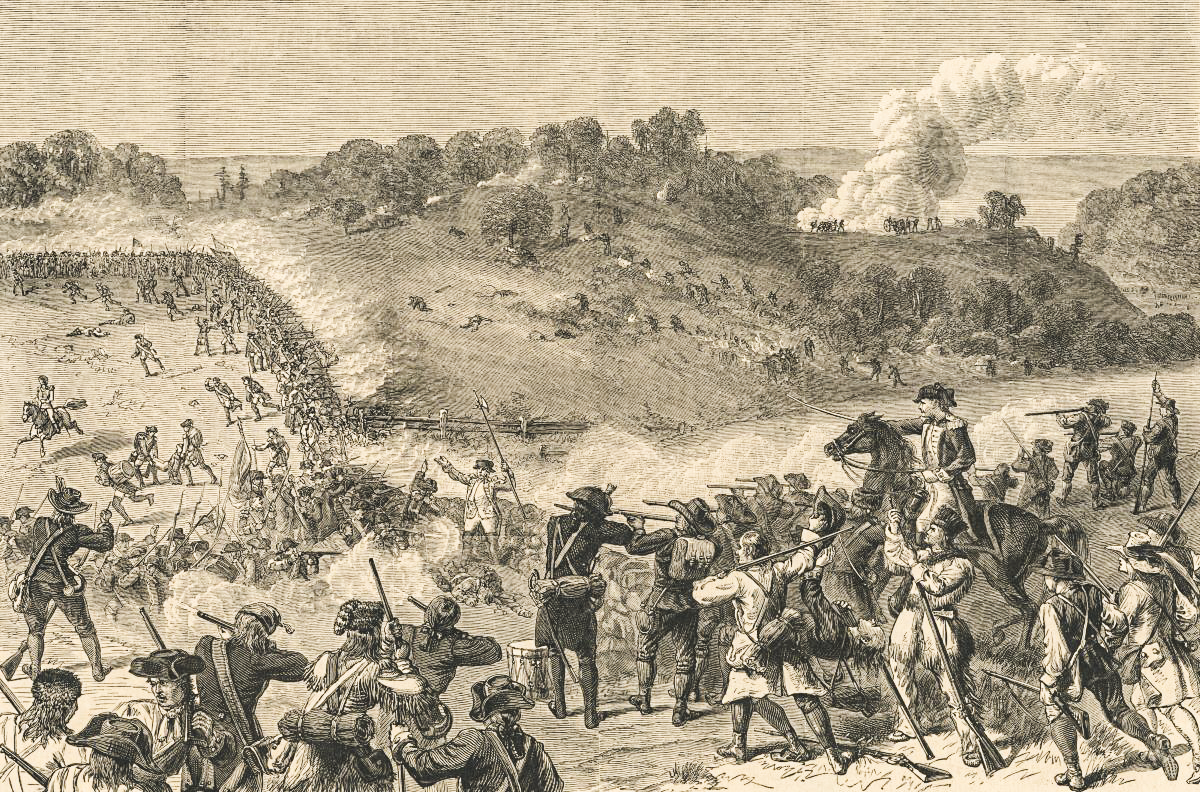
American forces remained on high alert throughout the morning of Sept. 16, 1776. Having lost New York City and most of Manhattan Island following the previous day’s disaster against British and Hessian forces at Kip’s Bay, the Continental Army and Patriot militias held only the northern stretch of the island.
Gen. George Washington and his staff were uncertain when or where the British would strike next. Various contingency plans were made, including deploying men to vulnerable areas depending on the scenario. For an amphibious landing on the mainland that threatened to encircle the entire Continental Army, a rapid evacuation off the island through King’s Bridge would be activated. For a ground attack, the men stood ready, muskets loaded, behind defensive entrenchments dug through the night. From their fortified positions on Harlem Heights, they had an unobstructed view of the Harlem Plains below and the enemy-held plateaus beyond.
Much of Manhattan’s topography consisted of cliffs, rocky hills, and plateaus. The two most likely routes for a ground attack were through Bloomingdale Heights, where Columbia University is now located, and McGowan Pass, now part of Central Park. McGowan’s Pass was 1.5 miles away, which would give the Americans time to prepare. Bloomingdale Heights, however, was only a quarter-mile away, giving them very little warning.
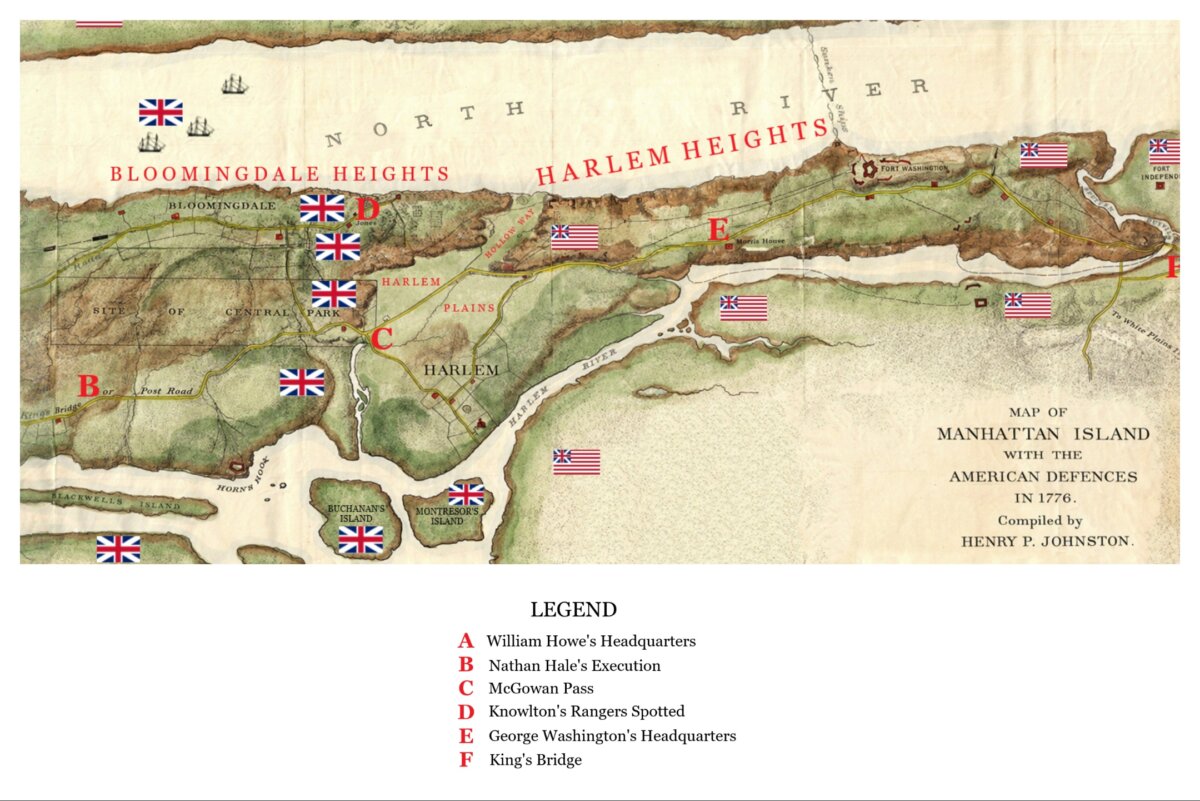
Dense forests covered much of the enemy-held areas, concealing British activities. Washington desperately needed intelligence on enemy troop movements and encampment positions. He therefore ordered a reconnaissance patrol to probe Bloomingdale Heights. The events that followed set in motion the Battle of Harlem Heights, illustrating American resilience and defiance while costing the nation two remarkable leaders.
Knowlton’s Rangers
Before dawn, roughly 120 elite Rangers led by Lt. Col. Thomas Knowlton crossed Hollow Way into Bloomingdale Heights and slowly moved south. Around sunrise, they were spotted by British pickets near the present-day intersection of West 106th Street and Riverside Drive.
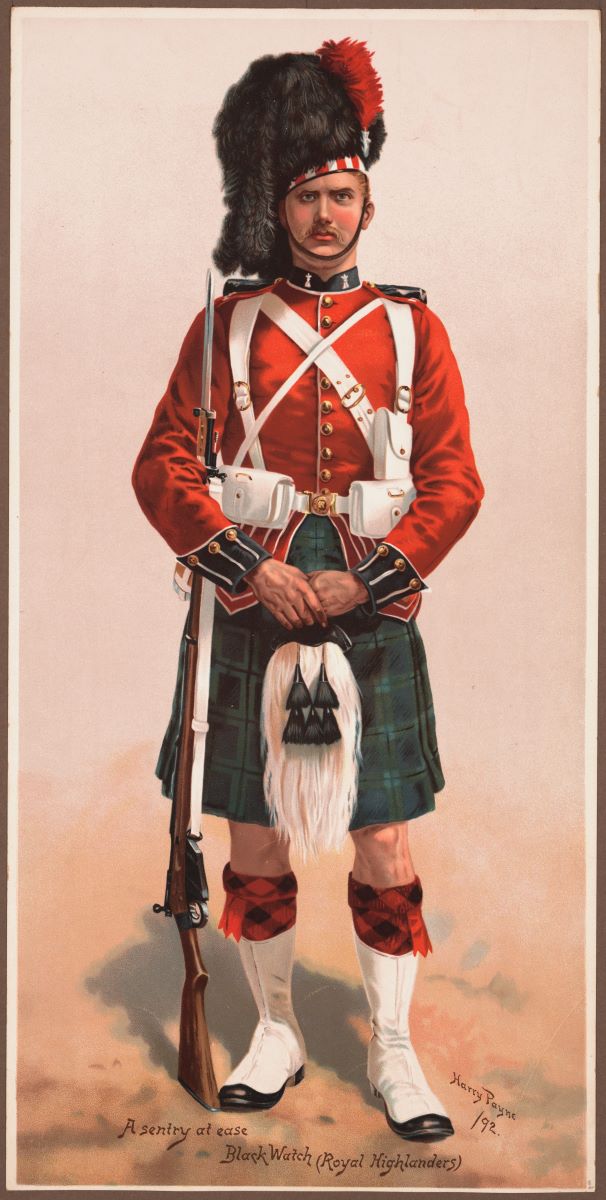
Shots were fired. British soldiers encamped nearby, including members of the 42nd Royal Highland Regiment, known as the Black Watch, rushed to join the firefight.
Knowlton’s Rangers fired several rounds before taking cover behind a stone wall. They stood their ground against 400 British soldiers and exchanged fire for more than half an hour. The British then formed into a column and advanced, forcing the Rangers into an orderly fighting retreat.
Back at Harlem Heights, Washington dispatched Adjutant Gen. Joseph Reed to find Knowlton and learn what he had discovered. By 9 a.m., Reed reported that Knowlton’s Rangers had fought well and returned safely, but British infantry were rapidly advancing toward the American lines. He urged Washington to respond with an immediate attack.
Just then, British troops appeared above Hollow Way. A bugler sounded the traditional fox-hunting tune “Gone Away,” signaling that the fox was on the run. Infuriated by the insult, Washington decided to set a trap.
The Trap
A force of 150 Rhode Islanders marched into Hollow Way and feigned an attack. The British took the bait and advanced into the open, exchanging gunfire with the Americans.
Meanwhile, Knowlton’s Rangers and three companies of Virginia riflemen under Maj. Andrew Leitch secretly marched around the British right flank. The plan was to maneuver behind the advancing British, attack them from the rear and cut off their retreat.
The Rhode Islanders maintained their position as more Americans marched downhill and joined the firefight. The growing American force compelled the British to fall back. Unable to resist the opportunity, the Americans pursued them.
The foxes were now chasing the foxhunters. This was not Washington’s plan.
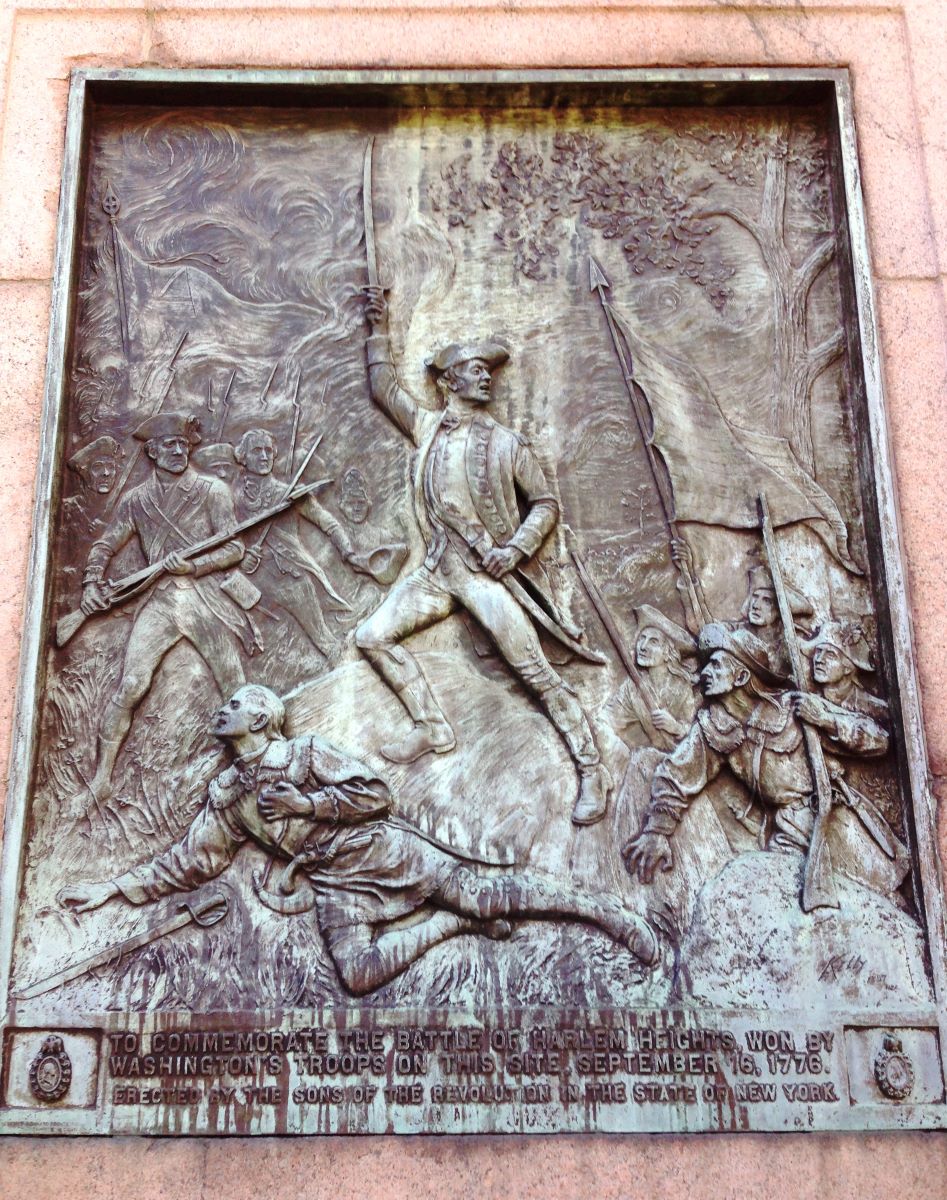
Knowlton and Leitch were unaware of the British retreat. Believing they were moving behind the enemy, they instead collided with the flank of the British line near a fence. Both sides opened fire. Knowlton and Leitch were mortally wounded in the initial volleys, but the remaining Americans pressed the attack and continued pushing forward.
As the fighting intensified, Washington sent reinforcements, including artillery, increasing American numbers to about 1,800. By noon, the British had retreated to a buckwheat field, where they made their stand. Reinforcements, including Hessians, increased British numbers to approximately 5,000.
By 2 p.m., the British and Hessian lines began to fracture as they ran low on ammunition, forcing a retreat. The Americans continued their pursuit.
By 3 p.m., Washington realized his men were dangerously close to the British army’s main body. Fearing a much larger battle—something he wished to avoid—Washington ordered his men to break off the pursuit and return to Harlem Heights.
The Americans returned to their lines, relishing their first victory.
The Great Fire
Following the American retreat from New York City, British forces began moving into the city. Loyalists pointed out Patriot-owned property to British soldiers by marking buildings with a large “G.R.”
On the night of Sept. 20, a small fire ignited near Whitehall Slip near the southern tip of Manhattan. Fanned by strong winds, the fire rapidly spread as dry wooden structures fueled the blaze. A vast majority of the city’s firefighters had evacuated before the British occupation, and much of their equipment was unusable.
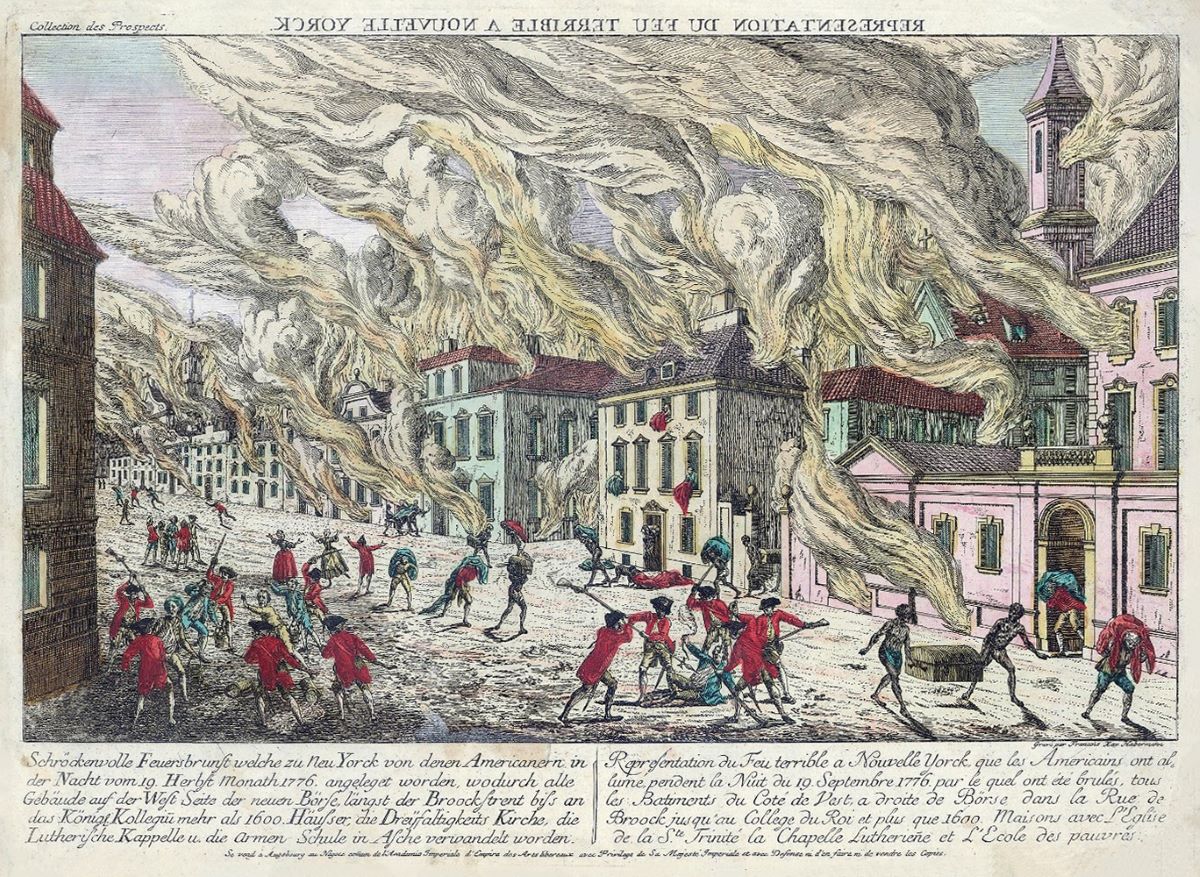
Around 2 a.m., the wind shifted and the fire crossed Broadway, devouring the west side of the city, including the famed Trinity Church. By 11 a.m., the fires reached open areas and largely died down.
Patriots observing from a safe distance reveled in the glow, which could be seen miles away. Washington, who had wanted to deny the British winter quarters by destroying the city, watched the fires with some satisfaction, stating that “Providence—or some good honest Fellow, has done more for us than we were disposed to do for ourselves.”
Blame was cast on Patriots. Writing to John Hancock, Washington denied any involvement or knowledge of “how the Accident happened.” Within the city, Patriots were arrested or violently attacked by British soldiers and Loyalists. Some were killed.
One Patriot ended up at the gallows—but for an entirely different reason.
Nathan Hale
Before the Battle of Kip’s Bay, Washington desperately needed operatives to slip behind enemy lines and gather intelligence. He met with Knowlton and requested a volunteer among his Rangers. Capt. Nathan Hale was that volunteer.
Disguised as a Dutch schoolmaster, Hale crossed into enemy-held Long Island. He gathered intelligence and made drawings detailing the positions and strength of British troops, then concealed the documents in his shoes.
Unfortunately, Hale was captured. Many believed his Loyalist cousin, Samuel Hale, had betrayed him. However, another Loyalist, named Tiffany, claimed in a manuscript later donated to the Library of Congress that Maj. Robert Rogers, famed commander of the Queen’s Rangers, was responsible for his capture.
Rogers spent several days tracking Hale, suspecting he was a spy. He approached Hale while pretending to be an American sympathizer, quickly earning his confidence. Hale agreed to meet Rogers and some friends for dinner. During the meal, British soldiers ambushed the gathering and arrested Hale.
On Sept. 21, he was taken to British Gen. William Howe’s headquarters at Mount Pleasant—owned by Patriot James Beekman, who had earlier fled during the American retreat—where a search of Hale’s clothing uncovered the incriminating evidence. Howe, who had been dealing with the great fire that engulfed the city earlier that morning, charged Hale with spying and sentenced him, without the benefit of a trial, to be hanged.
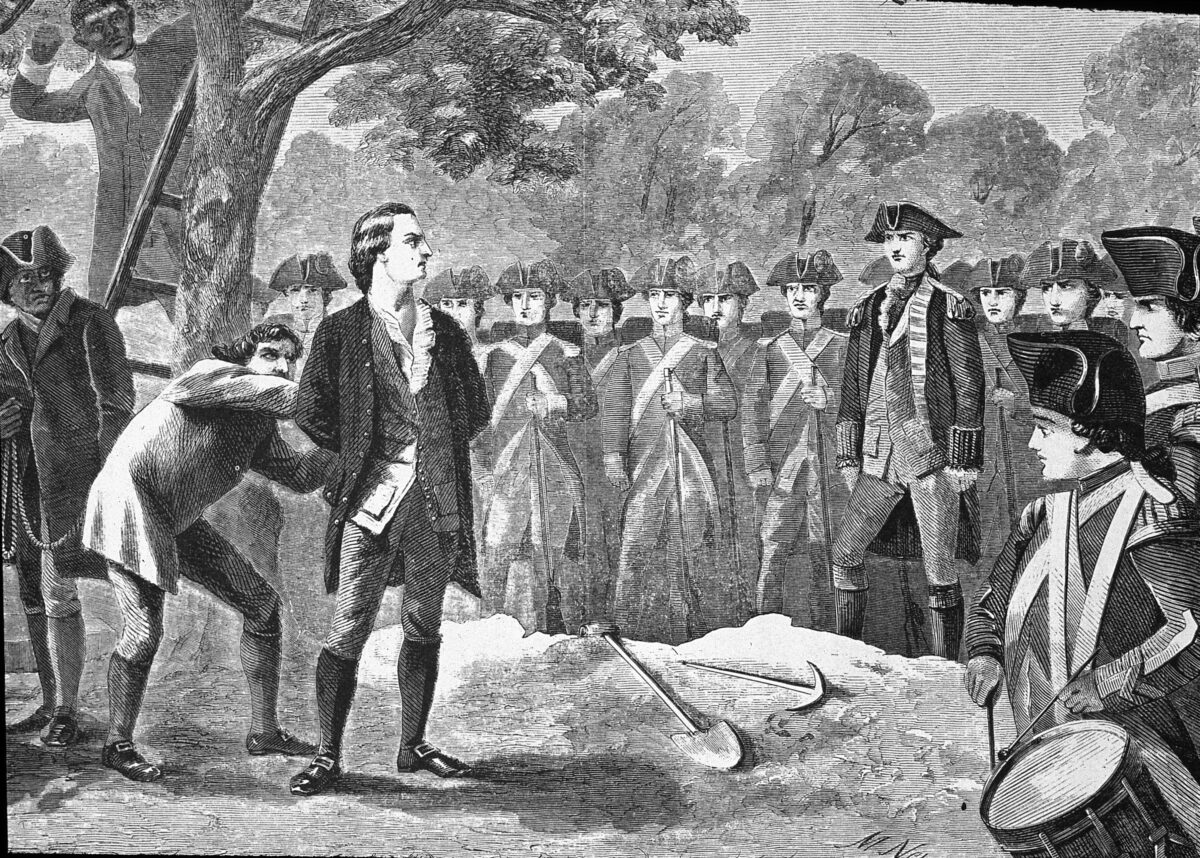
The following morning, Hale was taken to the Royal Artillery Park near Dove Tavern—most likely near present-day 66th Street and Third Avenue—to be executed. According to legend, when asked if he had any last words, Hale responded, “I only regret that I have but one life to lose for my country.”
Hale’s request for a minister and Bible was denied before he was hanged at 11 a.m. British officer Frederick Mackenzie wrote of Hale: “He behaved with great composure and resolution.”
Four years later, British Maj. John André suffered a parallel fate when Washington used Hale’s execution as precedent and ordered him hanged.
Aftermath
The British and Hessians suffered their first defeat in the Battle of Harlem Heights at a cost of 14 killed and 157 wounded. American losses were 30 killed and 100 wounded. Losing Knowlton and Leitch was especially costly, but overall, it was a much-needed victory that boosted morale.
A quarter of New York City was destroyed in the fire, further complicating housing needs in the already overcrowded city.
Despite the success, the Continental Army remained in a precarious position, facing the continuing threat of encirclement. The battle for New York was far from settled.
What arts and culture topics would you like us to cover? Please email ideas or feedback to features@epochtimes.nyc.