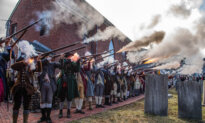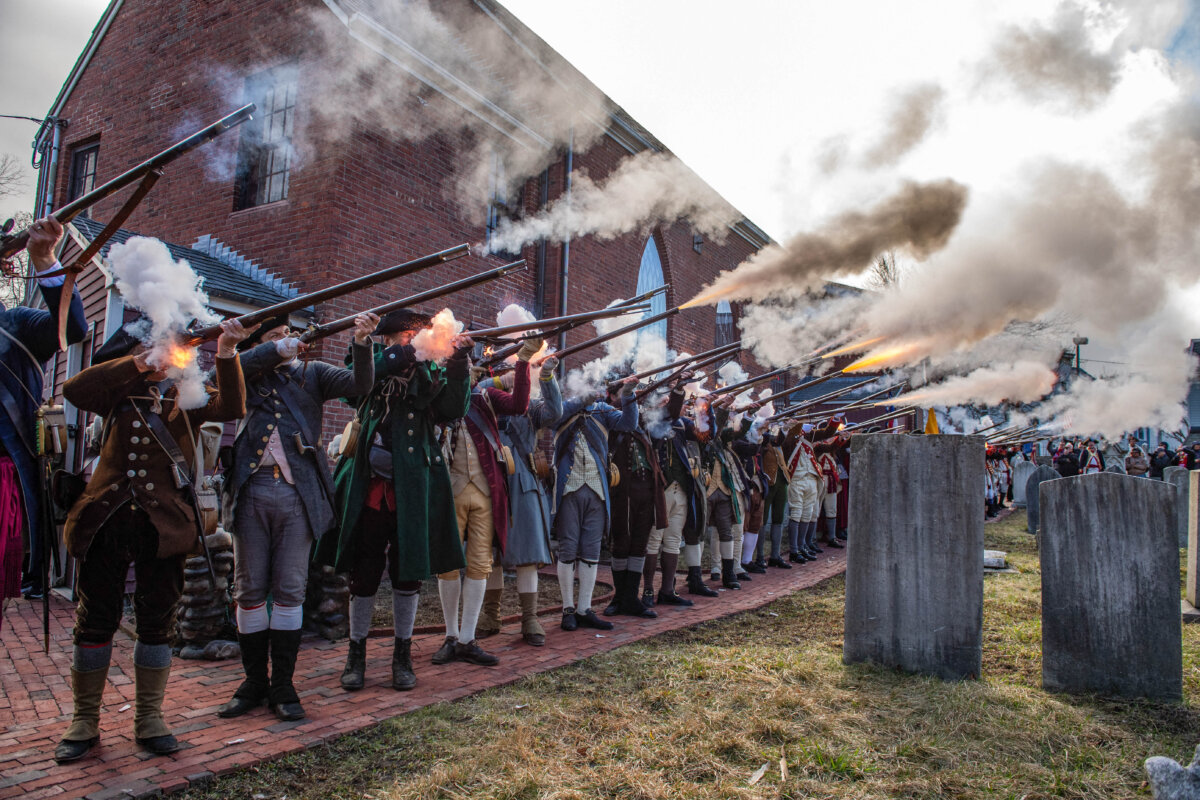

As Americans gear up to celebrate the nation’s 250th anniversary on July 4, many of the most fascinating facts from the war that brought U.S. independence are sometimes forgotten.
From the woman who disguised herself as a man to fight in defense of the colonies, to the deadly smallpox epidemic that claimed more lives than the war itself, these are five interesting facts you might not know about the American Revolutionary War.
1. Massive US Casualty Rate
Of the more than 230,000 American men who fought in the Revolutionary War, a staggering number died on the battlefield or from one of several diseases plaguing the colonies at the time.
Sometimes cited as one of the most accurate counts of the U.S. death toll in that war, historian Howard H. Peckham’s 1974 book “The Toll of Independence” puts the tally at just past 25,000.
Taken alone, that would make the U.S. casualty rate among the highest of all the wars the nation has fought in, but Peckham estimated that just under 7,000 Americans actually died in battle.
The rest either perished in unsanitary and confined conditions aboard prison ships or from disease.
Those diseases included typhus, typhoid, dysentery, and influenza.
However, many also died from a smallpox epidemic that was ravaging the colonies during the time of the war.
2. Smallpox Epidemic
While smallpox spread throughout North America in the 1700s, it is estimated that at least 100,000 people, including citizens, died from the illness during the Revolutionary War.
This is roughly four times as many soldiers who died during the same eight-year span.
The epidemic hammered Boston, particularly after a subsequent outbreak in 1775, which impacted both American and British troops.
After learning about its effectiveness from an influential Puritan minister, who learned it from one of his slaves, Boston-based Dr. Zabdiel Boylston began practicing smallpox inoculation.
Similar to modern-day vaccines, smallpox inoculation involved infecting healthy people with the live virus, but through their skin or nose rather than through the respiratory tract, as it would normally be contracted naturally.
The process, known as variolation, was intended to give the patient a less severe form of the illness from which their immune system could more easily recover.
However, smallpox inoculation proved to be controversial, as patients still needed time to recover from the illness, leading some to effectively protest the practice.
But since variolation was reported to have brought the fatality rate of naturally contracted smallpox down to 2 percent from 14 percent, George Washington ultimately ordered all Continental Army troops to be inoculated from the illness.
Despite being divisive among some in the colonies, Washington’s medical mandate is believed to have already significantly lowered the transmission of smallpox among soldiers by late 1777.
3. America’s ‘Mulan’
One of the most fascinating stories from the Revolutionary War is that of Deborah Sampson, who became the only woman to earn a full military pension from serving in the Continental Army.
After completing eight years of indentured servitude and following several years of working as a teacher, Sampson—like the main character from the Chinese legend of Mulan—disguised herself as a man and joined the military.
Going by the name Robert Shurtleff, Sampson joined the Fourth Massachusetts Regiment and would lead roughly 30 other soldiers on an expedition that resulted in capturing 15 men during the raid of a Tory home.
Sampson avoided detection of her true sex when she opted to remove a pistol ball herself from her left thigh after being shot.
However, Sampson’s identity was finally discovered a year and a half into her service after she fell unconscious in a Philadelphia hospital after becoming sick during an epidemic.
In 1837, a congressional committee awarded Sampson’s surviving husband her military pension after concluding that the history of the American Revolution “furnished no other similar example of female heroism, fidelity, and courage.”
4. The US Hired Pirates?
Since early American forces lacked the resources for the type of large navy required to outgun British ships, the Patriots hired privateers—or ships owned and manned by private citizens—while Congress slowly established the Continental Navy.
These vessels, of which there were nearly 800 commissioned during the war, ranged from whaling boats to schooners and brigantines.
Despite how critical the privateers were to weakening the power of the Royal Navy, capturing or destroying an estimated 600 British ships, they were not accepted by all colonists, as some viewed the “pirates” as greedy and self-interested.
This criticism came from the arrangement that motivated many privateers to work with Continental forces.
Whenever privateers took valuable cargo on British ships, they often shared the profits after the loot was sold.
However, other privateers were critical for disrupting British shipping and supply lines, helping the colonies gain independence.
5. Plot to Assassinate Washington
In 1776, a plot to assassinate Washington was uncovered, which involved members of his own elite security detail.
While many in the colonies supported the Americans during the war, others remained loyal to the British Crown, known as Loyalists.
William Tryon, who first served as governor of North Carolina and then New York in the years when the war broke out, was a Loyalist and allegedly orchestrated a plot with the mayor of New York City to kidnap or assassinate Washington.
Even though the two went as far as recruiting several members of Washington’s “Life Guards,” who were responsible for keeping the general safe, one of the co-conspirators ended up spilling the scheme to a cellmate after he was arrested for counterfeiting money.
The security guard, Thomas Hickey, would eventually be executed for treason for his part in the plot, and the event would inspire the United States to begin efforts in spycraft, or counterintelligence.
 Friends Read Free
Copy
Facebook
Tweet
Friends Read Free
Copy
Facebook
Tweet