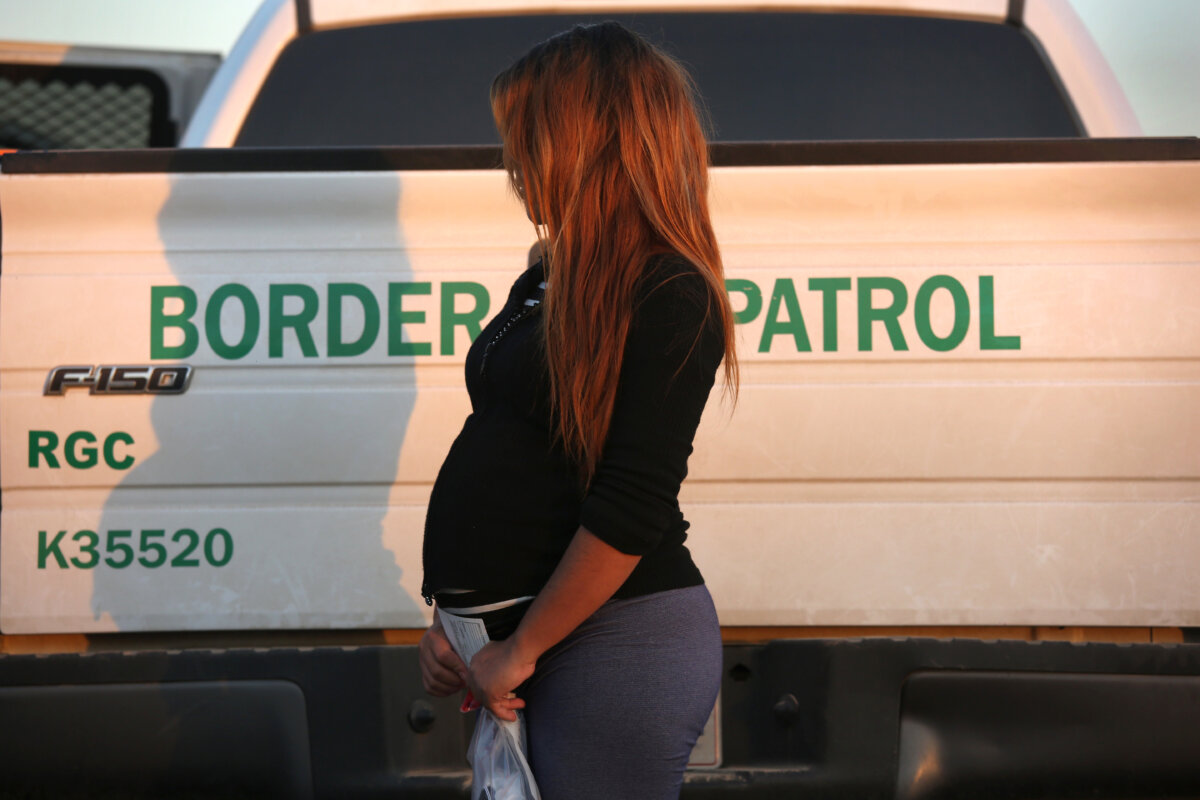
The Supreme Court on June 30 struck down President Donald Trump’s executive order excluding children of illegal immigrants and legal temporary visitors from automatic birthright citizenship.
Chief Justice John Roberts wrote the majority opinion in the case, which is known as Trump v. Barbara.
“A child born on American soil and subject to American law was made an American citizen,” Roberts wrote.
Justices Clarence Thomas, Neil Gorsuch, and Samuel Alito dissented.
Justice Brett Kavanaugh concurred in the decision to invalidate the executive order but disagreed with aspects of the reasoning in the majority opinion.
Trump’s Executive Order 14160 focuses on the 14th Amendment’s citizenship clause, which states, “All persons born or naturalized in the United States, and subject to the jurisdiction thereof, are citizens of the United States and of the state wherein they reside.”
The executive order states that the amendment has never been interpreted to bestow citizenship universally on everyone born in the United States. According to the order, an individual born in the United States is not “subject to the jurisdiction thereof” if that person’s mother was unlawfully present in the country and the individual’s father was not a U.S. citizen or lawful permanent resident at the time of the person’s birth.
In other words, the executive order excluded the children of illegal immigrants and legal temporary visitors from automatic birthright citizenship.
Trump had said on March 30 that the country’s current birthright citizenship rule, which arose out of the 14th Amendment, was created to grant citizenship to freed slaves and their children, not to children born to temporary visitors.
His order states that “the Fourteenth Amendment has never been interpreted to extend citizenship universally to everyone born within the United States.”
A federal district court in New Hampshire temporarily blocked the executive order, finding that it likely contradicts the 14th Amendment and Section 1401 of Title VIII of the U.S. Code, enacted in 1952, which generally mirrors the 14th Amendment.
The federal government appealed to the U.S. Court of Appeals for the First Circuit, but did not wait for a ruling and asked the Supreme Court to intervene. In the meantime, the appeals court upheld a preliminary injunction blocking the executive order in a separate case.
Origins of Current Policy
The current policy goes back to the Supreme Court’s landmark 1898 decision in United States v. Wong Kim Ark, which recognized that almost all persons born in the United States are U.S. citizens at birth.
Wong was born in San Francisco in 1873 to Chinese parents who were legally residing permanently in the United States. Because his parents were not serving in a diplomatic or official capacity for the then-emperor of China, the court, invoking the 14th Amendment, held that he was a U.S. citizen by birth.
Trump’s executive order uses a different interpretation of the 14th Amendment’s citizenship clause.
The order states that even though the clause adopted in 1868 “rightly repudiated” Dred Scott v. Sandford (1857), which misconstrued the Constitution to exclude people of African descent from citizenship based on race, it was never interpreted to bestow citizenship on everyone born in the United States.
The amendment has always excluded from birthright citizenship individuals who were born in the United States but were not “subject to the jurisdiction thereof,” the order states, noting that Section 1401 does the same.
Majority Ruling
In the majority opinion, Roberts said the current policy was based on the English legal doctrine known as “jus soli,” or the right of the soil, which means that being born in the country generally makes a person a citizen of that country.
Roberts focused on the meaning of the words in the 14th Amendment’s citizenship clause.
In the English tradition, he said, “[the child] owed an implied allegiance to the sovereign who protected him at his birth—no matter how ‘momentary and uncertain’ his presence in the King’s realms.”
The phrase “subject to the jurisdiction thereof” made “no exception for those only temporarily present within the sovereign’s territory,” Roberts said.
“Instead, nearly everyone within the territorial boundaries of the United States was ‘amenable to’ the Nation’s jurisdiction,” he wrote.
“[Citizenship is] the right to have rights—to freely participate in our political community.
“[The 14th Amendment’s framers] extended that promise to ‘every free-born person in this land.’ We keep that promise today.”
The Supreme Court affirmed the judgment of the federal district court.
Criticism of Ruling
Thomas took issue with the majority, issuing a 91-page dissenting opinion, saying that the ruling diminishes the value of U.S. citizenship as it was understood by those who crafted the 14th Amendment.
Thomas said the majority was misusing the amendment to protect its “own set of preferred rights that the Reconstruction Congress never contemplated and that cannot find support in its text,” referring to the post-Civil War era as the nation rebuilt itself.
The ruling denigrates the idea of U.S. citizenship “by recognizing a constitutional right to citizenship for the children of all foreign birth tourists and illegal aliens,” he wrote.
The amendment was “designed and understood to secure equal rights for the freed blacks but has instead been repurposed for political projects that the Reconstruction Congress did not support,” Thomas said.
“I am not sure that today’s opinion will stand the test of time. The Citizenship Clause ‘added greatly to the dignity and glory of American citizenship.’ Today’s opinion devalues that citizenship,” he wrote.
Trump criticized the ruling on Truth Social.
He sarcastically congratulated Chinese leader Xi Jinping “and the Great Country of China, on their massive Birthright Citizenship WIN!”
The Chinese regime has been accused of trying to subvert the United States by promoting modern birth tourism in which its citizens travel to the United States solely for the purpose of giving birth in the country and obtaining U.S. citizenship for their children.
In a separate post, Trump said the ruling was “too bad for our Country,” but that those who back the executive order’s intent “can easily make it up in Congress through Legislation, with the support of the President, that has now been determined during this process.”
There is no need to amend the Constitution, the president said. “Congress should start TODAY to work on ending expensive and unfair to our Country, Birthright Citizenship. They will have my Complete and Total Support!”
Mike O’Neill, vice president of legal affairs at Landmark Legal Foundation, said he was disappointed by the ruling.
“This decision essentially closes the door on any congressional action that would limit abuses in our system, i.e. incidents where foreign billionaires engage in ‘birth tourism,’” he told The Epoch Times.
The ruling freezes out Congress by issuing a blanket interpretation of the 14th Amendment that “limits the power of the American people to effectuate policies that ensure [the United States’] national security.”
Support for Ruling
American Civil Liberties Union National Legal Director Cecillia Wang, who argued the case at the Supreme Court, hailed the ruling.
“The court’s decision reaffirms a fundamental American promise—if you are born here, you are a citizen,” she said in a statement.
“A president cannot change the Constitution by executive fiat. Our brave clients and our legal team stand with millions of people around our country who spoke up for one of our most cherished rights.”
Maryland Gov. Wes Moore, a Democrat, said the decision was “a welcome relief to the immigrant communities across Maryland who have faced relentless attacks from this federal administration over the past two years.”
“The White House does not get to pick and choose who has the right to be an American,” he said in a statement.
California Gov. Gavin Newsom, also a Democrat, expressed support for the decision also.
“The Constitution barely survived today,” Newsom said in an X post.
“By a 5-4 vote, Trump’s Supreme Court declined to let him rewrite the Constitution and end birthright citizenship,” said the frequent Trump critic.
Jack Phillips contributed to this report.
 Friends Read Free
Copy
Facebook
Tweet
Friends Read Free
Copy
Facebook
Tweet