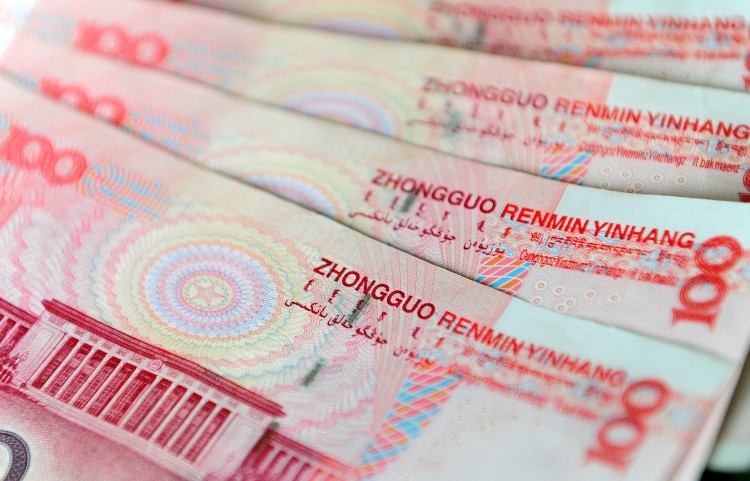
Chinese banks are in worse condition than the Chinese regime wants the world to know.
The Chinese communist regime considers this situation to be taboo and not to be discussed outside its borders or even outside a respective bank’s doors. Yet information has leaked out, and the outside world is not as ignorant as the Chinese regime thinks.
For example, analysts claim that the loans-to-deposit (LTD) ratio (derived by dividing gross loans by total deposits) of Chinese banks is above 60 percent. This indicates that the banks are sitting on a pile of cash, which should be enough to cover future loan losses.
On the other hand, there are quite a few experts who have argued of late that the LTD ratio in itself is useless and deceptive when discussing the creditworthiness of a bank. Yes, there is liquidity, and the higher the ratio, the better the liquidity. However, this ratio does not take into account existing or future loan losses that occur during an economic upheaval or a recession, which could wipe out liquidity within a short time when loans default.
“Estimates leaked by Chinese bank regulators suggest that 23% of loans to local government-sponsored infrastructure projects are an outright loss, with another 50% at risk of cash default,” according to a 2011 article on the Business Insider website.
The writer argues that if Chinese banks had provisioned adequately for loan losses (an amount set aside to cover future loan losses due to default), their earnings would drop sharply and their net worth would decrease significantly.
The problem with Chinese bank loans is that if the majority of loans were to state-owned companies for real estate development, which is in flux in China, and infrastructure projects (road, airport, and railway construction), many of which were not completed, the chances for defaulting are very high. Should these loans default, the bank’s capital could be reduced to nothing.
“The loan-to-deposit ratio doesn’t matter; they can have captive deposits and lots of cash, and still be bankrupt if they threw it all away on bad loans,” advised the Business Insider article.
In 2009, China’s lending institutions lent a record high of 9.59 trillion yuan (US$1.4 trillion), with a major portion for infrastructure projects, as published by The People’s Bank of China (PBOC). Although reports indicate that lending has slowed down in China, it cannot be confirmed, as analysts are skeptical that China’s authorities allow the true lending numbers to be published, because loans are a political tool for China’s central and local governments.
In mid-2011, international rating agencies, including Moody’s, said that a large portion of loans made by Chinese banks, especially by state-owned banks, may turn bad.
“Strong loan growth in the past two years and loose underwriting standards for projects related to the government’s stimulus package have weakened the banking industry’s average loan quality. Policy easing masked the damage,” said Standard & Poor’s in its Sector Review: China Banking Outlook 2011.
The PBOC, China’s central bank, raised its interest rates five times since October 2010 and was at 6.56 percent in July on loans, in an effort to rein in inflation, which in turn could result in a slew of nonperforming loans. It should be noted that the loan interest rate should not be confused with the deposit interest rate, which stands at 3.5 percent.
“The banking sector is highly susceptible to an increase in non-performing loans, which could result from an aggressive increase in interest rates,” said the Business Monitor in its China Commercial Banking Q4 2011 report.
In September, Fitch Ratings advised that a possible downgrade of China’s AA minus credit rating may be in the offing over the coming two years. It pointed to the country’s oversized bank debt and associated nonperforming loans.
In April, Fitch downgraded China’s long-term local currency debt from stable to negative because of that country’s lending spree to ensure continued economic growth despite the global economic slump.
“This announcement [Fitch’s downgrade] is ‘more of the same’ and ‘going in the same direction’ while focusing readers on what more and more seems to be a view that ‘China may not be all that it seems,’” commented a business analyst in an article on the Stock Research Portal website.
Continued on the next page ... Chinese Bank Crash Predicted
 Friends Read Free
Copy
Facebook
Tweet
Friends Read Free
Copy
Facebook
Tweet