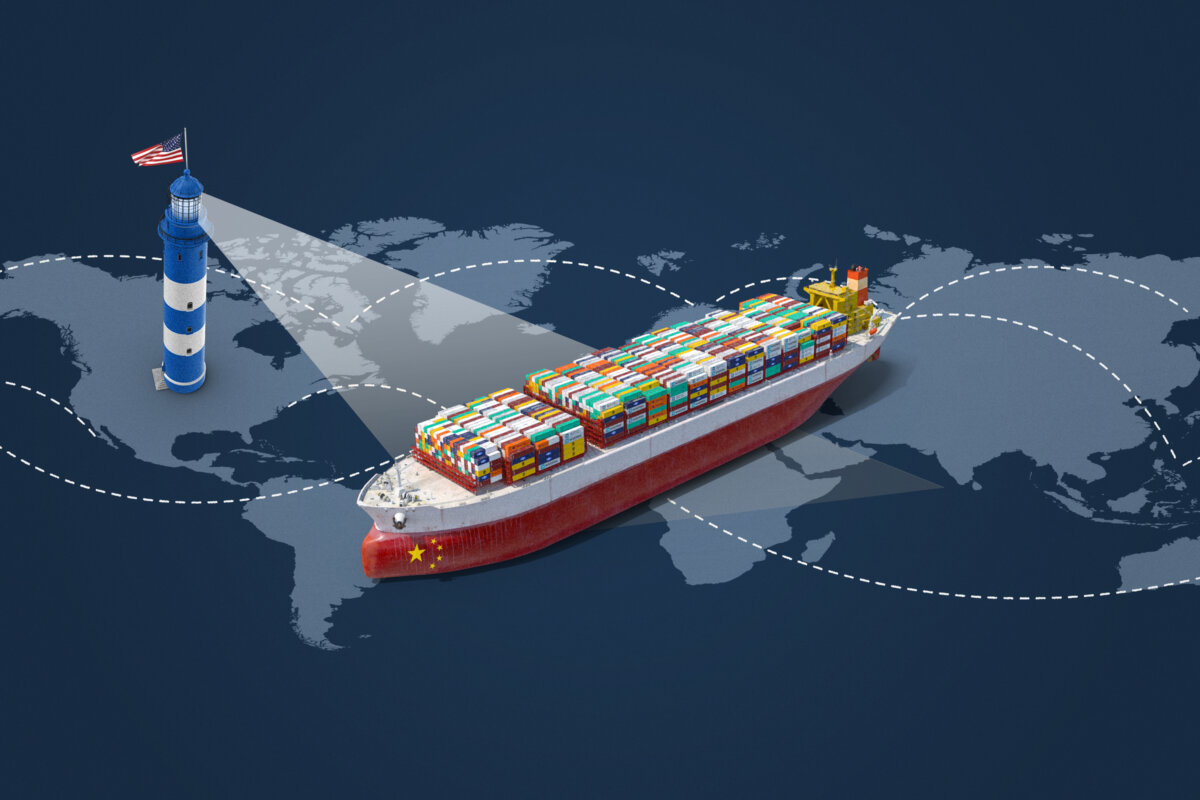
The United States has long been “sea blind” and is now waking up. That is how maritime historian Salvatore Mercogliano describes the country’s newfound awareness.
“We equate sea power with military naval power,” he told The Epoch Times. “We’re not equating it with commercial trade. China’s doing both, and they understand that.
“And I think that’s where the U.S. has to catch up, and that’s the sea blindness.”
Tune in to China Watch, a podcast on Chinese politics, technology, and business.
The United States knows how much it lags behind China in shipbuilding, said Mercogliano, who is an associate professor at Campbell University. But when it comes to global maritime shipping, Washington is seeking a better understanding.
He places many recent events under that umbrella.
A 2025 proposal to impose U.S. port fees on Chinese-operated ships was intended to provoke an industry reaction so the Trump administration could learn more about the Chinese presence, he said. The port fees are currently on hold during the one-year U.S.–China trade war truce that expires in November.
To Mercogliano, a high-profile deal in which a BlackRock-led U.S. consortium attempted to buy dozens of global ports from a Hong Kong company shows the United States’ intention to return to maritime commerce. Chinese firms have stakes, operating rights, or construction involvement in 110 ports across 67 countries, giving Beijing a presence in maritime hubs spanning every inhabited continent.
Recently, the U.S. Department of Justice (DOJ) indicted Chinese shipping container manufacturers and their executives for forming a price-fixing cartel during the COVID-19 years.
Chinese companies produce more than 95 percent of the world’s containers. Dry cargo containers, whether used on ships, trains, or trucks, are today’s units of global trade.
Most manufactured goods traded internationally are transported in such containers. As mundane as they sound, they can be another choke point at Beijing’s disposal, according to Carl Bentzel, former commissioner of the Federal Maritime Commission.
The recent DOJ case caused quite a stir in China because one of the indicted executives was arrested in Paris moments before boarding a flight to Hong Kong. His extradition to the United States is still pending. State-owned media criticized the arrest as an example of the United States’ “long-arm control.”
Washington is “anxious” about China’s maritime dominance, said Mike Sun, a U.S.-based Chinese business consultant. He told The Epoch Times that the arrest might evolve into a political event, as in the case of Meng Wanzhou, Huawei’s chief financial officer. She was arrested in Canada in 2018, held there under a U.S. extradition request, and eventually released to China as a result of a DOJ settlement coordinated with Beijing.
Although a single indictment is not going to break up China’s monopoly, Sun said, the case could add to U.S. President Donald Trump’s negotiation leverage in the U.S.–China trade war.
He and Mercogliano both said that Washington has to take steps to address Beijing’s power at sea because commercial dominance will spill over to the military side.
The Chinese regime is still using its navy for trade protection, Mercogliano said, but going “toe-to-toe with the U.S. Navy” may be “something down the road.”
How China Has Dominated the Sea
China’s maritime dominance today is similar to that of the British Empire in the 18th and 19th centuries, Mercogliano said.
In 1989, China built about 2 percent of the world’s new ships, according to BRS Shipbrokers.
China was a “minority player” in global shipping then, Mercogliano said, and as early as the ’90s, China began to focus on all aspects of shipping, including shipbuilding and ship repair. He described the initial efforts as “uncoordinated.”
That changed after Chinese leader Xi Jinping took the helm. With the five-year plan ending in 2015 and the following Made in China 2025 industrial policy, China solidified its dominance in shipbuilding.
Chinese businesses also started consolidating into state-owned conglomerates, and Japan and South Korea began losing market share to China.
China captured 70.9 percent of global ship orders by the end of 2025, up from 51 percent in 2022, according to BRS Shipbrokers. That rapid expansion occurred despite uncertainties surrounding proposed port fees and tariff roller coasters.
Mercogliano said China is intentional and strategic in its approach, including pushing regulation in its favor at the International Maritime Organization, a U.N. agency. A new set of decarbonization standards approved in April 2025 but not yet adopted would shorten an existing ship’s service life from 25 to 30 years to about 15 to 20 years, he said.
The adoption of the new standards is still in negotiation, delayed from its original implementation date in October 2025. The implementation will mandate the retirement of many existing ships and create a lot of demand for new ships. That will further increase China’s market share of new ships because of its leading position in producing low-emission vessels. In addition to its monopoly in shipping container manufacturing, China accounts for more than 70 percent of global ship-to-shore crane production and 86 percent of intermodal chassis. Its share of other critical components continues to rise, according to a 2025 report by the Office of the U.S. Trade Representative (USTR).
US Waking Up
American policymakers had assumed that the ocean was open and free and that commerce would naturally come to U.S. ports, Mercogliano said. The COVID-19 pandemic opened their eyes to issues of supply chain dependence.
During the pandemic, shipping companies rushed empty containers back to Asia because the U.S.-bound trip was more profitable. That left U.S. export businesses with insufficient capacity, resulting in delayed shipments and profit losses due to steep increases in freight costs.
Congress responded with the bipartisan Ocean Shipping Reform Act of 2022, the largest overhaul of ocean shipping law in decades. The law made it harder for carriers to reject U.S. export cargoes and expanded the Federal Maritime Commission’s authority to initiate investigations.
Armed with the new law, the Federal Maritime Commission has hired more lawyers and analysts to better understand global seaborne trade, according to former commission Chairman Daniel B. Maffei.
In March 2025, the Federal Maritime Commission began an examination of unfavorable shipping conditions affecting U.S. companies at seven global maritime choke points: the Northern Sea Passage in the Arctic, the English Channel, the Strait of Malacca, the Strait of Singapore, the Strait of Gibraltar, the Panama Canal, and the Suez Canal.
The examination was conducted before the Iran war and did not include the Strait of Hormuz.
The Federal Maritime Commission is also investigating whether the flagging practices of foreign governments impose disadvantages on U.S. businesses. Final findings of both investigations are still pending.
Deterring China’s maritime dominance has also been a bipartisan issue in the executive branch.
During the Biden administration, a group of labor unions filed a petition with the USTR alleging unfair practices that cause U.S. maritime businesses to become unprofitable. The agency accepted the case and opened an investigation in 2024.
The famous $1 million port fee for Chinese-operated ships per entry at U.S. ports was imposed as a result of the investigation. Li Chenggang, China’s lead negotiator in the U.S.–China trade talks, personally delivered a “global chaos” ultimatum over the port fees during an uninvited trip to Washington in August 2025, according to U.S. Treasury Secretary Scott Bessent.
The measures were suspended for a year as part of the truce Washington and Beijing reached in November 2025.
Along with the one-year truce, China lifted its export controls on rare-earth elements that would have prohibited the United States from using any products that source Chinese materials or use Chinese processing technologies, which are used in most rare-earth products worldwide.
The truce is due for renewal this November, weeks after Sept. 24, the date on which Xi will visit Washington if he accepts Trump’s invitation. So far, the Treasury, the Commerce Department, and the USTR have been visible in the U.S.–China trade negotiations. Mercogliano said he finds it “interesting” that the Federal Maritime Commission and DOJ are now being used to achieve political and economic goals.
He said he doesn’t think using the Federal Maritime Commission and DOJ to discover the global maritime market is a good process. However, it’s a way to achieve fast results, he said, given that the United States is playing catch-up in some trade policies.
“The U.S. has had a very significant sea blindness that is starting to be woken up to,” he said. “The question is, does it remain? Or do we get distracted by the next big topic out there and it kind of goes away?”
Correction: An earlier version of this article incorrectly stated that Meng Wanzhou, Huawei’s chief financial officer, had been extradited to the United States. Meng was held in Canada under a U.S. extradition request. The Epoch Times regrets the error.
 Friends Read Free
Copy
Facebook
Tweet
Friends Read Free
Copy
Facebook
Tweet