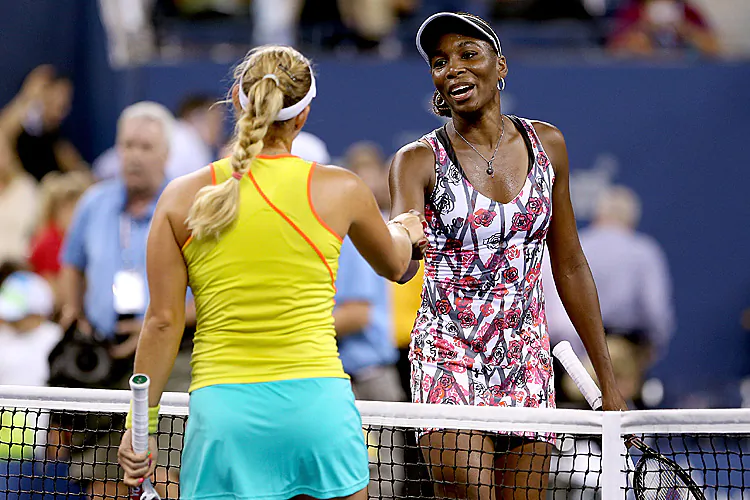
The career of Germany’s Angelique Kerber has been on a strong upward climb in the past twelve months. Since her amazing advance to the semifinals of the 2011 U.S. Open, the powerful left-hander has risen from 92nd to sixth in the world ranking. Kerber, 24, is becoming a big name in women’s tennis.
Venus Williams, on the other hand, has spent the past twelve months struggling to regain her form. Williams’ had to withdraw from the 2011 U.S. Open after being diagnosed with Sjögren’s syndrome, an autoimmune disease which causes fatigue and joint pain.
The 32-year-old, with seven Grand Slams, a World Championship and Olympic Singles (and three doubles) gold, has had a stellar career but a rough year. She planned to play at the Australian Open, but her health held he up.
She played some smaller tournaments, then went to the Olympics where she was defeated—by Angelique Kerber.
After the Olympics, Williams played in Cincinnati, where she hurt her back playing Li Na in the semifinals.
When these two met again at the U.S. Open, two scenarios dominated: Kerber would use Williams as another rung on the German’s ladder to the top, or Williams would get her revenge for the Olympics and advance a step in her comeback.
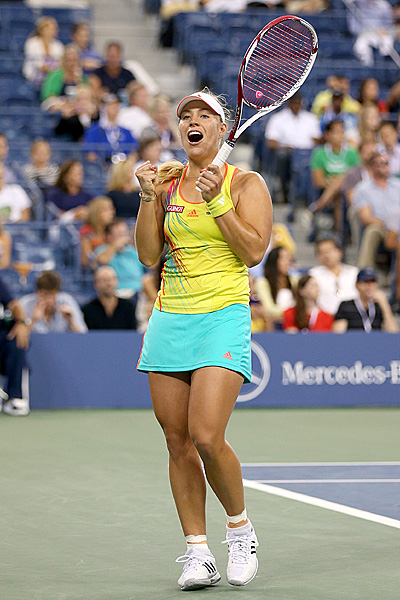
Kerber didn’t brag, but she was plainly aware that beating Venus on home turf was a major achievement, even after a year of signal successes.
“It is unbelievable; it starts one year ago, I had so great memories from last year, and I knew today it is so tough, the match was so close. Venus is such a great player and she has won so many grand slams, so I am very happy to beat her here in New York.
“Everybody was against me—” this brought howls of protest from a crowd which had been loudly pro-Venus throughout the mat—”but I just tried to play my game plan, fighting every point until the last. I am very happy to be in the third round here.”
No Surrender
Things looked grim for Venus Williams in the first set: Kerber put her away in 31 minutes. Venus never held serve, won only two games, hit five double faults and 15 unforced errors to just nine winners. Kerber had speed and power; her quick, compact backhand sent balls hard and flat up the line for eight winners, and Kerber also won three of four at the net.
Kerber only won 43 percent of her first-serve points, but Williams only got 36 percent of her first serve in—and won on only 14 percent of her second serves. The match looked to be over in under an hour.
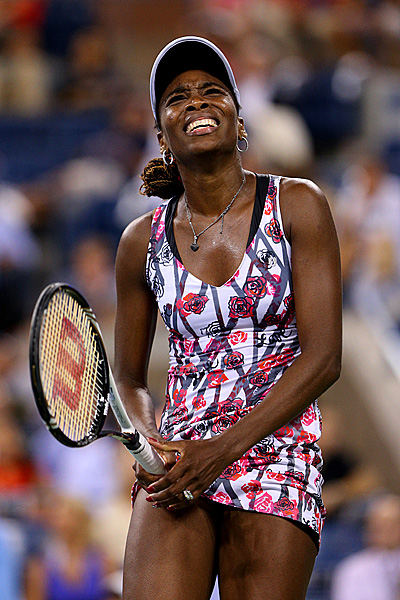
Venus Williams didn’t earn her record by quitting, and she wasn’t about to give up against Kerber. Unfortunately her fighting spirit was not matched by her play.
Williams hit 26 unforced errors in the second set and four more double faults. She did however start moving better; when she made it to the net she won nearly 60 percent of the points, though she still mis-hit a bunch of easy shots.
Williams and Kerber fought for 76 minutes; in the end it was a huge effort by Venus, plus the twelve unforced errors which Kerber hit, which let Venus win 7–5
Williams kept fighting through the third set, but the fight was too hard. Almost all of Williams’ service game went to deuce while Kerber held at love a few time—Venus had to fight to hold while Kerber fought for a service break.
Even so it was Williams who got the first break, but her lead only lasted until the next game when Kerber broke back. Williams play was much improved in the final set: she won 14 of 18 at the net and hit 16 winners to 19 errors—bad, but good in the context of this match. She also hit seven double faults; without those free points off her serve, no amount of charging the net could get her a win.
The younger, stronger Kerber showed a lot of poise. In past matches she has had a tendency to crack emotionally. Against Williams she faced obvious frustration with her own play, endured a bad call or two, and still kept calm—rarely showing anger, and rarely showing joy—while being taken near her limits to beat one of the world’s best.
Kerber is a rising star; now that she is mastering the mental game, she could go far. Venus Williams, for all her natural talent and strong will, might face too many obstacles to make it back to the top of the rankings. Age and illness—particularly one which attacks joints and energy levels, for an athlete whose mobility and energy were her keys to success—might have slowed Venus too much to regain her former glory.
She is still a fighter, and she still loves the game. Tennis fans might not see her in finals much anymore, but they will be seeing Venus Williams for some time to come.
 Friends Read Free
Copy
Facebook
Tweet
Friends Read Free
Copy
Facebook
Tweet