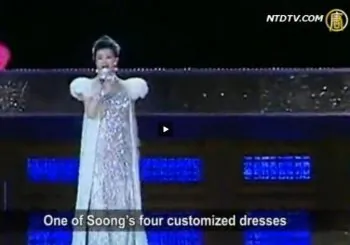

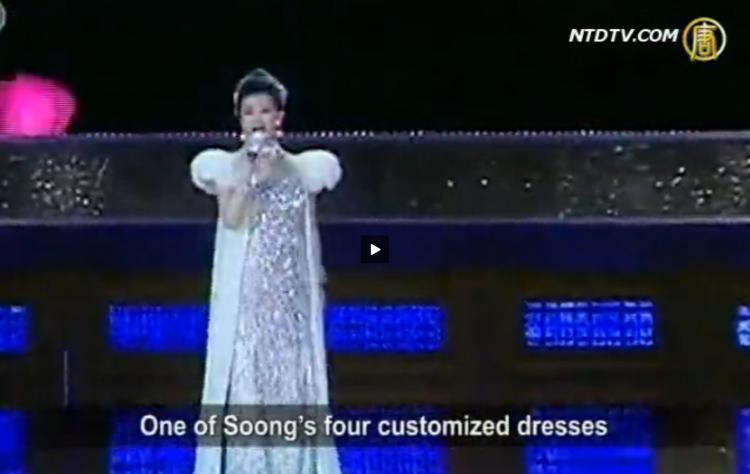
Her debut in Taiwan showcased communist-themed selections. While the program was a lavishly pricey production co-sponsored by Chinese companies, admission was free.
Song is purported to be the mistress of former Chinese Communist Party (CCP) leader Jiang Zemin. She has been given the unofficial title “Mother of Communist China.”
The program included 22 songs praising the Communist Party, its culture and exploits, with a few torch songs thrown in. The selections depicting the CCP subduing and defeating the Kuomintang (the Nationalist Party) were given center stage.
Not resorting to sleight of hand, only heavy-handedness, Song’s singing the crimson-tinged songs was staged to humiliate and taunt the Taiwanese.
The medleys were chosen with strategic precision. The first song, “A Hundred Birds Serenade or Hail the Phoenix” represented the Kuomintang officials attending the concert to support the CCP.
The third song “Good Days,” with its lyrics, “Today and tomorrow are all good days, as we are so lucky to live in prosperity,” reflected sentimentality for Jiang Zemin’s rule, bragging that mainland China is prosperous and strong under communist rule, which also extends peace to Taiwan.
The fourth song “Ode to Coral” ends with “Welcome the Savior to the Island,” with its singular message that the PLA will land in Taiwan, and the Taiwanese are bound to welcome them with open arms.
2012 General Election
Not only intended to humiliate Taiwan, Song’s recital was of course a united front tactic—an attempt to advance the agenda of the CCP through apparently independent organizations—taken against the country. The CCP has taken measures focused on controlling Taiwan’s general election in 2012 and conquering Taiwan, without resorting to war.
Song not only attempted to win over the people of Taiwan with her artistic performance and stage presence, she also shamelessly played her role as agent provocateur. Ever since China and Taiwan entered the Economic Cooperation Framework Agreement (ECFA) in June 2010, the CCP has been using cultural initiatives to try to strengthen economic and trade exchange, and believes that now is the time to reap the political harvest.
One of the main reasons the CCP carried out its surprise arrest of artist dissident Ai Weiwei was the fear that he might affect Taiwan’s unification with China. Ai had planned to attend an art event in Taiwan in early April, but the CCP feared that Ai’s influence would interfere with Song’s visit to Taiwan.
There are indisputable signs that the CCP has sped up its political unification with Taiwan: one being that its high officials no longer avoid openly interfering with Taiwan’s general election.
“To maintain the stable development of cross-strait relations, the Taiwanese must elect the ‘right candidate’ in the next two important elections.” Jia Qinglin, chairman of the National Committee of the Chinese People’s Political Consultative Conference, made this statement in the recent Seventh Cross Straits Economic Trade and Cultural Forum, emphasizing that not electing the preferred candidate of the CCP is “creating instability,” thus affording an excuse for the CCP to send troops to Taiwan. His statement at the same time rallied some people from Taiwan to vote for pro-CCP candidates.
In a meeting of the Chinese regime’s Political Bureau in June 2008, Vice Premier Li Keqiang said that the economic expenditure on Taiwan was worthwhile and will receive political returns. In other words, all the benefits Taiwan has received from the ECFA today will be paid back, through political reunification in the future.
Please continue to next page
Views expressed in this article are the opinions of the author and do not necessarily reflect the views of The Epoch Times.
 Friends Read Free
Copy
Facebook
Tweet
Friends Read Free
Copy
Facebook
Tweet