
The Trump administration has been working to revive the struggling U.S. coal industry, but despite recent signs of growth, analysts say a renaissance is far from assured.
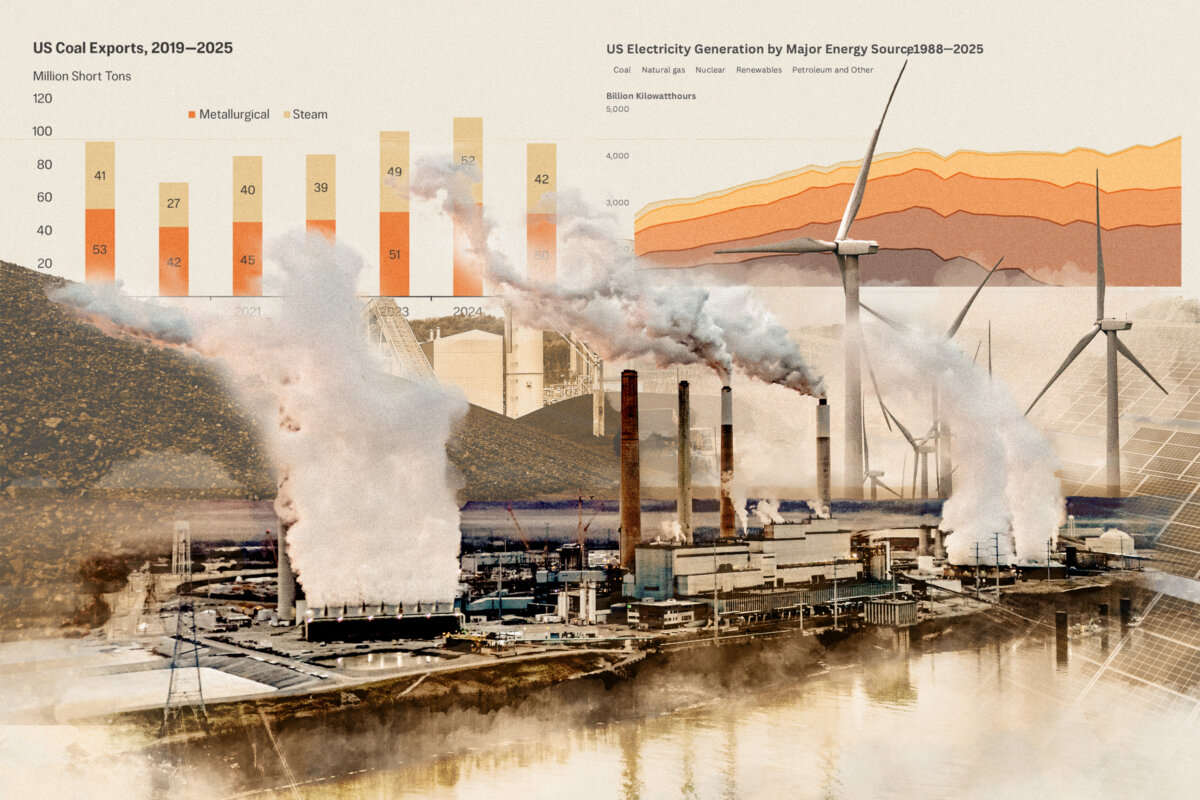
The share of the country’s electricity produced by coal has plummeted to 17 percent in 2025 from 57 percent in 1988, according to Global Energy Monitor and the Energy Information Administration (EIA). Energy analytics firm Wood Mackenzie predicts that coal-fired generation will continue its decline, falling by more than one-third between 2025 and 2032.
In April 2025, President Donald Trump issued executive orders to accelerate coal leasing on federal lands, ease the permitting process for coal plants, designate coal as a strategic mineral, and roll back tight emissions regulations placed on coal plants under the Biden administration.

Analysts say these initiatives are helping to keep the industry afloat—for now.
“The Trump administration’s actions to stop the anti-coal policies of the prior administration—which were designed to prematurely shutter well-operating coal plants—and to support affordable, reliable electricity … have done exactly that,” National Mining Association spokesperson Ashley Burke told The Epoch Times.
Utilities struggling to meet increasing demand for electricity are pushing back closure dates for existing coal plants.
Ed Crooks, Wood MacKenzie vice chairman, said in a 2025 report that “the surge in U.S. electricity demand, driven principally by new data [centers] for AI, is reviving hopes of at least a slightly brighter future for coal.”
“Several planned retirements of coal-fired power plants have been delayed, as utilities look to secure whatever generation capacity might be available,” Crooks said.
U.S. coal output in 2025 grew by 13 percent over the prior year, and dozens of coal plants that were scheduled to shut down have had their working lives extended, Burke said. Without them, many utilities would not be able to guarantee reliable electricity, she said.
But delaying plant closures is one thing. Building new, modern plants is another.
“Preserving existing plants is good for affordability and reliability, but ultimately, the coal industry needs to start building a significant number of new coal-fired power plants now if it is going to be viable for the long term,” Isaac Orr, vice president of research at Always On Energy Research, told The Epoch Times. “If the industry can’t add more megawatts during the boom in data center demand, when will it ever happen?”
Coal Facing Headwinds
Prior to Trump’s executive orders, the EIA projected that total U.S. coal production would fall by 2 percent in 2026 and another 4 percent in 2027. Compounding this, U.S. coal exports fell by 14 percent in 2025 compared with 2024—a decline of about 15 million short tons—mostly because of a 92 percent reduction in coal exports to China.
Even with the support of the Trump administration, analysts say the U.S. coal industry is facing severe headwinds.
“While the Trump administration has done a lot to help the domestic coal industry, the sector isn’t growing, and it faces a lot of political risk,” Robert Bryce, energy expert and author of “A Question of Power,” told The Epoch Times.
This political risk includes well-funded environmental nonprofits that “have revenues of hundreds of millions of dollars per year, are spending a lot of that cash to shut down existing coal plants, and will spend heavily to prevent any new coal plants from being built,” Bryce said.
Among coal’s opponents are the Sierra Club, which stated that 6,500 Americans die prematurely from illnesses linked to air pollution from burning coal. The club’s Beyond Coal campaign director, Laurie Williams, said in a statement that pro-coal policies are “making us sicker, driving up already-costly medical bills, and threatening our children’s futures.”
To meet rising demand, power plant developers and operators expect to add 86 gigawatts (GW) of new capacity in 2026, the EIA reported. But new construction is expected to be heavily concentrated in renewables, with no new capacity coming from coal. Solar power will be 51 percent, battery storage 28 percent, wind 14 percent, and natural gas about 7 percent.
In May, the country’s electric grid hit a milestone, with solar generation overtaking coal for the first time. Global energy think tank Ember reported that solar energy provided a record 12.8 percent of U.S. electricity that month, with coal declining to 12.2 percent.
Wind and Solar and Electric Bills
Critics of coal power say that, beyond environmental concerns, economics are driving coal’s decline and that wind and solar are now cheaper to produce than coal.
A 2025 report by the International Renewable Energy Agency reads, “On an LCOE basis, 91 % of newly commissioned utility-scale renewable capacity delivered power at a lower cost than the cheapest new fossil fuel-based alternative.”
LCOE, or leveraged cost of energy, measures the total lifetime costs of building and running a power plant against the total electricity it is expected to generate over its operational life, and it has been used by the United Nations and other proponents as the basis for claims that wind and solar are cheaper alternatives to gas or coal. Using this metric, the International Renewable Energy Agency stated that solar and onshore wind were 41 percent and 53 percent cheaper, respectively, than the lowest-cost new fossil fuel power plant in 2024.
However, critics say LCOE only captures a fraction of the total costs of wind and solar. By contrast to building new wind or solar plants, existing coal plants do not require new construction, and even new plants do not require the additional construction of parallel generation, typically gas-fired plants or batteries, to deliver power when the sun is not shining or when the wind isn’t blowing or of new transmission lines to connect the grid with sunny or windy locations.
“Existing coal plants generate electricity at a much lower cost than new wind and solar projects, especially when the cost of backup power (either battery storage or natural gas) is factored in,” based on Federal Energy Regulatory Commission data, Orr said. “Existing coal plants are low cost because they have been largely depreciated, meaning their mortgages have effectively been paid off, resulting in reliable, low-cost power for customers.”
Likewise, a 2023 report from the Massachusetts Institute of Technology Climate Portal states that, while adding wind and solar to the grid may reduce local emissions, it will likely drive up electricity bills because of the extra infrastructure that must be added to cope with dependence on weather.
With wind and solar, “you get what you get when nature gives it to you,” MIT professor Richard Schmalensee said. “That’s just a more complicated system, and it’s not going to be cheaper.”
Also affecting the economics of coal plants is the fact that most existing plants are aging and consequently require more maintenance, and they are operating at a fraction of their intended capacity, according to the Environmental Protection Agency. Originally built to provide base-load electricity because of their ability to run continuously, coal plants are now being used intermittently when wind and solar are not available and require more energy to warm up from idle.
Energy Security
Coal proponents say the reliability of coal plants should also be factored into calculations. Whereas wind and solar are weather-dependent and even natural gas depends on timely deliveries from pipelines, several months’ supply of coal can be stored on site, allowing the plants to function through short-term interruptions.
While anti-fossil fuel activists have argued that the “social cost of carbon,” essentially the harms from emissions, should be considered, Orr has quantified, based on recent blackouts in Spain, Texas, and California, what he calls the “social cost of blackouts.”
These costs include spoiled food in grocery stores and restaurants, lost sales and work hours, and even deaths from lack of heat or air conditioning. Removing dependable electricity from the grid would “impose blackout costs large enough to materially erode or fully offset projected national climate benefits,” the study states.
Bryce said there are strategic reasons why Americans should not dismantle a cheap and reliable energy source that they have in abundance.
“We need to keep our existing coal-fired power plants online and operating to help assure our energy security,” he said. “The U.S. cannot and should not ignore its massive coal resources.”
Estimating that the United States possesses 400 years’ worth of coal at current usage rates, Bryce said that “the U.S. isn’t the Saudi Arabia of coal; it’s the entire OPEC of coal.”
Coal Expanding Abroad
As the nation debates the future of its coal industry, many other countries are aggressively adding coal capacity.
“Looking far beyond the administration’s policies, globally more and more countries are turning back to coal in the face of increased demand and constrained [liquid natural gas] supplies,” Burke said.
While China and India continue to build new coal plants at a record rate, Germany and other European Union members are delaying their phase-out of coal. Germany’s Energiewende, which featured a complete phase-out of coal by 2038, is now being reevaluated in light of rising energy costs that some analysts say are prompting manufacturers to relocate to countries where energy is cheaper.
German Chancellor Friedrich Merz said in March that he was “not prepared to jeopardize the core of our industry simply because we have adopted phase-out plans that have become unrealistic.”
In 2025, China added 161 GW of new or reactivated coal capacity, while India’s total coal generation hit a peak of 187 GW in April, according to the Centre for Research on Energy and Clean Air and Reuters.
By comparison, the United States currently has about 175 GW of coal capacity remaining, down from more than 300 GW in 2013, of which only about 75 GW is used due to plants sitting idle, according to Global Energy Monitor.
“China and India are getting a supply of low-cost, locally sourced energy that provides reliable power around the clock,” Orr said.
“Unlike liquefied natural gas, coal is more insulated from supply shocks and global price spikes, such as those occurring due to the war in Iran. By shutting down U.S. coal plants, America is forfeiting reliable power plants that can provide superior reliability during winter storms.”
 Friends Read Free
Copy
Facebook
Tweet
Friends Read Free
Copy
Facebook
Tweet