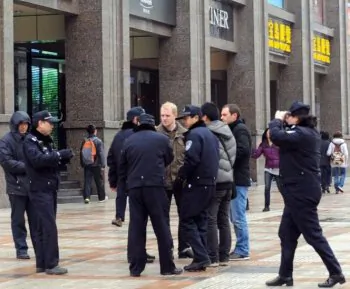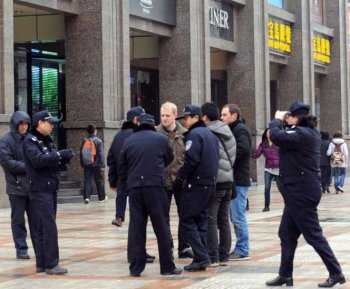

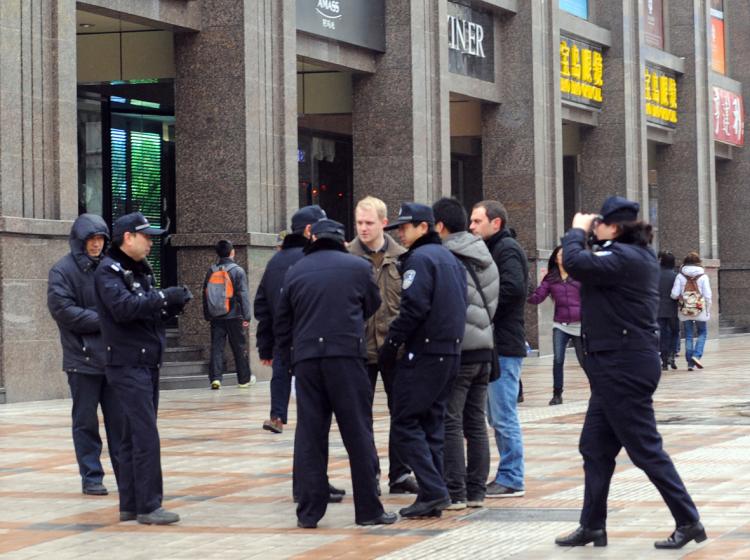
The actions taken against foreign reporters have made it clear that this is a “highly sensitive” time for the CCP. The formerly “relaxed” rules for foreign journalists in China seem to no longer apply, and neither does the regime veil its disdain of the world’s free press.
The shrill, irrational, authoritarian comments by MFA spokesperson Jiang Yu reflect the Chinese regime’s fears and impotence of dealing with the threat of mass discontent in China in a civilized and humanitarian manner.
Policy ‘Very Clear’
On Feb. 27, a large number of foreign journalists gathered along Wangfujing Street, a busy business section in Beijing, trying to report on Jasmine protest that had been announced on the Internet. The journalists were violently assaulted and dispersed by police, some were arrested.
On March 1, Jiang Yu, spokesperson of the MFA held a press conference and got tangled up in a heated verbal exchange with dozens of foreign journalists. The astonishing spectacle was reported by world media, including Japan’s official television station NHK, Radio France Internationale (RFI), and Taiwan’s United Daily News.
The MFA press conference broke many records, including taking the longest time, and the number of times a single question was asked.
Foreign journalists were treated to a sample of the Chinese Communist Party’s favorite defense strategies: deny the facts and blame the victims.
After more than 30 reporters asked the same question, why plain clothes police can attack foreign journalists and even take some of them into custody, Jiang rebuked them to stop mentioning the Wangfujing incident again.
Jiang turned tables and said the journalists are to blame for the trouble at Wangfujing.
“Why do some journalists always create trouble?” she asked. “We find it strange. Who did so many reporters receive a notice from? Who called on you to gather and stake out there? This is the question I would like to ask you,” Jiang said.
She also insisted that the policy is “very clear,” and that it was the reporters who had deliberately misinterpreted it.
“A huge group of people gathered and staked out in a busy business street for a long time for no reason at all, and the policemen on duty tried to guide and disperse the journalists. The journalists should understand and cooperate,” Jiang said.
“This is the fact, and you should not distort the facts. As a reporter, fairness is your basic professional ethics,” Jiang added with a stern demeanor.
Next: Regulations for Foreign Journalists
Views expressed in this article are the opinions of the author and do not necessarily reflect the views of The Epoch Times.
 Friends Read Free
Copy
Facebook
Tweet
Friends Read Free
Copy
Facebook
Tweet