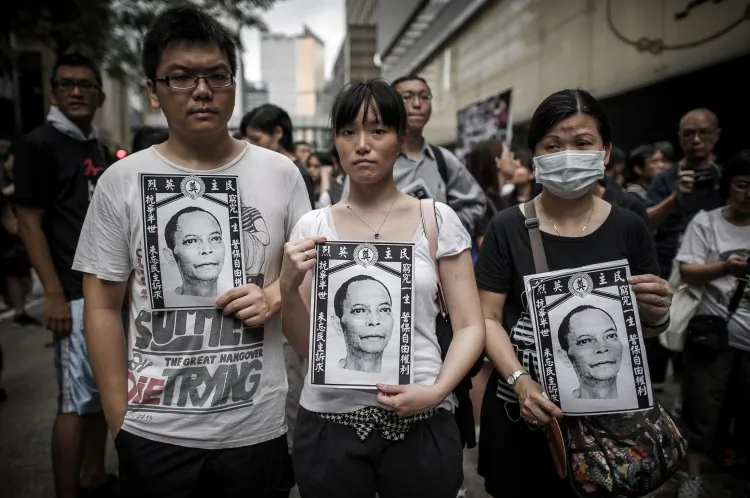
Amid strong protests from the Chinese public both in and outside China, on Thursday, June 14, Chinese officials announced through Hong Kong media that they will be conducting an investigation into the death of Chinese democracy activist and dissident Li Wangyang.
Li was jailed for more than two decades following his attempt to establish an independent labor union in his hometown of Shaoyang City, Hunan province during the 1989 democracy movement.
On June 6, Li was found dead in an apparent suicide at the hospital where he was being treated for diabetes and heart disease. However, Li’s relatives and friends suspect that the suicide was staged, as Li was found hanging from a window security bar with his two feet planted on the ground.
In addition, Li’s family found it difficult to believe that Li, who was blind and nearly deaf from years of torture in prison, would have been able to succeed in a suicide attempt.
Just a week before his death, Li was interviewed by a Hong Kong cable television station, where he expressed his determination to fight for an end to the Communist Party’s authoritarian rule.
This past week, protests have escalated in Hong Kong, where many have voiced their demand for a thorough investigation into the cause of Li’s death. On June 14, a spokesman from the Hunan Province national security bureau announced via the state-run Hong Kong China News Agency that forensic experts from an outside province have been commissioned to conduct an autopsy and investigate Li’s death. The spokesman noted that the findings from the investigation will be made public.
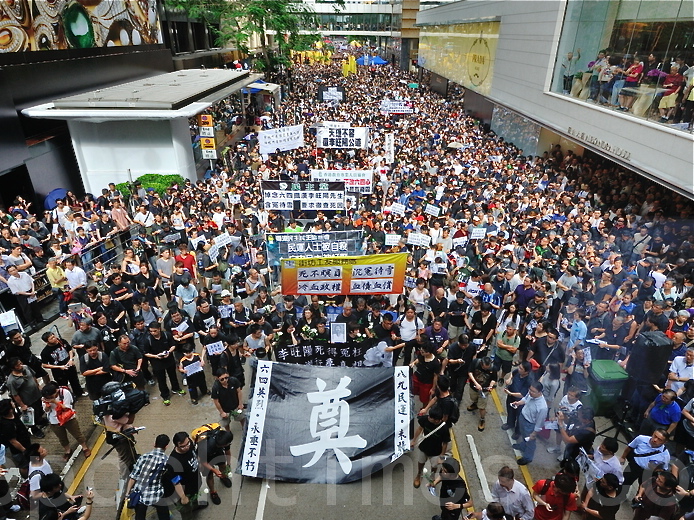
As Chinese leader Hu Jintao is expected to visit Hong Kong on July 1 for the 15th anniversary of Hong Kong’s return to China, analysts believe that the decision to open an investigation into Li’s death is an attempt to silence the widespread discontent in Hong Kong and prevent protesters from targeting Hu and “ruining” his visit.
In an interview with Hong Kong newspaper Apple Daily, Lee Cheuk Yan, chairman of the Hong Kong Alliance in Support of Patriotic Democratic Movements of China, said the investigation is likely a measure to prevent Hong Kong residents from taking to the streets at the annual July 1 march and criticizing Hu Jintao for Li’s death.
In 2003, the July 1 march drew large numbers of protesters who opposed the Basic Law Article 23 legislation, an anti-subversion law that they believed would have curbed the political and religious freedom of groups that the Chinese Communist Party disproves of. The legislation was then shelved indefinitely. Since then, the march has continued to draw large crowds, although not of the size of the 2003 march.
Lee called the investigation a “stalling tactic,” adding: “Li Wangyang’s sister and family have not been released yet, his friends are still being held under close surveillance by the police—how can this [investigation] possibly serve to redress the injustice done to Li?”
Click www.ept.ms/ccp-crisis to read about the most recent developments in the ongoing crisis within the Chinese communist regime. In this special topic, we provide readers with the necessary context to understand the situation. Get the RSS feed. Get the new interactive Timeline of Events. Who are the Major Players? 
As of June 13, Li’s sister and brother-in-law have not yet returned to their home after checking out of the hotel where they stayed to oversee Li’s funeral, according to a statement by Hong Kong rights group Information Center for Human Rights and Democracy (ICHRD).
Although Chinese authorities promised an autopsy, it is unclear how it will conducted, as the ICHRD reported that Li’s body was cremated on June 9 (without the permission of Li’s family).
According to information provided to The Epoch Times by a reliable source within the Hunan Province Public Security Bureau, the primary suspect for Li’s death is the police chief at the Shaoyang City Domestic Security Division, Zhao Luxiang. He was heavily involved in the persecution of students and laborers during the June 4th movement, as well as democracy activists in Shaoyang City.
Speculation about Li’s death continues unabated.
The democracy activist Paul Guo, who lives outside China, claimed in a recent post on twitter that high ranking officials in the Political and Legislative Affairs Committee (PLAC) ordered Li’s murder in order to stop him from talking to foreign media and to crush the Hong Kong People’s hope for redressing June 4—the Tiananmen Square massacre. The PLAC is the powerful Party organ that controls nearly all law enforcement agencies in China.
When Chongqing’s former top cop, Wang Lijun, fled for his life to the U.S. Consulate in Chengdu on Feb. 6, he set in motion a political storm that has not subsided. The battle behind the scenes turns on what stance officials take toward the persecution of Falun Gong. The faction with bloody hands—the officials former CCP head Jiang Zemin promoted in order to carry out the persecution—is seeking to avoid accountability for their crimes and to continue the campaign. Other officials are refusing any longer to participate in the persecution. Events present a clear choice to the officials and citizens of China, as well as people around the world: either support or oppose the persecution of Falun Gong. History will record the choice each person makes.
With research by Liu Xiaozhen.
chinareports@epochtimes.com
The Epoch Times publishes in 35 countries and in 19 languages. Subscribe to our e-newsletter.
 Friends Read Free
Copy
Facebook
Tweet
Friends Read Free
Copy
Facebook
Tweet